Peace for the World World ! Your War Our Lives

The Dalai Lama
A Brief Colonial History Of Ceylon(SriLanka)
Sri Lanka: One Island Two Nations
A Brief Colonial History Of Ceylon(SriLanka)
Sri Lanka: One Island Two Nations
(Full Story)
Back to 500BC.

Wednesday, April 25, 2018
Recurring Violence Against Muslims: What Is It All About?
Mohamed R. M. Farook
 Peace
is more important today than any of the earlier eras because of the
positively advantageous characteristics in the post-modern world with
its attendant advancement in technology, socio-political vibrancy and
religious freedom. Yet violence erupts mainly either on political or
religious issues. Violence is the antithesis of peace. If we desire
peace, harmony and peaceful coexistence among communities then violence
has no place and should be abhorred. Yes, the vast majority of people
from all communities in Sri Lanka – Buddhists, Muslims and Tamils – are
not inclined towards violence of any type or form. They love peaceful
coexistence which is openly visible to everybody from their daily
interactions among one another on an individual and collective scale in
their personalized transactions in their neighbourhood, routine, social,
purchasing / marketing / selling activities throughout Sri Lanka. What
else we need to be inclusive and like / love and be kind to one another?
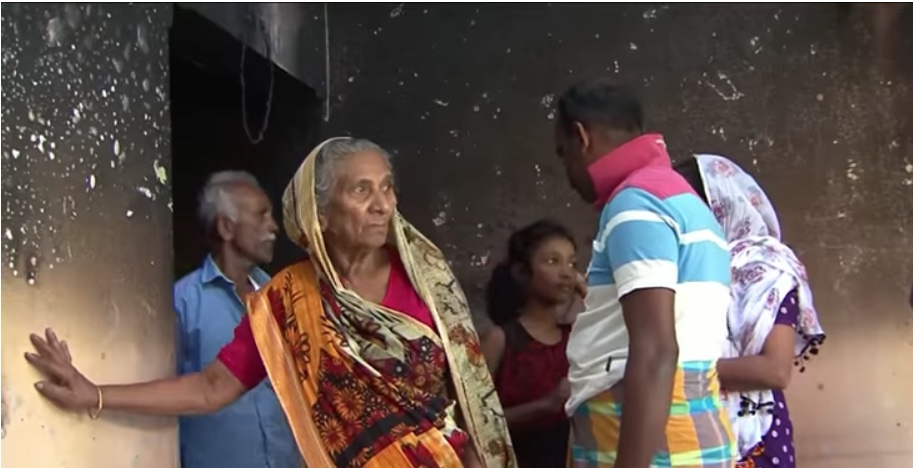
Yet violence ‘exists’ and has emerged in recent times, particularly
against Muslims, in different locations starting from Aluthgama (2014), Gintota (2017), Ampara, Digana, Teldeniya and
few other areas in Kandy (2018). Can one find the causes / reasons for
this sporadic ‘attacks’ on Muslims and their properties – homes and
businesses? The answer is ‘YES’ and also ‘NO’.
Peace
is more important today than any of the earlier eras because of the
positively advantageous characteristics in the post-modern world with
its attendant advancement in technology, socio-political vibrancy and
religious freedom. Yet violence erupts mainly either on political or
religious issues. Violence is the antithesis of peace. If we desire
peace, harmony and peaceful coexistence among communities then violence
has no place and should be abhorred. Yes, the vast majority of people
from all communities in Sri Lanka – Buddhists, Muslims and Tamils – are
not inclined towards violence of any type or form. They love peaceful
coexistence which is openly visible to everybody from their daily
interactions among one another on an individual and collective scale in
their personalized transactions in their neighbourhood, routine, social,
purchasing / marketing / selling activities throughout Sri Lanka. What
else we need to be inclusive and like / love and be kind to one another?
Yet violence ‘exists’ and has emerged in recent times, particularly
against Muslims, in different locations starting from Aluthgama (2014), Gintota (2017), Ampara, Digana, Teldeniya and
few other areas in Kandy (2018). Can one find the causes / reasons for
this sporadic ‘attacks’ on Muslims and their properties – homes and
businesses? The answer is ‘YES’ and also ‘NO’.
The world has changed from a religiously and culturally based
internalized communities to high tech societies banging on the concept
of Global Village and with that human thinking too has changed from
human and humanely based thinking to technology- directed thinking which
has given rise to self-seeking pursuits devoid of empathy and wellbeing
of others within one’s own community and other communities. This is the
scourge of the present day behavioural pattern particularly in the
South Asian regions. The outcome (or output) of this phenomenon is that a
large number of people from every community lacks the essential
fundamental knowledge of their own religion and practise only rituals
and thereby do not know the important aspects of treating / respecting
the followers of other religions. Similarly the present generation does
not know the cultural / traditional aspects that had transcended through
years within the three communities that respected each other and was
the cornerstone for peaceful living. Thus conflict leading to ad hoc
chaos. We, for that matter any analyst / researcher, may not be able to
identify all the reasons / causes of the violence or may miss out the
vital ones as some of them may be known only to the perpetrators
themselves. Yet we can point out some leading events that definitely
could have contributed towards the unwanted calamity that got unfolded.
A few years ago some Sinhala Buddhists (SB), for reasons known to them only, propagated the ‘false notion’ that
Sri Lankan Muslims (M) will overtake the SB population by about 30 to
35 years in time due to SB families having lesser number of children
than M families. With the official statistics of 70% SB and 09% M in a
total Sri Lankan population of 21 Million, and assuming that the
reproduction processes of SB and M are, say, two (2) and five (5) per
family respectively, even by one hundred years from now, the Muslims
will not be able to overtake the Sinhala Buddhists through population
growth. Forget overtaking, the Muslims will not be able to reach even
12% of the population say within hundred years. It is the Sinhalese
peasants who had a larger number of children per family than the
Muslims. The one, two or three children per Sinhalese families are
confined to their educated and elite class and never to their rural
population. With the present day complex lifestyles, high cost of
living, woes of bringing up children, the hassles of schooling and
living as nuclear family, everybody, irrespective of race or ethnicity,
is going for small – two / three – children families. The myth of Muslim
population expansion gets exposed.
After this canard they started the Halaal issue
and from stage to stage from Colombo, through Kandy, Kurunegala and
other places, Buddhist monks indoctrinated the Buddhist audience present
with falsehood against Islam and Muslims. While some would have
believed in what these monks said, a reasonable majority of the SB
rejected such propaganda and in fact were questioning the behaviour of
the monks as per the teachings of Buddhism. Next came the interference
in and incitement at Muslim businesses that got culminated in Aluthgama
violence (in2014) followed by Gintota (2017), Ampara, Digana, Teldeniya
and other areas in Kandy recently – a sad spectacle for the otherwise
hospitable, helpful and kindhearted Sri Lankans in general and
especially the Sinhala population in particular.
What all these show is that a very small minority of Buddhist monks has
influenced a group of Buddhists (youth) to their (monks’) ways of
thinking of initiating and developing hatred against Muslims – an
unnecessary and uncalled for endeavour by this minority group of
Buddhists. This goes on and is an unhealthy and dangerous social
behaviour that affects not only the Muslims but also the perpetrators
themselves, the Sinhala Buddhists at large, others and finally the Sri
Lanka as a country in the long run. What have the Muslims done for you
(the Buddhists) to go against them? They are in business because they
could not get employed in the state sector or in established commercial
enterprises as they did not have educational qualifications due to
either their (or parental) neglect on school education or their
inability to get admission to leading schools – and finally became
drop-outs through de-motivation and / or frustration.
Whereas the majority in a country especially in the South East Asian
region are somewhat complacent with their strengths in their numbers,
enjoy official / state patronage and have a perceived self-confidence in
their livelihood, the minorities get into the notion that they have to
be hardworking to survive economically / financially. This is the story
everywhere in the world be it Britain, Belgium, America, Philippine,
Indonesia, Malaysia, India, or Sri Lanka – minorities are hardworking
and their business activities, small, medium or large have invariably
helped the people and the economy of the respective countries – a plus
point for any minority in any part of the world. Why be jealous of the
Muslims of Sri Lanka? Benchmark them for your progress in your personal
life as well as in business. Thereby together the Sinhalese, the Muslims
and the Tamils can rise up morally and economically for the benefit and
progress of all concerned! This may appear as a Utopian suggestion –
yet let us give a try shunning violence and stretching the hands of
friendship.
Read More
