Peace for the World World ! Your War Our Lives

The Dalai Lama
A Brief Colonial History Of Ceylon(SriLanka)
Sri Lanka: One Island Two Nations
A Brief Colonial History Of Ceylon(SriLanka)
Sri Lanka: One Island Two Nations
(Full Story)
Back to 500BC.

Saturday, May 26, 2018
Children in Israeli detention suffer scars for life
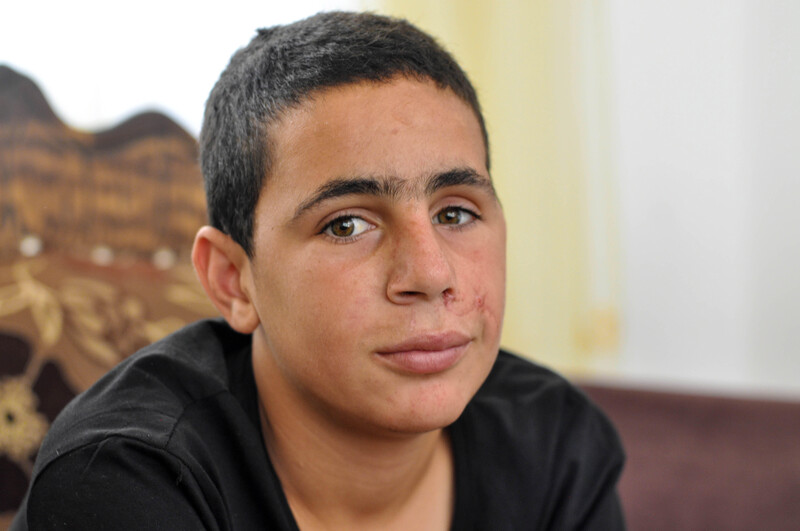
Muhammad Tamimi
(

Muhammad Tamimi sat on the couch, occasionally laughing nervously as he described what had happened to him.
“Not that many journalists have come this time,” he said. “Just you and a
Palestinian film crew. Hopefully there will not be any more.”
The 15-year-old has been held in military detention three times now, an
experience that many Palestinian children suffer and that has healthcare
professionals warning of lifelong trauma.
Muhammad’s latest detention came on the morning of Sunday, 20 May, when
he went to the supermarket in Nabi Saleh, his village in the occupied
West Bank, to buy groceries. He noticed a white car in front of his
uncle’s house from which two young men emerged.
When Muhammad approached, the men grabbed him from behind and pulled him into the car.
“They pointed a gun at me, so I would not scream or call for help,”
Muhammad said, recounting the short but frightening drive. When they
stopped at the military watchtower near Nabi Saleh, he understood that
he had been taken by Israeli undercover forces.
There, the military commander in charge of the area of Nabi Saleh and
nearby Beit Rima, told his captors to keep him. “He said I would not be
going home,” Muhammad recalled.
He was then transported to an Israeli military base near the town of
Aboud. “They beat me everywhere, very hard,” Muhammad said. “They were
wearing boots, they hit me on my back, my hands, my head.”
The Israeli army handed him over to Palestinian security forces at
night, after Muhammad’s family managed to convey to the army that the
boy needed to take his medicine.
Scarred for life
Muhammad is still recovering from a head injury he
sustained in December last year when an Israeli soldier shot him in the
face with a rubber-coated steel bullet in protests following the
announcement of the US embassy move to Jerusalem.
In the six-hour operation that followed the injury, the surgeons had to
remove a large part of his skull to relieve pressure on the brain.
This was the third time the army has detained Muhammad. He was first
taken from his home at the age of 13 and served a three-month prison
sentence. The Israelis then arrested him again in a night raid in February, just two months after his injury and still awaiting restorative surgery.
“Even if Muhammad is never arrested again, he will be alert every second
of his life. Always ready to be taken again,” Murad Amro from the
Palestinian Counseling Center in Ramallah explained. “It is the
military’s way of teaching children a lesson, inflicting a sort of
psychosocial handicap from a young age.”
Addameer, the prisoners rights group, reports that as of April 2018, Israel is holding more than 300 Palestinian children, of whom 65 are under the age of 16.
Statistics gathered by Defense for Children International Palestine find that in 2017, almost 75 percent of detained children reported physical violence during arrest.
Several members of the extended Tamimi family have been detained in the
recent past. The most high profile of them is Muhammad’s cousin Ahed Tamimi, who was sentenced to eight months imprisonment in March.
Ahed, then aged 16, was arrested after she confronted Israeli soldiers
outside her home in Nabi Saleh last December. The confrontation occurred
on the same day that Muhammad was shot in the head.
Murad Amro said that the way a child reacts to the trauma of arrest can
vary. The reaction is connected to a number of factors, like
socioeconomic background, family dynamics and predisposition.
“However, we generally observe that childhood detention has a severe
impact on the functioning of a child and family structure,” Amro
explained. “A child after detention is not the same child.”
Deliberate psychological abuse
Samah Jabr is a Palestinian psychiatrist and psychotherapist and an author of the book Derrière les fronts(Behind the Fronts), which deals with the military occupation’s impact on mental health in Palestine.
“Adolescence in itself is a dangerous place,” she told The Electronic Intifada.
Adolescents, she said, are more impulsive. They tend to engage in more
high risk activities than adults. In Palestine, those activities are
likely to involve confrontations with soldiers “especially because
soldiers provoke children,” Jabr added.
“Recently, the Israelis reduced the age of responsibility to 12,” she
said, meaning that children at a vulnerable and impulsive age are
treated as adults in Israeli military courts.
During every stage of detention, the child experiences a number of
shocks. The first is to be taken from home by soldiers and to see that
parents are powerless in front of the Israeli military.
“Your parents are the ones that discipline you, try to control your
behavior and claim to protect you,” Jabr said. “It is a shock for the
child to see that when there is a real need for protection, the parents
are helpless.”
Then children often endure severe abuse on the way to the interrogation
center. “The child is beaten, humiliated, sometimes bitten by dogs,
sometimes soldiers piss on him or her,” Jabr said.
Interrogators also attempt to make children believe that society has
betrayed them, Jabr said, for instance by saying a child’s name was
given to soldiers by friends or classmates. At the same time,
interrogators might try to induce guilt by threatening to demolish the
home or harass the child’s siblings.
“Sometimes, they bring belongings from home to the interrogation, just
to show the child their ability to reach family members,” Jabr said.
Such psychological pressure pushes many children to sign confessions in Hebrew they do not understand.
When Muhammad Tamimi was arrested last February, he signed a confession within
hours of his arrest, stating that his injury was not caused by a bullet
but a bike accident. The statement was patently signed under duress and
he later told journalists that the soldiers beat him into confession.
Learned helplessness
The psychological pain does not end after release. When a child returns
home from prison, there are celebrations. But Jabr explained that
children themselves can suffer from the ambivalence of the experience.
“There is a tendency to amplify the child’s sacrifice – to glorify him
or her as a hero,” Jabr said. “Meaning there is no space for the child
to talk about the pain and shame. Children often feel guilty because
they confessed or gave names.”
“The parents themselves also feel guilty, because they could not prevent
what happened,” Jabr said. “The whole family system is disturbed by the
experience.”
Jabr also emphasized that every child reacts differently to detention.
Not all children display symptoms of trauma, and there are countless
psychosocial factors at play.
“Some become submissive,” Jabr explained, “others will want to identify
with the physically stronger group, the soldiers. Others will be very
angry and engage in even more high risk activities. It is the last group
that is more likely to end up in prison again.”
Jabr explained that children can come out of prison suspicious of
others, as they were told by interrogators that society betrayed them.
The children have learned from the experience that the structures around
them cannot protect them. Many find it hard to adapt again and obey
social norms and many drop out of school after detention.
For his part, Muhammad puts up a brave front. After three arrests, he is not scared anymore, he told The Electronic Intifada.
His mother, Imtithal Tamimi, tells a slightly different story. Sunday night, for instance, he slept in his older brother’s bed.
“He is afraid to sleep alone,” she said.
