Peace for the World World ! Your War Our Lives

The Dalai Lama
A Brief Colonial History Of Ceylon(SriLanka)
Sri Lanka: One Island Two Nations
A Brief Colonial History Of Ceylon(SriLanka)
Sri Lanka: One Island Two Nations
(Full Story)
Back to 500BC.

Saturday, May 12, 2018
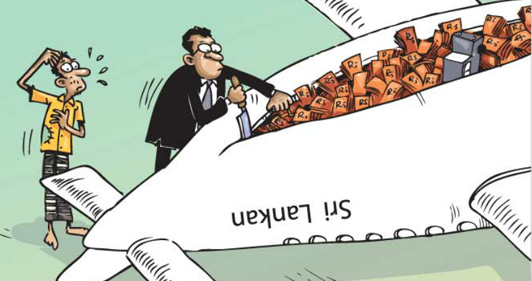
CORRUPTION MUST BE ERADICATED AT THE LEVEL OF THE EXECUTIVE- R. SAMPANTHAN

 Rajavarothiam Sampanthan.-11/05/2018
Thank you, Mr. Speaker. We are debating the Policy Statement made by His
Excellency President Maithripala Sirisena in Parliament on the 08th of
this month. This Adjournment Motion has been requested by the Leader of
the Joint Opposition, the Hon. Dinesh Gunawardena and has been seconded
also by an Hon. Member of the Joint Opposition.
One could see, Sir, that the main theme of their speeches was that this
Government should cease to govern, which should also mean that they must
be returned to governance or they must be enabled to govern the
country. They have governed this country for a long time. They governed
this country for ten years before the present Government came into
power. When they gave up their Government, they were neck-deep in debt.
One of the biggest issues identified by the President as confronting the
country is the foreign debt and the domestic debt. I will, in the
course of my speech, Sir, address issues that need to be addressed to
take the country forward, to take the country on a different path, to
define for the country a different future. It would be my submission
that merely changing Governments is not going to resolve problems. On
the contrary, we must all come together and think in terms of what needs
to be done for the country to move forward, for the country to prosper,
for the country to be redeemed from its present position. Therefore,
Sir, my speech will be on an entirely different basis.
The President in the course of his address identified three main issues.
One was, the economy; the second was, the issue of the North and the
East, popularly referred
to as the “national question” and the third was, the issue of
corruption and fraud. All these three issues are fundamental issues
which have a great impact on the future of this country. But, Sir, I
will in the course of my address primarily deal with issue number two.
That is the national question, the issue pertaining to the North and the
East and the people who live in that part of the country. It has
afflicted the country from the time the country attained Independence,
70 years ago. The non-resolution of the issues in the North-East has
been the primary cause for all other problems and various difficulties
the country has faced. It is also my contention, Sir, that the country
is in its current parlous state and corruption and fraud have aggravated
to its present height primarily on account of the non-resolution of the
issue in the North-East.
North-East issue
This country will never be able to redeem itself unless the North-East
issue is resolved. I also consider it my duty, Sir, as the Leader of the
Opposition, to pay the maximum possible attention to this issue. I do
so in the interest of the country, not in the interest of one Government
or the other and my appeal is to all Members of Parliament, to all
persons in Government, to all persons in Opposition to come together to
resolve this issue. I do so in the interest of the country as a whole.
Very much unlike some who want the North-East issue to continue for
their political survival and for the advancement of their political
fortunes, I want the North-East issue resolved within an undivided,
indivisible and one Sri Lanka on the basis of fairness, justice and
equality, wherein all Sri Lankans are equal citizens of this country,
Sri Lanka, subject only to the country’s Constitution and laws. That is
why, Sir, we are currently engaged in the framing of a new Constitution
and it is in this background that I will examine some aspects of His
Excellency the President’s Policy Statement and other relevant material
to put the whole issue in its proper perspective.
Before I do that, you will permit me, Sir, to refer to the Election
Manifesto of the Federal Party in 1970. This is what the Federal Party
said in its Election Manifesto in 1970. The whole country should know
this. I quote:
“It is our firm conviction that division of the country in any form
would be beneficial neither to the country nor to the Tamil-speaking
people. Hence we appeal to the Tamil-speaking people not to lend their
support to any political movement that advocates the bifurcation of our
country.”
This was the position taken by the Federal Party in 1970 in its Election
Manifesto, that they were opposed to the bifurcation of the country and
wanted the Tamil people to vote against any political movement that
advocated bifurcation of the country. I say this because many people
seem to think that we have demanded separation and that we are
responsible for the state in which the country is.
It was after this election in 1970 and the enactment of the 1972
Constitution that there was a demand for a separate State. But, ever
since the Indo-Sri Lanka Peace Accord in 1987 and certain Constitutional
changes that came about with that Accord, all Tamil political parties
in this country have been prepared to find an acceptable, reasonable
solution within the framework of a united, undivided, indivisible Sri
Lanka. That has been our position. That had been the position in all
elections in the past. For almost three decades, ever since 1988, that
has been our position at Local Government Elections, at Provincial
Council Election and Parliamentary Elections.
1972 constitution
As I said before, Sir, it was the non-resolution of the North-East issue
and the enactment of the 1972 Constitution unilaterally by the party in
power at that time without any consensus with anybody else that
resulted in all that happened since 1970 and the country being brought
to its present state. The whole question, Sir, is, “Do you want the
country to continue in the same trend and get even worse in the future
or, do you want to give the country a new direction and a new future?”
It is in this context, Sir, that I shall be quoting from the Statement
made by His Excellency the President in Parliament on the 08th of this
month and some other Statements made by the President earlier, the
Resolution adopted by this Parliament converting this Parliament into a
Constitutional Assembly and also the Statements made by former President
Hon. Mahinda Rajapaksa in the course of his election campaign. In the
course of the Statement His Excellency the President made in Parliament
on the 08th of this month, he said, “I wish to make this Statement as an
extension of the Statement presented by me at the commencement of the
First Session of the Eighth Parliament.” – that was on the 1st of
September 2015. Before I read that Statement, Sir, let me state what
His Excellency the President said in the course of his speech on the 08th of May. He said, I quote,
“The foundation of a stable country is national reconciliation. It is
important to introduce a structure for taking political decisions based
on equality for achieving meaningful reconciliation. I believe, it is
the dire need of the day to strengthen the existing provincial council
system in order to achieve these objectives. Whatever the opposition, it
is essential to enter into a political programme with the consensus and
agreement of the people to find a permanent solution to the issue of
unrest of the people in the North and the East.”
His Excellency, in the course of his Statement in Parliament on the 08th of
this month, made reference to the North-East issue because he
identified the North-East issue as one of the most serious problems
afflicting this country. Thereafter, Sir, I quote from the Statement
made by His Excellency the President on the 1st of September, 2015, when he addressed the First Session of this Parliament.
Srisena at 2015
He said, Sir, I quote:
“Hon. Speaker, the identity of a nation or a country is based on its
Constitution. That is why a Constitution is considered supreme. During
the 60 years after Independence, we have adopted three Constitutions.
Yet, it is unfortunate that we have not been able to adopt a
Constitution which enables all of us to agree as a single nation.”
This is what His Excellency said on the 1st of September, 2015 when he addressed Parliament and then when he addressed the Parliament on the 08th of
this month, he said, “What I now make is a continuation of the
Statement I have made when I addressed Parliament at its First Session
on the 1st of September, 2015.”
You would permit me, Mr. Speaker, to quote from the Resolution of Parliament on the 9th of
March, 2016 in regard to the framing of a new Constitution which His
Excellency referred to in the course of his first Policy Statement on
the 1st of September, 2015. The Resolution states, I quote:
“AND WHEREAS it has become necessary to enact a new Constitution that,
inter alia, abolishes the Executive Presidency, ensures a fair and
representative Electoral System which eliminates preferential voting,
strengthens the democratic rights of all citizens, provides a
Constitutional Resolution of the national issue, promotes national
reconciliation, establishes a political culture that respects the rule
of law, guarantees to the peoples fundamental rights and freedom that
assure human dignity and promotes responsible and accountable
government.”
It goes on to state, I quote:
“There shall be a Committee of Parliament hereinafter referred to as the
‘Constitutional Assembly’ which shall consist of all Members of
Parliament, for the purpose of deliberating, and seeking the views and
advice of the People, on a new Constitution for Sri Lanka, and preparing
a draft of a Constitution Bill for the consideration of Parliament in
the exercise of its powers under Article 75 of the Constitution.”
That is the Resolution, Sir, adopted by this Parliament converting
itself into a Constitutional Assembly in March, 2016. What has happened
thereafter? The Constitutional Assembly has functioned; a Steering
Committee has been appointed; Subcommittees have been appointed;
Subcommittees have come up with their Reports; the Steering Committee
has come up with an Interim Report to the Constitutional Assembly and
debates have taken place in Parliament. The enactment of a new
Constitution has been seriously considered and much work has been done
on that. Experts have been appointed; their views have been obtained;
there have been consultations with the people; there have been
consultations with civil society and a lot of work has been done.
Unfortunately, in the past couple of months, that work has not continued
on account of other developments in the country: Local Authorities
Elections and certain differences in Government. Sixteen Ministers of
the Government have crossed over and joined the Opposition.
On account of these disturbances, that process has not continued. But
that must continue; that process must recommence and that must reach its
logical end. It was a unanimous Resolution adopted by this Parliament
converting Parliament into a Committee of the whole designated as the
Constitutional Assembly for the purpose of drafting a new Constitution
for this country. The Steering Committee appointed by the Constitutional
Assembly has continuously met; everybody has participated. The
Resolution was adopted unanimously. Therefore, that is the will of this
House; that is the will of the Members of Parliament and it must
continue.
What we want
It will be relevant for me to examine, Sir, in this context, what
President Mahinda Rajapaksa had to say in regard to a new Constitution.
Particularly, Sir, when he contested the Elections in 2015, he wanted a
new Constitution. I quote from his Manifesto. He said: “A Wide Political
Reform – A New Political Culture
We have been battered for 36 years by the 1978 Constitution which was
thrust upon our people and country, without an appropriate debate or
discussion. We must also collectively acknowledge that our Constitution
is now further distorted due to the various amendments over the years,
some of which are not consistent with others. Therefore, instead of
amending the Constitution further with piece-meal changes, I will take
action to formulate a new Constitution that reflects the peoples’ ideas,
aspirations and wishes within a period of one year.”
That is what he said: he wanted a new Constitution. When he went before the people on the 08th of January, 2015, he told the people this country needs a new Constitution.
Sir, he further said, I quote:
“I will first submit the Draft Constitution which will consist of the
proposals of these groups, for the Parliament’s approval in accordance
with the Constitution. Thereafter, I will present the Draft Constitution
to a referendum seeking the approval of the people.”
That is what we want. It is our contention that the Constitution must be
approved by Parliament by a two-thirds majority and after the
Constitution is approved by Parliament by a two-thirds majority, it must
be submitted to the people of this country and it must obtain the
approval of the people of this country at a Referendum. That is our
position. We do not want a Constitution enacted behind the backs of the
people.
That was President Mahinda Rajapaksa’s position. That is, Sir, why the
Opposition was not able to oppose the Resolution tabled in Parliament.
That is why the Opposition was compelled to cooperate with the
activities of the Steering Committee and in fact, even today, it is
continuing to cooperate with the Steering Committee. So, Sir, what this
country needs is to frame a new Constitution in such a way as to resolve
that issue, a conflict, that has plagued this country from the time of
Independence, from 1947-1948. That is what the country needs. Nobody
wants to trick anybody, Sir; nobody can trick anybody. The Constitution
must be approved by a two-thirds majority in Parliament and the people
at a referendum.
Srisena and Rajapaksa
Moreover, Sir, ever since 1987-1988, the Constitution-making process had
been a continuing process. Under President Premadasa’s time, there was
the Mangala Moonesinghe Select Committee which came up with proposals
for a new Constitution in regard to power sharing and various other
matters. During President Chandrika Bandaranaike Kumaratunga’s time,
there were various proposals that she made in 1995, in 1997 and in
August, 2000, she brought to Parliament a Constitution Bill. The matter
was widely discussed and that Bill was approved by the Cabinet. Both
President Mahinda Rajapaksa, the former President and President
Maithripala Sirisena, the present President who were the Members of
President Chandrika Bandaranaike’s Cabinet approved those proposals in
Cabinet. They accepted those proposals at Cabinet. Therefore, Sir,
thereafter, when President Mahinda Rajapaksa became President, he
appointed the All Party Representative Committee called the “APRC”. He
appointed Prof. Tissa Vitharana, Member of Parliament as the Chairman of
that Committee. Then, he appointed the Multi-Ethnic Experts Committee
who came up with their reports. Prof. Tissa Vitharana Committee has
submitted its report to Mahinda Rajapaksa and the report is now
available.
Tamil rights cannot be buried
Therefore, Sir, from 1987-1988, for the last 30 years, the Constitution
process has been taking place. It had been a continuous process. All of
which, Sir, provide substantial material for the framing of a new
Constitution. Sir, nobody can think that the North-East conflict that
the rights – the political rights, the social rights, the economic and
cultural rights – of the Tamil people in this country can be buried.
They have lived in this country for as long as anyone else. They have
historically inhabited a certain part of this country and the
Tamil-speaking people are a majority in that part of the country which
they have historically inhabited even today. We want a united country;
we want an undivided country; we want an indivisible country but, we
want to live as equal citizens. We must be assured of our dignity and
self-respect. We must be assured justice within an undivided country.
That is what we are asking for. I do not think, Sir, that can be denied
to us. I think the time has come for everyone to realize that this is an
obligation that they – not merely the Tamil people, all the
Tamil-speaking people in this country are entitled to.
If this country is to prosper, if the country is to achieve its full
potential, if the country is to grow economically and succeed as a
country as other countries have done in this region and in the world,
then I think Sir, a new Constitution needs to be framed and this matter
needs to be resolved.
I would like to say a few words on the economy Sir, before I conclude my
speech and also on the question of corruption and fraud.
Nothing is happening, why?
I think, Sir, any government must have the courage to take decisions
that are challenging. We have heard of a Free Trade Agreement with
Singapore, we have heard of an Economic and Technology Co-operation
Agreement with India and we have heard of an Agreement with China. Our
leaders have been visiting various countries in the world over having
discussions but nothing is happening. We are expecting foreign
investment. We are hoping to fashion an export-oriented economy. We say
that we occupy a very strategic position in the Indian Ocean Region. Why
are not all these things being exploited? This Government has been in
power in the past three and a half years. The former Government that the
Hon. Dinesh Gunawardena talked about was in power for 10 years. All
that they did was to enact the Eighteenth Amendment taking away the
independence of the judiciary, taking away independent commissions and
enabling the President to run for presidency any number of times. What
else did you do? This country got neck-deep in debt during
your period. You cannot deny that. Therefore, Sir, I think there is an
obligation on the part of the Government to act expeditiously, to act
swiftly. We do not want the interests of our country to be sacrificed in
any way. We do not want the interests of the people of this country to
be sacrificed in any way. We will join all other people in opposing any
such move. But, at the same time, if you want to redeem yourself, if you
want to come out of difficulties that are very deep, out of which you
were unable to come out for a long period of time, you must make bold
decisions. You must make expeditious decisions and it must be
implemented.
Clean up the top
On the question of bribery and corruption, Sir, I do not want to say
very much. We must start here. Corruption must be eradicated in this
Parliament. I am not talking about the officials of Parliament. I am
talking about myself and my Colleagues. Corruption must be eradicated at
the level of the Executive. Unless we start cleaning up at the very
top, we can never clean the bottom, we can never clean the middle. We
need to commence cleaning up at the very top. Corruption must be
eliminated at the level of political parties. Political parties must
realize that they have a duty by this country to ensure that the persons
whom they bring into politics are persons of stature, persons of
character, persons who will not sell their country. I think Sir, if
corruption is to be eradicated in this country, we have got to first
start cleaning up at the top. Without cleaning up at the top, it will be
futile to think of cleaning up in the middle or at the bottom.
I thank you, Sir.
(Full transcript of the speech made by Hon Sampanthan in Parliament on 10th of May 2018.)
