Peace for the World World ! Your War Our Lives

The Dalai Lama
A Brief Colonial History Of Ceylon(SriLanka)
Sri Lanka: One Island Two Nations
A Brief Colonial History Of Ceylon(SriLanka)
Sri Lanka: One Island Two Nations
(Full Story)
Back to 500BC.

Monday, May 28, 2018
Israel’s high court blesses killing and maiming of Gaza protesters
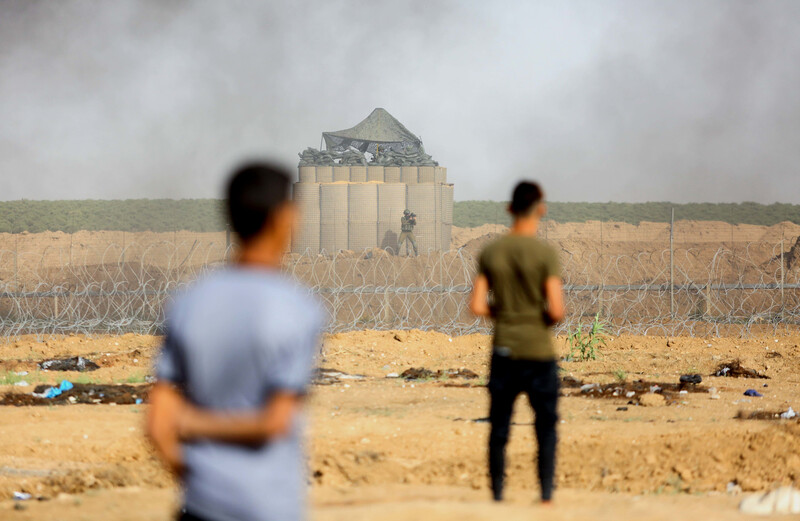
Israeli forces aim towards Palestinian protesters east of Gaza City on 25 May.
APA images
Israel’s high court rejected two petitions from human rights groups
challenging the military’s open-fire regulations this week as several
more Palestinians died from wounds sustained during Gaza’s ongoing Great March of Return protests.
It was the second ruling made by the court on Thursday rubber-stamping war crimes.
The high court ruling may be viewed by the International Criminal Court
as an indication that Israel’s judicial authorities are unwilling to
carry out genuine proceedings concerning crimes against Palestinian
civilians.
Between 19 and 25 May, Gaza’s health ministry announced the deaths of
seven Palestinians from injuries inflicted during protests along the
eastern perimeter of the territory beginning 30 March.
The deceased were identified as Hussein Salem Abu Oweida, 41, Ahmad
al-Abed Abu Samra, 21, Muhammad Mazen Alayan, 20, Muin Abd al-Hamid
al-Saee, 58, Muhannad Abu Tahoun, 21, Ahmad Qatoush, 23 and Yasir Sami
Saad al-Din Habib, 24.
Also this week a 15-year-old in the occupied West Bank, Oday Akram Abu Khalil, died from wounds sustained
when he was shot in the stomach by Israeli forces during protests on 15
May, the annual commemoration of the 1948 Nakba or catastrophe.

Odai Abu Khalil, 15, was pronounced dead Wednesday, eight days after Israeli forces shot him in the abdomen. buff.ly/2Lw1u1O

More than 115 Palestinians
have been killed by Israeli forces in the Gaza Strip since 30 March,
the vast majority of them during Great March of Return protests – including 14 children, two journalists and a paramedic.
Some 3,600 people were injured by live fire during the protests.
A lightly wounded soldier was the only reported Israeli casualty resulting from the protests in Gaza.
Court sides with state – again
The Israeli high court ruled in favor of the state’s argument that
protesters constituted a danger to Israeli soldiers and civilians, thus
justifying the use of lethal force.
The judges sided with the government’s contention that the protests take
place in the context of a long-running armed conflict between Israel
and Hamas. The state argues that the legal framework that regulates the
use of fire during the protests is international humanitarian law, or
the laws of war.
Human rights groups say that
irrespective of the political affiliation of any of the organizers or
participants, the demonstrations along Gaza’s eastern perimeter are a
civilian matter of law enforcement governed by the framework of
international human rights law, which allows for the use of deadly force
only to stop an imminent lethal threat.
“Some of the rioters have tried to trample or break through the border
fence, creating a clear and present danger that terrorists will
penetrate into the state’s territory, and this is happening in areas
near towns on the Israeli side,” wrote Hanan Melcer, one of the three judges who reviewed the petitions.
“Among the rioters were some who threw rocks and fire bombs at Israeli
troops. Therefore, it seems that gunfire was employed to achieve a legal
purpose – defending citizens of the state and Israeli soldiers,” Melcer
added.
The court ruling gives the military “a green light to its continued use
of snipers and live fire against Palestinian protesters in the Gaza
Strip,” stated Al Mezan and Adalah, two of the groups that had petitioned the court.
The two groups stated that the court had “refused to watch video clips
documenting Israeli shootings of demonstrators and, rather than actually
examining the case, fully accepted the claims presented to it by the
state.”
Al Mezan and Adalah published a video montage of such clips:
“The extreme nature of the ruling is also highlighted by the striking
absence of any mention of the casualty figures that had been presented
to the court,” the human rights groups added.
The Israeli high court said it could not move forward with an inquiry
into the military’s rules of engagement because petitioning
organizations rejected a request by the state to present the judges
secret intelligence without the petitioners being allowed to review it.
“We have no concrete information about the identity of the key activists
and inciters, the nature of their acts, their organizational
affiliation, their involvement in terrorist activity or other forbidden
hostile activity, or whether and in what manner they constituted a clear
and present danger,” Melcer stated.
The justices accepted the state’s description of the Gaza protests as
“violent disturbances” which were “organized, coordinated and directed
by Hamas, which is a terrorist organization in a state of armed conflict
with Israel.”
No imminent threat
Adalah and Al Mezan stated that the court ruling “contradicts the
conclusions and preliminary results of international human rights
organizations and United Nations bodies documenting and evaluating the
events in Gaza.”
During a special session of the UN Human Rights Council concerning the
events in Gaza last week, the body’s High Commissioner Zeid Ra’ad Al
Hussein stated:
“Although some of the demonstrators threw Molotov cocktails, used
slingshots to throw stones, flew burning kites into Israel, and
attempted to use wire-cutters against the two fences between Gaza and
Israel, these actions alone do not appear to constitute the imminent
threat to life or deadly injury which could justify the use of lethal
force.”
The Human Rights Council voted to establish a commission of inquiry into mass civilian casualties during the demonstrations with a final report due next March.
Tania Hary, executive director of Gisha, an Israeli human rights group which challenged the open-fire regulations, said she
was “disappointed but not surprised to see the court again sanction
Israel’s grave violations of human rights and international law in
Gaza.”
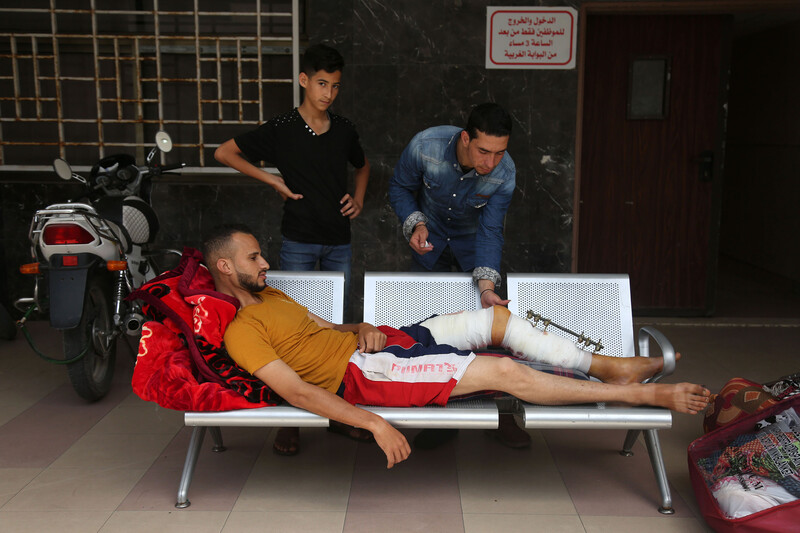
A Palestinian injured during Great March of Return protests rests
outside Gaza City’s al-Shifa hospital after being discharged, 19 May.
ActiveStills
Israel’s high court has long championed policies towards Palestinians that violate international law.
Gisha has previously faulted Israel’s
judiciary, and principally the high court, for accepting “the state’s
legal positions almost unquestioningly” regarding the 11-year blockade
of Gaza.
Palestinian human rights groups have urged the International Criminal
Court to investigate the unprecedented closure of Gaza as a crime of persecution.
The Palestinian Authority’s foreign minister made a referral to the International Criminal Court on Tuesday, calling for an immediate investigation into Israeli crimes.
In 2015, the court launched a preliminary examination into potential war crimes in the occupied West Bank and Gaza Strip.
Preliminary examination by ICC
A preliminary examination is the first step in the court’s process to
determine whether to open a formal investigation, which can then lead to
indictments and trials.
But while a preliminary examination is carried out whenever a referral
is made, it is open-ended and can carry on for years, at the discretion
of the chief prosecutor.
In 2006, the prosecutor began a preliminary examination of alleged crimes committed in Afghanistan from 2002.
Eleven years after the examination was opened, and up to 15 years after
the commission of the first alleged crimes, the prosecutor concluded that
there was enough evidence to proceed with a formal investigation into
alleged war crimes and crimes against humanity by the Taliban, the
Afghan government and the United States.
A preliminary examination into alleged crimes against humanity and war crimes in Colombia, opened in 2004, is still pending, according to the Coalition for the International Criminal Court.
In her response to the Palestinian complaint, chief prosecutor Fatou
Bensouda signaled that she does not intend to expedite the process,
stating that the “preliminary examination has seen important progress
and will continue to follow its normal course.”
Israel’s foreign ministry lashed out against the Palestinian move,
calling it an effort “to politicize the court and to derail it from its
mandate.”
Over the past several weeks Bensouda’s office has expressed “grave concern” over the situation in Gaza and warned Israeli leaders that they may face prosecution for the killing of unarmed Palestinian protesters.
Earlier this month the press freedom watchdog Reporters Without Borders formally requested that the International Criminal Court prosecutor investigate the targeting of journalists in Gaza as war crimes.
The Palestinian rights groups Al-Haq, Al Mezan and the Palestinian Center for Human Rights stated this weekthat they “have submitted five comprehensive communications to the prosecutor” as part of the court’s preliminary examination.
“These communications have related to the 2014 offensive against the
Gaza Strip, the Israeli-imposed Gaza closure, the use of the Hannibal
Directive in Rafah, and crimes committed in the West Bank including
Jerusalem,” the groups stated, adding that they “have also provided
information on the lack of domestic investigations and prosecutions.”
The prosecutor “has sufficient evidence” to open a full investigation, according to the rights groups.
“The ICC acting as a court of last resort must provide redress to Palestinian victims,” they added.
