Peace for the World World ! Your War Our Lives

The Dalai Lama
A Brief Colonial History Of Ceylon(SriLanka)
Sri Lanka: One Island Two Nations
A Brief Colonial History Of Ceylon(SriLanka)
Sri Lanka: One Island Two Nations
(Full Story)
Back to 500BC.

Monday, June 4, 2018
They need to be handled not systematically but immediately
“When you see some evil you proceed to immediate action, you make an immediate attack to cure the symptom.”
~Johann Wolfgang von Goethe
~Johann Wolfgang von Goethe
 2018-06-02
 In
the Third World people go into government to enrich themselves. When
patriotism and service have been sacrificed for bottomless appetite for
personal avarice and indulgences, loyalty within the power bubble counts
immeasurably. The Rajapaksa government managed to elevate that loyalty
to a new level; a level that was beyond the average wage earner and
self-employed vendor, the gram seller or coconut plucker. They attracted
to their political abode partners, who were equal not only in that
society-gutting greed and natural magnetism towards self-enrichment, who
were hell-bent on destroying accepted norms and traditional human
values. For them human life is of no greater value than the quick buck
they could make by circumventing the so-called Administrative and
Financial regulations (AR & FR) of public service.
In
the Third World people go into government to enrich themselves. When
patriotism and service have been sacrificed for bottomless appetite for
personal avarice and indulgences, loyalty within the power bubble counts
immeasurably. The Rajapaksa government managed to elevate that loyalty
to a new level; a level that was beyond the average wage earner and
self-employed vendor, the gram seller or coconut plucker. They attracted
to their political abode partners, who were equal not only in that
society-gutting greed and natural magnetism towards self-enrichment, who
were hell-bent on destroying accepted norms and traditional human
values. For them human life is of no greater value than the quick buck
they could make by circumventing the so-called Administrative and
Financial regulations (AR & FR) of public service. When AR and FR began its downward ride, Presidential decrees became the rule of law in the country. The Governor of the Central Bank became a mere pawn in the grand chessboard of a nasty political dynamic. Secretaries to President and the Ministry of Finance were executioners of devious acts of financial fraud. The siblings of the President became more powerful than senior ministers. There is no more evidence necessary than the current President who was a senior minister in that Cabinet until he said enough is enough, just before the presidential elections in 2015. Those senior minsters had to be satisfied with the bare bones while the meat, flesh and blood, including the marrow was sucked out by the First Family. It was against such a backdrop that the presidential election was held in January, 2015.
The UNP, whose economic policies and principles are based on capitalism and the SLFP which advocates at every corner of the country a society that has to share its poverty instead of wealth were bound to clash when the time came. That time has come
But a more profound tragedy occurred after the presidential elections.
The platform that was so strongly built as a counter to the many
misdeeds and criminal activities such as the slaying of Lasantha
Wickramatunga, the then editor of the Sunday Leader newspaper and
disappearance of another journalist, Prageeth Eknaligoda, could not
withstand the stormy waves of the vicious propaganda of the joint
opposition (JO). Not holding parliamentary elections immediately after
the presidential elections in 2015 came to haunt the current
Administration, as is seen today. That blame is held against Maithripala
Sirisena, the new President. His ambition to salvage the Sri Lanka
Freedom Party (SLFP) instead of looking after those who elected him, the
Northern and Estate Tamils, Muslims all over the country and the United
National Party (UNP), the traditional rival of the SLFP, overshadowed
the real purpose of the election.
Two strategic blunders were committed not only by Mahinda Rajapaksa opting out of the leadership of the SLFP, and Maithripala Sirisena too, by betraying his voters and embracing the SLFP which he left to become the ‘Common Candidate’ against the Rajapaksas. Had Mahinda Rajapaksa chosen not to withdraw from the leadership of the SLFP, he would not have had to grapple with the current impasse the SLFP is in. He would have been the undisputed ‘King’ of his party and would have been a much more formidable threat to the current government. Had Sirisena chosen to stick with the ‘common platform’ (Northern and Estate Tamils, Muslim conglomeration and the UNP), instead of choosing to salvage his former SLFP, he would not have had this disunited ‘Unity Government’ and maybe, just maybe, the UNP would have had to choose him again as the next Candidate for the forthcoming presidential election.
This double-jeopardy committed by the double - Ms, Mahinda and Maithripala, took its unkind toll. The wisdom of this inept and disparate double-move will be the subject talked about by many a social scientist and historian yet to come. But we, as contemporaneous writers, can indulge in the analysis of such a foolhardy strategy hugged by our leaders.
The people at large are paying a very high price for a commodity that is rotten and soiled to the core. The momentum of defeating the ‘spoiled brats of power’, the Rajapaksas, is lost. The loss of momentum has in turn engendered a lackadaisical approach to the country’s financial woes created by the Rajapaksas. Instead of a UNP cabinet led by a UNP Prime Minister and a ‘common President’, Sri Lanka is being led by a UNP cum SLFP Cabinet headed by a clumsy duo of party leaders whose primary goal is safeguarding their own self-interests. The UNP, whose economic policies and principles are based on capitalism and the SLFP which advocates at every corner of the country a society that has to share its poverty instead of wealth were bound to clash when the time came. That time has come. The basic clash between the two philosophies which are diametrically opposed to each other has produced the current gridlock. The birth of crony capitalism which occurred somewhere in the mid nineteen-nineties (1990s) has come of age from its pangs. That vicious subtext of capitalism has continued its meandering journey triggering unforgiving circumstances turning the politically pious into a venomous creed of political scavengers. Their prey is the national coffers and an ill-fated people whose susceptibilities are beyond repair.
This session of predator-prey game has been in play for the last twenty five years. That’s a long time for any cultural pattern to set in. The prey gets used to its being used by the predator to unimaginable extents, until the prey gets intensely enveloped in the web, hardly noticing that its very survival becomes dependent upon lengths to which the prey gets consumed by its own blood. This morbid survival game has been continuing unhindered, without the knowledge either of the predator or the prey.
We have reached the depths of that existence. The cynical politician has realized that stark truth. His willful participation in the deception of the voter is exponentially expanding. The politician and the voter, one feeding on the other, have bonded together, forming a bizarre relationship to sustain a self-destructive dynamic whose irreversible passage doesn’t look all that unrealistic. People at large don’t seem to have either the time or the willingness to sort this curious collection of social energies out by themselves. So they look to the politicians whose wicked activities have clouded the whole issue of corruption, nepotism and wanton killings and disappearances of political opponents.
In the Third World people go into government to enrich themselves. When patriotism and service have been sacrificed for bottomless appetite for personal avarice and indulgences, loyalty within the power bubble counts immeasurably
The deliberate attempts and carefully crafted propaganda gimmicks
engineered by the Rajapaksas and his henchmen have taken a full toll of
Sri Lankan mindset. As an unintended and collateral damage of these
shocking schemes are our culture and traditions. These traditions and
values have taken a blast from the Rajapaksa-led regime. A society that
was being gradually swallowed by the jaws of Capitalism’s ill-effects
strode more vigorously during the Rajapaksa-rule. They calculated that
the war-victory against Prabhakaran and other Tamil militants gave them
an open licence to kill and rape the country they thought they saved.
But this writer’s grievance is this: when elected to power on an unambiguous platform of undoing the Rajapaksa-rule, instead of undoing those society-destroying acts immediately, they adopted a more slow process of systematic handling. Systematic handling is another phrase for ‘not handling’. Period.
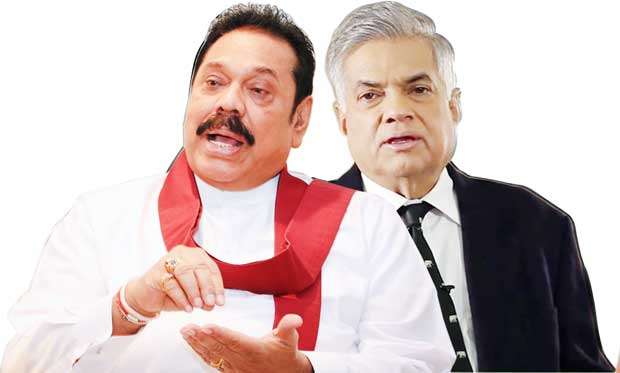
Ranil Wickremesinghe, if he still frits with the idea of winning at a presidential election, has one chance and one chance only. He has to go after the corrupt Rajapaksas and bring them before justice. Not tomorrow or day after, but yesterday! He doesn’t have time, maybe six months. With the dawn of the next year, the country will be on a campaign-roll. At the beginning of 2019, the people will be beginning to form their opinions on the forthcoming presidential election due within 12 to 13 months thereon. His covert attempt at driving a telling wedge in the SLFP has fallen flat. President Sirisena’s share in the SLFP seems to be less than a pathetic 5%! The rest is with Mahinda Rajapaksa and his gang and that was well articulated in the 2015 Presidential Election itself, which was later reconfirmed at the recently concluded local government elections.
Therefore, in the context of the failure of this master strategy to divide the SLFP in the middle, Ranil Wickremesinghe’s space for further manoeuvrering has shrunk. If he wishes to nominate himself as the next UNP candidate for President in 2020, Ranil has to move fast. The recent Band-Aid solutions introduced into the UNP structure do not mean anything unless and until the fundamental issue of prosecuting the Rajapaksas for their alleged felonies is settled. If, however, Ranil Wickremesinghe decides to introduce another candidate other than himself for the 2020 presidential elections, either Navin Dissanayake or Sajith Premadasa, the prognosis will be certainly different. A new face, for that matter, a much younger one than anyone else in the field now, would attract a lot of attention provided a correct branding and campaign plan is executed.
The writer can be contacted at vishwamithra1984@gmail.com
