Peace for the World World ! Your War Our Lives

The Dalai Lama
A Brief Colonial History Of Ceylon(SriLanka)
Sri Lanka: One Island Two Nations
A Brief Colonial History Of Ceylon(SriLanka)
Sri Lanka: One Island Two Nations
(Full Story)
Back to 500BC.

Saturday, June 2, 2018
Trump-Kim summit: Rollercoaster diplomacy vs. inclusive diplomacy
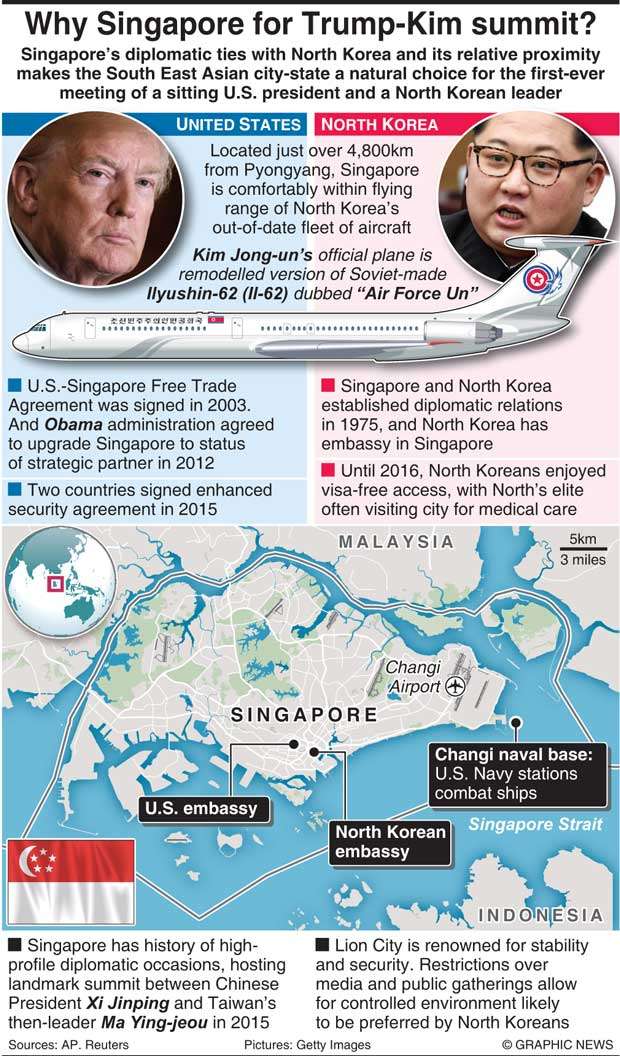
2018-06-01
 Till
it happens, it is a tough call. Given the unpredictability that has
now come to characterise the policies of the United States President
Donald Trump and North Korean leader Kim Jong-un, the much-hyped summit
is mired in uncertainty till the two leaders meet in Singapore on June
12.
Till
it happens, it is a tough call. Given the unpredictability that has
now come to characterise the policies of the United States President
Donald Trump and North Korean leader Kim Jong-un, the much-hyped summit
is mired in uncertainty till the two leaders meet in Singapore on June
12. First
there was rhetoric or name calling. Trump threatened to unleash “fire
and fury” on North Korea after the reclusive regime in August last year
successfully tested Intercontinental Ballistic Missiles capable of
hitting the US territory of Alaska. North Korea hit back, calling Trump
mentally deranged. A month later, Trump ridiculed Kim as “Little Rocket
Man” and threatened to “totally destroy” North Korea if it attacked the
US or any of its allies. An angry North Korea responded with a bigger
ICBM test, bringing the whole of the US under its range.
First
there was rhetoric or name calling. Trump threatened to unleash “fire
and fury” on North Korea after the reclusive regime in August last year
successfully tested Intercontinental Ballistic Missiles capable of
hitting the US territory of Alaska. North Korea hit back, calling Trump
mentally deranged. A month later, Trump ridiculed Kim as “Little Rocket
Man” and threatened to “totally destroy” North Korea if it attacked the
US or any of its allies. An angry North Korea responded with a bigger
ICBM test, bringing the whole of the US under its range.
In the face of North Korea’s nuclear missile muscle flexing, the Trump
administration pushed for tougher United Nations sanctions on North
Korea, with even China, North Korea’s closest ally, being forced to
endorse them. As the hostilities were seen to be on the rise, the then
US secretary of state Rex Tillerson announced the Trump administration
was in direct contact with North Korea. In the meantime, South Korea’s
behind-the-scenes peace offensive led by President Moon Jae-in began to
work, with North agreeing to send athletes and a high-level delegation
led by Kim’s sister, Kim Yo-jong, to the Winter Olympics in February
this year.
Then, in April this year, what President Moon described as a “miracle”
happened, when the leaders of the two Koreas met on the South Korean
side of the truce village of Panmunjom, with the North Korean leader
favouring the denuclearisation of the Korean peninsula. Against the
backdrop of this historic summit, President Trump announced a possible
meeting between him and the North Korean leader in what was seen as one
of the biggest diplomatic shocks in the post-World War II history. The
announcement came against the backdrop of a secret meeting between Mike
Pompeo, the then CIA director and now the Secretary of State, and Kim
Jong-un.
But after fixing June 12 as the date for the Kim-Trump summit and
Singapore as the venue, the Trump administration on May 24, in a show of
crude diplomacy, announced the cancellation of the meeting after North
Korea reacted angrily to remarks made by Vice President Mike Pence and
Trump’s hawkish National Security Advisor John Bolton. They had given
the impression to North Korea that the fate that befell Libya and its
leader Muammar Gaddafi would befall North Korea and
Kim Jong-un.
Kim Jong-un.
Taking the moral high ground, North Korea held a public ceremony to
destroy its controversial nuclear site the same day Trump announced the
cancellation of the summit.
On Friday, Trump made a dramatic about-face, announcing that the
US-North Korea summit would go ahead as scheduled. Re-enter President
Moon. Amidst such chaotic public utterings of Trump, in a refined act of
delicate diplomacy, the South Korean leader met his North Korean
counterpart on May 26 on the North Korean side of the truce village of
Panmunjom in an effort to salvage the Korean peninsula’s historic
opportunity for peace, reunification of the two Koreas and to end the
Cold War era tensions.
As the roller coaster diplomacy, symbolising the capricious nature of
the policies of Trump and Kim, kept the world guessing, heightened
activity in Washington, Beijing and the capitals of the two Koreas point
at a greater possibility of the Singapore summit taking place.
Yesterday, US Secretary of State Pompeo met Kim Yong Chol, considered
the right hand man of Kim Jong-un, in Washington, to discuss
summit-related matters, while Russia dispatched its foreign minister
Sergei Lavrov to Pyongyang for talks.
One cannot downplay the role of China in the turn of events. Kim Jong-un
has in recent months visited China twice for crucial talks with
President Xi Jinping, China’s virtual lifetime leader. It is expected
that Kim Jong-un may visit China again ahead of the June 12 summit with
Trump, and these meetings indicate that the Kim-Trump summit outcome
will not undermine China’s national interest. US media have accused
Beijing of coaching North Korea and blamed Beijing for giving Kim
Jong-un the courage to take Trump head on. True, in terms of power, the
US is much bigger than North Korea. In the event of a war,
notwithstanding Kim Jong-un’s nuclear weapons and ICBMs, the United
States could wipe out North Korea in a matter of days or weeks, if we
were to assume that China would not intervene and South Korea, fearing a
million deaths in the first hour itself of such a conflict, would not
dissuade the US against such a war. Thus, for Kim Jong-un, ties with
Beijing give him the necessary boost to meet Trump on an equal footing.
US media reports say there is as yet no agreement between the two sides
on the terms of the summit. At the core of the summit is, however, the
issue of the denuclearisation of North Korea. But the US side still does
not know whether Kim Jong-un has made a decision to denuclearise.
If North Korea were to wind up its nuclear weapons programme, what will
North Korea gain in return from the US? This could be the key question
at the summit. Lifting the economic sanctions and promises of economic
aid alone may not be enough. North Korea, probably goaded by China, may
insist on the withdrawal of the US military from South Korea and other
bases in Asia. Not only North Korea, but China and Russia also see the
US deployment of Thaad missiles in South Korea as a major military
threat and a hostile act.
If there is to be a positive outcome, ironically, it lies in a tested
model -- the Iran nuclear agreement which Trump has discarded. Under
this agreement signed by Iran and six world powers, including the US,
Iran’s enriched uranium stockpiles were transferred to Russia. In North
Korea’s case, China could be the guarantor of North Korean nuclear
assets.
The meeting, if it takes place, therefore, will take place in an
atmosphere of mutual distrust. If the Singapore dialogue were to bring
results, it is imperative that China, Russia and Japan also come to the
negotiating table.
