Peace for the World World ! Your War Our Lives

The Dalai Lama
A Brief Colonial History Of Ceylon(SriLanka)
Sri Lanka: One Island Two Nations
A Brief Colonial History Of Ceylon(SriLanka)
Sri Lanka: One Island Two Nations
(Full Story)
Back to 500BC.

Thursday, July 5, 2018
Erdogan’s victory: Regaining Turkey’s Ottoman power and heritage

 2018-06-29
A 2018 political phenomenon: First it was Xi Jinping, then Vladimir
Putin and now Recep Tayyip Erdogan. It appears that they are all here to
stay in politics for a long time. According to some development
theorists, virtual one-party rule with popular support is good for
growth as it ensures policy stability, provided the leaders have a
vision.
Lee Kuan Yew governed Singapore for more than 30 years and Robert Mugabe
ruled Zimbabwe for nearly four decades. Singapore under the visionary
leadership of Lee rose from a basket case to a model to be emulated by
other countries to reach high levels of development, while Mugabe’s
Zimbabwe rapidly went down a sinkhole, though he too had a vision.
Zimbabwe’s downfall was largely due to corruption, an imprudent foreign
policy that courted the hostility of the west and western sanctions on
the country.
Critics believe the Nationalist Party can act as a check against Erdogan
If Lee and Mugabe are on the two extremes of a virtual one-party spectrum, Turkey’s Erdogan who won last Sunday’s presidential election falls in between. No doubt, like Lee, Mugabe, Chinese President Xi and Russian President Putin, Erdogan is a democratic dictator. But whether he can turn Turkey into a world power is the question that looms large after his landmark victory.
Erdogan, who has been in power since 2003, is now the all-powerful executive president, the country’s first.
The victory at Sunday’s presidential poll, held under a state of
emergency, enables him to pick the vice presidents, head the state and
government, command the armed forces and appoint ministers, high-level
officials and senior judges. The powers vested in the presidency – which
the Turkish people narrowly approved in a referendum last year – have
seriously undermined the checks and balances required to prevent a
democracy from turning into a dictatorship. The new constitutional
reforms approved last year have done away with the office of the prime
minister. Parliament is largely a rubber stamp of presidential decrees.
The President can dissolve parliament, issue executive decrees and
declare a state of emergency.
The President can dissolve parliament, issue executive decrees and declare a state of emergency
But the election results show that the people had voted intelligently.
Yes, Erdogan, a professional soccer player and Marmara University
business administration graduate who once sold lemonade and sesame bread
at traffic lights, is popular enough to be reelected, but the people
apparently had felt that he needed to be checked. So they did not give
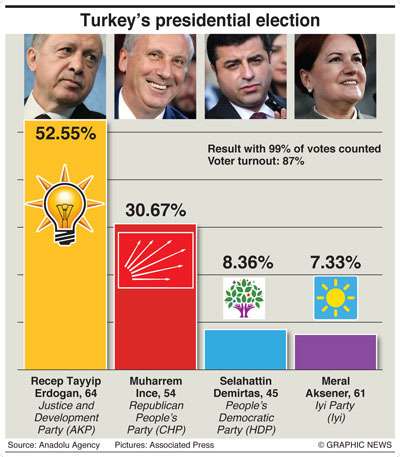
his party a majority in parliament. Although he won the presidential
election with 53 percent of the votes in the first round itself, his AK
Party (Justice and Development Party) suffered a 7 percent dent in
parliamentary polls held simultaneously. The party won only 43 percent
of the votes, securing 295 seats. However, the far-right Nationalist
Movement Party (MHP) has agreed to extend support and the two parties
add up to 343 seats in the 600-member assembly – yet 20 short of the 363
seat mark required to give legal effect to last year’s referendum.
Critics believe the Nationalist Party can act as a check against
Erdogan.
The results also show that Turkey is politically divided down the middle
– with one half endorsing Erdogan and the other half opposing him. In
another blow to Erdogan, the Kurdish political party, HDP, whose leader
has been jailed, crossed the ten percent cutoff point to win 67
parliamentary seats.
Under his 15-year-rule, the country’s economy grew significantly.
Critics say this was because he happened to be in office at the right
time when the coordinates necessary for economic growth were in place.
The US invasion of Iraq in 2003, the year in which Erdogan was ensconced
as prime minister, made Turkey a key supplier nation. Turkey won a
large number of contracts to rebuild war-ravaged Iraq’s infrastructure.
In 2017, when Saudi Arabia broke ties with Qatar and imposed an economic
blockade on the tiny but rich Gulf nation, Turkey stepped in to ensure
that Qatar did not suffer food shortages, thereby further straining ties
with Saudi Arabia and Egypt. Turkey and Qatar were supporters of
Egypt’s post-Arab Spring Brotherhood government, which the Saudis
together with US support subsequently ousted. Turkey’ economy has been
growing at a remarkable of 7.5 percent since Erdogan took office, though
its currency, lira, has suffered a 20 percent depreciation while
inflation has reached double digits and the current account runs a
deficit in what is seen as a major imbalance in the economy.If all
systems go, the 64-year-old Erdogan will be the president till 2028,
provided he wins the second term in five years’ time.
But the botched military coup on July 15, 2016 became a game changer
His reelection is crucial for the stability of the Middle Eastern
region. At a time when key Middle Eastern nations have muted their
support for the Palestinians in deference to US President Donald Trump’s
wishes and in view of their growing secret ties with Israel due to
their antagonism with Iran, Erdogan has emerged as a champion of
Palestinian rights. Many Muslims believe that he can fill the leadership
vacuum in the Muslim world.
Turkey is a key player in the Syrian war, too. Initially, it supported
the Saudi-Qatar moves to oust Syrian President Bashar al-Assad. Turkey,
which became a generous host to millions of Syrian refugees, turned a
blind eye when jihadists from all over the world used the country as a
transit base before they crossed into Syria. Many joined the ISIS and
other extremist groups.
By shooting down a Russian fighter jet in November 2015, Erdogan
displayed courage to take on Putin’s mighty Russia, which had militarily
intervened in the Syrian conflict to prop up the
Assad regime.
Assad regime.
But the botched military coup on July 15, 2016 became a game changer.
Erdogan was livid that the United States, whom he supported in the
Syrian war, had doubled crossed him and had a hand in the military coup.
The US has denied the charge. In a surprise turnaround, Erdogan visited
Russia and agreed to work with Moscow in finding a solution to the
Syrian conflict.
While Erdogan courted Russia’s friendship, the US established strategic
ties with the Syrian Kurds, whom Erdogan’s Turkey has branded terrorists
for their close links with Kurdish separatists in Turkey. This further
strained Ankara’s ties with Washington and other western nations. The
West has accused Erdogan of undermining democratic principles. Scores of
journalists are in jail for criticising Erdogan while tens of thousands
of public servants are in detention for being members of a banned
Islamic religious group led by Fethullah Gulen, a self-exiled scholar
living in Pennsylvania. Erdogan has accused the Gulen movement of
engineering the 2016 coup, a charge the group has denied.
Erdogan has scoffed at Western criticism. He no longer expresses desire
to seek the oft-rejected European Union membership. On the contrary, his
government is courting China for investments and trade.
Erdogan, an Islamist in secular Turkey, is now a virtual sultan -- an
Ottoman caliph sans its vast empire. His ambition is for Turkey to
reclaim its Ottoman heritage at least by 2023, the centenary of the
founding of modern Turkey by Mustafa Kemal Ataturk. But the question is:
can he achieve his dream, overcoming many economic and international
hurdles?
