Peace for the World World ! Your War Our Lives

The Dalai Lama
A Brief Colonial History Of Ceylon(SriLanka)
Sri Lanka: One Island Two Nations
A Brief Colonial History Of Ceylon(SriLanka)
Sri Lanka: One Island Two Nations
(Full Story)
Back to 500BC.

Sunday, August 12, 2018
Evolution of plantation sector into diversified, vertically-integrated, globally aligned, agri-biz
 Friday, 10 August 2018
From its inception up to the present day, the history of Sri Lanka’s
plantation industry has been unique; undergoing drastic changes from the
colonial era, to the period of private management by Agency Houses,
into an extended period of nationalisation and finally and most
drastically through the sustained transformations that the plantation
sector has undergone subsequent to the 1992 privatisation.
In order to truly appreciate the present circumstances and performance
of this industry and the role of the Regional Plantation Companies
(RPCs) in particular, it is vital to consider the development of our
industry as a whole.
Today’s international markets are changing at an increasing pace, while
the threat of climate change continues to cause varying disruptions to
agricultural productivity across the globe. At this crucial juncture, we
assert that our entire industry must be viewed in its totality in order
to ascertain the true reasons as to why Sri Lankan RPCs have achieved
such success across so many key areas today – from improvements in the
socio-economic conditions of its employees on the estates to substantial
improvements in quality control, management techniques and
infrastructure – in order to accurately ascertain what more is required
of each and every stakeholder group and to ensure commercial,
environmental and social sustainability for the Sri Lankan plantation
industry moving forward.
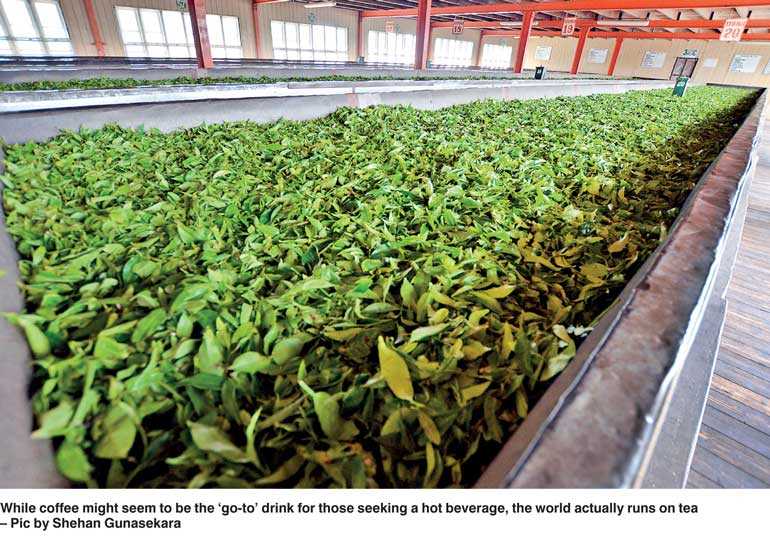
While coffee might seem to be the ‘go-to’ drink for those seeking a hot
beverage, the world actually runs on tea. Aside from water, tea is the
most popular beverage in the world and in the United States alone; tea
imports have risen over 400% since 1990. It would be futile if we don’t
capitalise on the trend and re-instate our position of being the number
one exporter in USD terms.
Colonial roots
Established in the era of British colonisation, Sri Lanka’s plantations
experienced a period of progress with the agrarian elite investing in
bank institutions, infrastructure, railways, credit expansion and
industrialisation. The money earned from tea and later rubber exports
was the essential capital that would bring about important changes in
the country’s society, economy and culture.
However, living and working conditions of the bonded estate labour was
not a consideration and the feudal hierarchy lorded over them ensuring
productivity, quality, and profit above all. Basic necessities like
healthcare, housing and education were limited to the basic
requirements. Plantations were run tightly, in order to maintain the
lowest cost of production and highest rates of productivity and soon
Ceylon tea began to be recognised and consumed the world over.
When Sri Lanka gained its independence, the management of the country’s
plantation industry was still retained in private companies known as
Rupee and Sterling companies. While the British no longer retained
sovereignty over the island, there was a substantial continuity in terms
of how the island’s plantations were operated and managed.
During the pre-nationalisation period, Agency Houses on behalf of them
managed approximately 134,000 hectares of tea alone with rubber
occupying 64,000 ha and coconut, 22,000 ha, all of which covered 8% of
the Country’s land with their continuing performance instrumental in the
preliminary establishment of Ceylon tea’s reputation for the highest
quality.
The nationalisation debacle
During the 1972–1973 periods, the Government of Sri Lanka nationalised
privately-owned estates, taking over some 502 privately-held tea, rubber
and coconut estates, due to socialist ideologies that led to major land
reforms, limiting the extents that could be privately held. In 1975 the
Rupee and Sterling companies were nationalised – with Agency Houses
continuing as trustees. Thereafter in 1976, these were turned over to
the two largest State-owned plantation agencies, namely: Janatha Estates
Development Board (JEDB) and State Plantations Corporation (SPC).
Several smaller entities such as Usawasama, Janawasa, were also created
and stacked with political appointees who mismanaged the estates to an
extreme point where they had to be shut down and land distributed for
village expansion. Pulling political strings was rampant, with totally
incapable, inexperienced managers hired.
Although socialist ideologies were being rammed into the system’s
administration, the plight of estate workers was yet to be factored in.
Rather, the debates surrounding nationalisation were almost purely
motivated by a desire to take control of significant profit generating
resources, ply it with political sycophants and distribute land in a
sweeping, authoritarian manner. Estates began to degenerate rapidly
under State management, while the numbers employed in these estates
ballooned in size with the country’s political class increasingly
viewing the sector as a job bank to purchase support each election
cycle.
This reality was plainly understood even at the time, as evidenced by
academic publications from the era. An excerpt from an American
publication in 1992 noted: “The privatisation initiative in the tea
sector as part of structural adjustment programmes advocated by the
World Bank and the International Monetary Fund (IMF) is intended to
balance the national budget by removing Government subsidies and
privatising State enterprises such as JEDB and SLSPC. Theoretically this
policy initiative may generate more efficiency and equity in the Sri
Lankan tea economy”.
“Public funds which were previously used in subsidising inefficient
bureaucratic agencies can now be reallocated for the purpose of much
needed infrastructure and human development programmes. Moreover, the
management of privatised entities may have the choice to operate free of
political interference and financial regulations of the Government.”
(Economic Rationale for the Privatisation of Tea Plantations in Sri
Lanka by Dr. Patrick Mendis, 1992)
All official records and high powered government committees have
confirmed that by the time the estates were handed over to the RPCs,
post privatisation in 1995 that “the State-run plantations continued to
make heavy losses and performed poorly throughout most of its
existence”.
Overstaffed, underperforming and riddled with debt that was ultimately
costing the Sri Lankan tax payer approximately Rs. 400 million per
month, there was only one lesson that ultimately came out of the 20
years of nationalised management of Sri Lanka’s plantation sector,
namely that politicisation breeds inefficiency, especially when mixed
with complex businesses. From this era the positive contributions that
did come about were the result of World Bank funding which was directed
towards much needed replanting, factory development and transport
vehicles.
By the time privatisation was completed in 1992, conditions on the
estates had reached their lowest point. Considering the continuous
losses and increasing debts of JEDB and SLSPC up to the time of RPC’s
and private management from 1992 onwards, it is very likely that they
would have continued to make losses and incur Government financial
support. If privatisation had not taken place, the Rs. 1.5 billion per
year financial support provided by the Government to the JEDB/SLSPC in
1992, would in today’s Rupee amount to almost 12 billion per year.
The political upheavals during the 1970s and 1980s were sharply felt by
estate communities and the plantation industry as a whole. Our industry
has endured through the severe weathering effects caused by the ensuing
conflicts including the 1970s and ’80s JVP insurgency when many young
college students were forced to take refuge in hill country estates.
This in turn resulted in the estates becoming easy targets for violent
police raids with estate management being hounded by the insurgents in
turn. The situation became grave when planting executives on duty were
brutally murdered in the remote plantations. Talented estate managers
migrated overseas with many of their competent peers leaving in disgust
at the senseless violence.
The conflict with the LTTE also took its toll on the industry and estate
communities with several thousand estate workers seeking refuge in
South India with racial discrimination levelled against them. The scars
of decades of ethnic conflicts are still clearly felt today,
contributing to the mass exodus of the more productive estate staff and
workers, leading to a depleted work-force, faced today.
Adapting on-the-go: The era of privatised management
Once the inability of the State to manage the plantations had finally
manifested, privatisation emerged as the only possible alternative to
the collapse of the industry and offer-for-sale documents were prepared
to serve as the legal foundation for privatisation. These documents,
executed by the State, provided each RPC complete freedom to use the
leased land for diversification into any other crop, extraction of
minerals, forestry and timber harvesting and setting up of any venture
permitted by law.
The overarching provisions and terms of these documents hinged on the
promise of complete autonomy for the private sector to manage their
plantations in the most efficient and productive ways possible and this
was the very reason for estates to attract strong interest, both locally
and internationally. Unfortunately for our industry, neither the offer
document nor the spirit of these initial agreements was respected by any
subsequent Governments. Such a resounding failure on the part of
successive Governments has been the source of continuous and severe
disruption to many development plans for RPCs.
The plantation companies were bequeathed a total land extent of 239,398
ha – comprising of 94,244 ha of tea land and 57,930 ha of rubber land at
the time of privatisation in 1992. In the 23 years since, politically
motivated acquisitions and illegal encroachment resulted in a 28.2%
reduction in the most productive land extents – including a 16.3%
reduction in tea land and a 25.8% reduction in rubber lands – shrinking
total RPC land extent down to 180,291 ha by 2016.
The main aim of privatisation was to improve the overall managerial
performance and in just over a quarter century later, the plantation
sector has showed drastic improvements across many indicators, be they
economic, social or environmental.
Significant investments were made by shareholders in the 1995/96
privatisation era, based on the several opportunities laid out in the
bid document. These included agri-diversification, forestry, the setting
up of hydro-power projects, and total autonomy on how the land should
be best utilised.
Post privatisation, salaries of estate staff increased with employees
confirming that there were more opportunities for promotions linked to
performance rather than political connections and influence. Previous
insecurities present in State-owned plantations, where political
affiliation and influence determined employee security, were tempered
down, as a performance-based culture was instilled by the new
management.
Weathering all storms and hurdles, along with ad-hoc policy decisions
detrimental to best agri-practices, the 2016 edition of world fact book
on exports and commodities, stated Sri Lanka as second in total USD
worth of exported tea, next to China. China at $ 1.5 billion commands
22.8% of total tea exports, Sri Lanka: $ 1.3 billion – 19.2%, Kenya:
$680.6 million at 10.4%, India: $ 661.7 million at 10.1% and United Arab
Emirates, the newest entrant that does not grow any tea: $ 287.9
million at 4.4%.
While Kenya has beaten Sri Lanka as the biggest tea exporter, Sri Lanka
continues to maintain its position as the world’s highest tea exports
revenue earner, losing its number one position to Kenya as the highest
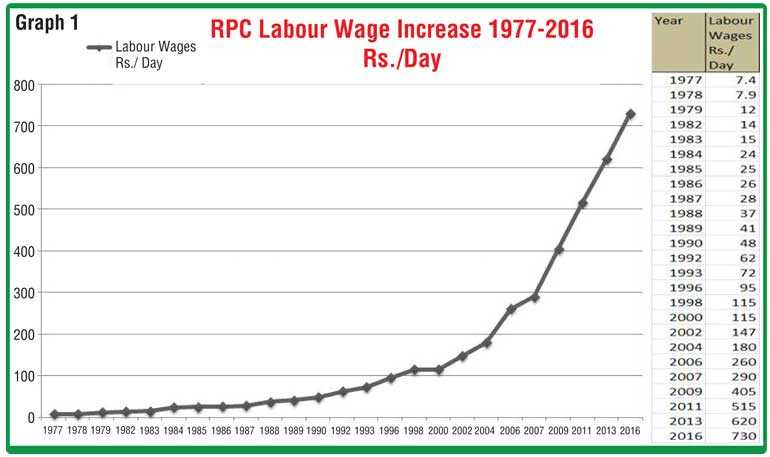
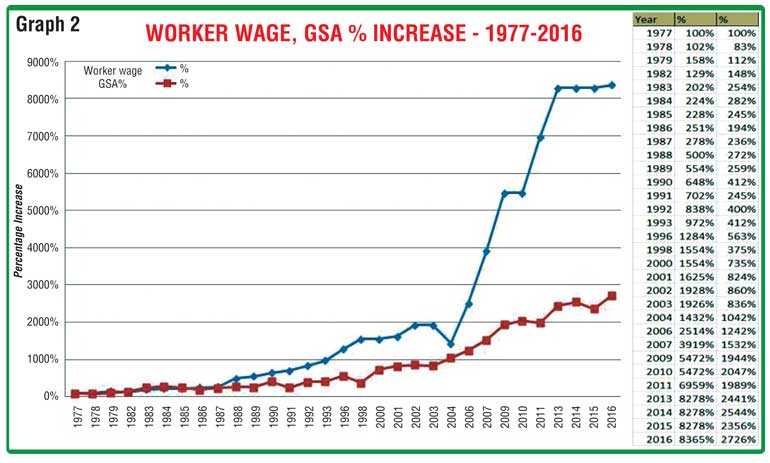
exporter in the world a few years ago. Notably, Sri Lanka also remains
as the most expensive tea producing nation in the world, with average
wages having steadily increased, at a rate higher than the General Sales
Average of Pure Ceylon Tea in international markets.
Facing severe encroachments, a shrinking labour force, and the
periodical obstacles created by Government policy interventions, RPC tea
production reduced to 72.9 million kg, but the yield per hectare
improved to 1,138 kg per ha in 2016, as compared with 1,021 kg per ha in
1992. However with another ad hoc decision of the Glyphosate ban since
March 2015 the YPH dropped to 900 by end March 2017.
At this point, it must be mentioned that the glyphosate ban, a decision
made on a whim, with no scientific evidence to justify such a drastic
action has caused a total colossal loss of Rs. 35 b to the industry
while the Country risks losing a longstanding, lucrative export market
in Japan.
Meanwhile, rubber YPH has recorded a sharp increase from 647.3 kg per ha
in 1992 to 862 kg per ha in 2016. Since 1992 the RPCs have replanted
vast extents, at times exceeding the average 3% replanting per annum.
 The
RPCs strategic forward planning saw the need for diversification within
a short period which prompted many RPCs to diversify in to another
major crop oil palm in the best suitable areas. Mitigating total
dependency on tea and rubber, factoring in shortage of workers was the
strategic decision for oil palm – justifiably so, given that the
financial performance of oil palm during the period 2013 to 2016, a
tenure in which both tea and rubber prices crashed. Oil palm companies
set up processing mills with their own funding which has saved the
national economy valuable foreign exchange by curtailing edible oil
importation.
The
RPCs strategic forward planning saw the need for diversification within
a short period which prompted many RPCs to diversify in to another
major crop oil palm in the best suitable areas. Mitigating total
dependency on tea and rubber, factoring in shortage of workers was the
strategic decision for oil palm – justifiably so, given that the
financial performance of oil palm during the period 2013 to 2016, a
tenure in which both tea and rubber prices crashed. Oil palm companies
set up processing mills with their own funding which has saved the
national economy valuable foreign exchange by curtailing edible oil
importation.
Today, it is the RPCs which are leading the charge on crop
diversification, with upwards of 2,300 hectares of RPC land now under
diversification on crops other than oil palm.
The oil palm plantation industry is also facing turmoil with a temporary
ban being enforced for the cultivation, based on emotional agitation by
some groups with vested interests, sharply interrupting an entire
development programme. Plants to the value of almost Rs. 400 m
propagated with imported seeds with the necessary government approval is
currently running the risk of being destroyed if they are not planted
at the correct time.
Large-scale diversifications of innovative crops include arecanut,
macadamia, pineapple, rambutan, soursop, lemon, oranges, papaya,
avocado, passion fruit, pears, and vanilla together with spices like
pepper, cloves, cardamom, and forestry initiatives from khaya, giant
bamboo and other fuel-wood plantations.
Meanwhile, the 36 State-managed estates which were also managed by the
same JEDB and SLSPC during the nationalised era remain a horrendous
burden on taxpayers, being in arrears of close to Rs. 3 billion on their
statutory dues of EPF, ETF and Gratuity and the Government continues to
subsidise them to the tune of Rs. 1.5 billion a year. Here, the State
has ample opportunity to turn its attention to the massive loss making
State-managed plantations and implement so called ‘alternative models’.
Government and stakeholders must clearly understand that plantations
cannot be managed in the historical manner given the current political,
environmental and economic issues and continue to be viable business
entities. Provisions for changes are available in the lease document and
RPCs must be given a free hand to exercise the rights without
interference and subsequent directives which interrupt the development
programmes. Each RPC has a business plan based on indicators such as
location of the plantations, crop mix, availability of workers and
several factors which are not common across all plantations.
In the spirit of a privatised plantation sector
RPCs have invested a cumulative Rs. 70 billion between 1992 and 2016,
contributing seven billion in lease rentals and a further 1.72 billion
in income tax, coupled with dividends to Sri Lankan shareholders,
totalling Rs. 8.17 billion, despite continuing challenges from
diminishing availability of labour, incessant increases in labour wages
not linked to productivity. The emergence of competitors like Kenya,
operating on significantly larger economies of scale to produce volumes
of tea, at drastically lower costs of production poses a big risk.
In addition to the clear superiority of RPC management in terms of
productivity, it has only been under our stewardship that more
uncompromising, environmental protection standards have been adopted.
These include Rainforest Alliance certifications secured only upon the
completion of a stringent process of auditing and the implementation of
extensive environmental safeguards. To date most RPCs have secured the
Green Frog seal of compliance propelling them to the prestigious Global
Sustainable Agriculture Network standard.
Similar efforts have been channelled towards forest conservation and
rehabilitation, with the majority of RPCs certified with the Forest
Stewardship Council. Membership requires organisations to develop
national forestry standards, localised to meet the unique requirements
of each natural habitat, as per global standards.
To-date RPCs have cultivated in excess of 20,000 ha of forestry.
We wish to recognise and thank the Governmental authorities for
commencement of guidelines towards a national policy for commercial
forestry, on a request by the Planters’ Association. Despite a five-year
forestry plan in place, a sudden ban, imposed five years ago on felling
timber which is grown for fuel wood, meant that estates had to
transport their requirement of fuel wood at an additional cost, causing
additional and unnecessary burden on the bottom-line.
At present, there are 688 International certifications for 297 RPC
factories including HACCP, ISO 22000, Fair Trade, Forest Stewardship
Certification (FSC) ISO 9000, Care Quality Commission (CQC), Ethical Tea
Partnership (ETP), UTZ, Rainforest Alliance (RA), Global GAP, SA etc.,
thereby ensuring the maintenance of extremely strict production and
processing standards that ensure the safety of consumers, workers and
the wider environment.
Furthermore, the ‘Ceylon Tea’ image and the branding of Food Factory
Concept, Chemical Free Tea, Cleanest Tea in the world, Ethically Managed
Plantations, Zero Child Employment, Ozone Friendly Tea, Sustainable
Agriculture, Product Traceability to Source and Single Origin Estate
Marks are predominantly RPC standards which is a huge plus for the image
of Ceylon Tea and its branding.
Other internationally-accepted certifications which entail rigorous
compliances with environmental, agricultural, economic and social
standards of conduct, obtained by RPCs include Good Manufacturing
Practices (GMP) for Rubber and Cinnamon processing, Global Organic Latex
Standard, for rubber ISO 9001:2008 Quality Management Systems
Certification, for Oil Palm & Fruits, while the Round Table on
Sustainable Palm Oil (RSPO) certification is work in progress.
To-date not a single estate worker has been laid off; instead, their
opportunities have increased with the productivity linked clause
attached to their daily wage. Living conditions have improved vastly
with two-bedroom houses with en-suite toilets built to replace the line
rooms. A total of 50,000 such homes have been built in an ongoing effort
for the 180,000 families that still live on RPC estates – all of whom
may not be actually working in the fields.
From schools to hospitals, crèches to retirement homes, ongoing welfare
activity to one-tenth of the country’s population is a priority of the
RPCs which constitute the Plantations Human Development Trust (PHDT)
along with trade unions and Government. Today an estate worker has the
ability to earn in excess of Rs. 25,000 per month, in addition to all
other infrastructure facilities provided by RPCs.
The true strengths of Sri Lanka’s plantation industry and their source
In light of these and many other achievements by the RPCs, standards of
Sri Lanka’s plantations have been elevated far beyond its difficult past
and therefore we assert that in truth, many of the strengths that
remain in our industry today are initiatives taken by the RPCs.
Environmental protection and quality standards have been implemented
across the RPC sectors, where none were in place before privatisation.
Our produce continues to fetch favourable – and often times record
breaking prices from international buyers.
To say that worker wages have been increased periodically is an
understatement. Wage increments have been awarded not commensurate with
productivity, politically prodded and not considering the
competitiveness of the company. Holding back wage increments was never
the RPC agenda; however linking it to productivity will be the future of
the plantation industry in Sri Lanka.
Despite constant politically motivated interference, many RPCs have
commenced investments into crop diversification in order to consolidate
revenue streams, even when various Governments have continued to
vacillate on vital policies such as the importation of seed material.
Meanwhile, important progress is being made to emulate the successful
examples of RPCs who have partnered with large conglomerates to enter
into value addition; something which did not exist during the time of
State management.
Diversification through tea tourism is hugely successful. These include
tea factory tours, hotels and niche luxury tea trails experiences
–attracting high-spending tourists from across the globe – helping to
further raise the profile of the island as a vibrant tourist
destination. Many others are working on investments into this sector
with the Planter’s Association committed to supporting the relentless
exploration of innovative diversifications.
Favourable policies that will look at the industry 50 years from now and
start sowing the seeds to propel it to a future-ready, economic power
base, is the need of the hour. As an industry we cannot afford any more
random ad-hoc policy decisions. Extending leases is an economic
imperative, given crop cycles of rubber and oil palm. RPCs must be
assured that leased land will not be annexed or encroached through
political heavy handedness.
Ultimately, the RPCs each need to be allowed to draw upon their precious
experience gained from the last quarter century of management, in a
rapidly changing environment, to autonomously decide on the best course
of action for each company, in alignment with a common ethic of
sustainable, profitable, diversified plantations.
(The writer is Chairman, Planters’ Association of Ceylon.)
