Peace for the World World ! Your War Our Lives

The Dalai Lama
A Brief Colonial History Of Ceylon(SriLanka)
Sri Lanka: One Island Two Nations
A Brief Colonial History Of Ceylon(SriLanka)
Sri Lanka: One Island Two Nations
(Full Story)
Back to 500BC.

Sunday, September 9, 2018
Chandra Jayaratne Wants Ranil To Act On Perpetual Treasuries


Chandra Jayaratne has requested Prime Minister Ranil Wickremesinghe to make good on commitments articulated to Parliament to take additional steps regarding the Treasury Bond scam in the interest of upholding the Rule of Law, justice and the promotion of anti-corruption action.
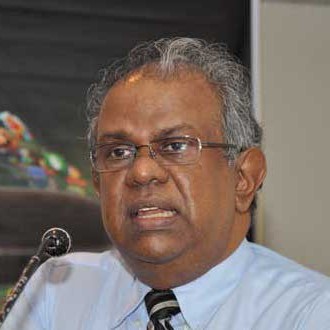
Chandra Jayaratne
Jayaratne claims on behalf of ‘the citizens’ that they (the citizens)
‘have noted with great satisfaction’ the commitments made in response to
a question raised by the Chief Opposition Whip, which he has detailed
as follows:
1. The Government had sought the Attorney General’s advice, as to
whether it can take over the Rs. 11 billion lying to the credit of the
Perpetual Treasuries Group in frozen accounts, without waiting till the
conclusion of the on-going case in the Colombo High Court; which is
purportedly more than the loss incurred due to the questionable Treasury
Bond issuance
2. The Attorney General and the Police are free to initiate action in the High Court upon the conclusion of the investigation
3. You will ask the Attorney General’s Department and the Bribery Commission to expedite and complete the investigations early;
4. All legal steps have been taken in bring the former Governor back to the Country; and
5. To inform you of anything else that needs to be done:
Jayaratne has requested that the following ‘action steps’ are initiated
immediately under the Prime Minister’s personal direction and oversight:
1. Instruct the Commissioner General of Inland Revenue, to initiate a
process to assess and recover the following taxes due, along with
applicable penalties due thereon, in the event it is determined that any
member of the Perpetual Treasuries Group of Companies have willfully
avoided and / or failed to return and settle the dues, arising from
engaging in business activities and “Acting As a Primary Dealers and or
Trading in Government Securities, Bonds etc”, and in respect of profits
made there from:
a. Income Tax
b. Financial VAT
c. Deemed Dividend Tax
(Opinions of two leading Tax Experts in above connection is annexed)
2. Insist that the Auditor General or a Competent Auditor selected by
the Auditor General, conducts a Forensic Audit and Transfer Pricing
Audit on the operations of any member of the Perpetual Treasuries Group
of Companies, which engaged in business activities as Primary Dealers,
and or Trading in Government Securities, Bonds etc during the financial
years 2015 and 2016, and the findings are transparently published and
provided to the Attorney Generals Department and the Bribery Commission.
3. Arrange for the Securities and Exchange Commission of Sri Lanka(SEC),
as well as any of the Professional Accountancy Bodies who are members
of IFAC (including CA Sri Lanka, CIMA Sri Lanka and ACCA Sri Lanka),the
Chartered Financial Analysts Sri Lanka, the Bar Association of Sri
Lanka, the Directors Institute and any Chambers of Commerce to assess
whether any entity or any Director, Officer or Manager or Employee of
the Perpetual Treasuries Group of Companies were also concurrently
members of the respective Professional bodies/associations and Chambers;
and were bound by Codes of Governance, or Professional Codes of Conduct
and Ethics; and if so require such Associations, professional bodies
and Chambers to carry out a review whether any of their members who were
in employment or acted in a professional capacity as Accountants,
Mangers, Lawyers, Investment Managers, Auditors, Consultants or Tax
Practitioners have violated the binding Professional Codes of Conduct
and Ethics and / or any Commitments arising from:
a. Non compliance with Laws and Regulations (NOCLAR) or
b. Any provisions of the Prevention of Money Laundering Act
and if so to compel them to institute relevant disciplinary hearings and
impose required sanctions where in default of applicable codes.
He has also opined that Perpetual Treasuries ‘seems to be treating the
gain as a capital gain’ and has detailed his views on the matter in
order ‘to clarify the legal position’ as follows:
1. It is clear that the fiscal concession conferred in respect of
interest received by section 32 (2) of the Inland Revenue Act, No 10 of
2006 (as amended), is confined to a “primary dealer” alone (within the
contemplation of the definition of the relevant term phrase as set out
in section 217 of the Act) who is engaged in a primary market
transaction.
2. The question that arises for consideration is whether a primary
dealer who purchases a relevant security, treasury bond or treasury bill
issued under the relevant empowering statutes in a primary market
transaction and retains such security or instrument until maturity or
for more than one day comes within the scope of the tax concession
conferred by section 32 (2).
3. The statutory provision makes it explicit that the fiscal concession
is confined to a primary dealer engaged in a primary market transaction
who holds the relevant security or instrument for no more than one day.
It is trite law that a transaction cannot be both a primary market
transaction and a secondary market transaction at the same time. It is
possible for a transaction to have that status on a consecutive basis
but the status cannot be concurrent.
4. The general rule of interpretation is that a statute is to be
construed, if possible, so as to give sense and meaning to every part.
The maxim expressio unius est exclusion alterius (which means the
express mention of one thing implies the exclusion of another) was never
more applicable than when applied to the interpretation of this
statute.
5. Francis Bennion in his well known work Bennion on Statutory
Interpretation [London: Lexis Nexis, 5th edn., 2008], at p. 1259,
commenting on the operation of the principle in specific statutory
contexts, states as follows:
Uncertainty in one part of a proposition may be resoved by implication
from what is said in another part, even though that other part is not
directly referring to the first part. Accordingly, account is to be
taken of a meaning of one provision in an Act that logically if
obliquely arises from what is said elsewhere in the Act. Equally, an
express statement in an enactment may carry oblique implications
respecting the legal meaning of other Acts, or of unenacted rules of
law.
Read More
