Peace for the World World ! Your War Our Lives

The Dalai Lama
A Brief Colonial History Of Ceylon(SriLanka)
Sri Lanka: One Island Two Nations
A Brief Colonial History Of Ceylon(SriLanka)
Sri Lanka: One Island Two Nations
(Full Story)
Back to 500BC.

Friday, September 28, 2018
Is it time for a rate cut?
 Friday, 28 September 2018
If you look at the successful economies of our region they have followed economic policies that are diametrically the opposite of what our nation state has followed. These economies had;
1. Low nominal interest rates
2. Competitive to slightly depreciated exchange rates
3. Low government deficits
By following these policies they were able to grow their exports and build prosperity.
We are unable to implement the preceding prescription as our Central
Bank more closely represent our political classes. Former governors and
governing hopefuls fill the paper with falsely-framed interpretations of
the facts and the current Governor says things that he lacks the
backbone to implement.
Monetary Policy Review no. 6 of 2018 is round the corner (2 October) and
it is strongly suggested that the Monetary Board unanimously consider
moving towards low nominal interest rates. Even a slight reduction would
be in the interests of the Central Bank.
 It
must be noted that the Central Bank is moving towards inflation
targeting when setting rates and the implementation is due early next
year but there is nothing like the present to implement a good idea.
What is being suggested would also help smoothen out the shock to the
reduction in rates brought about by switching to inflation targeting. So
why reduce rates now? Three reasons.
It
must be noted that the Central Bank is moving towards inflation
targeting when setting rates and the implementation is due early next
year but there is nothing like the present to implement a good idea.
What is being suggested would also help smoothen out the shock to the
reduction in rates brought about by switching to inflation targeting. So
why reduce rates now? Three reasons.
1. To be in line
with declining
long-term rates
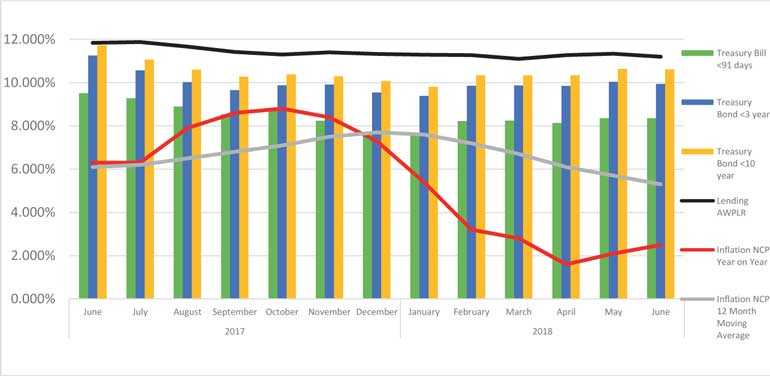
Rates, inflation, prime lending rates, and Government financing costs
are already on a declining long-term trajectory. Anyone saving for
retirement would be well served by buying out a mix of long-term rates
from the Government, a proxy State institution, or something too big to
fail.
Notably as a retail investor it is practically impossible to access the
Government debt markets. This is because of the lack of integration with
any accessible intermediary. More alarmingly, the DEX trading system
for corporate debt is also closed to retail investors. Atrad has the
inbuilt functionality to provide us access via their portal but have
been prevented by regulatory diktat.
Our Central Bank is often likened to the Catholic Church that prevented
people from engaging in finance. The structuring of the micro finance
bailout, wherein they guaranteed the return of the predatory lender,
would also suggest that they shared an anti-minority world view. There
is also no incentive to access the Government debt market as the
transmission of policy to the financial sector is very slow. That is to
say that lending institutions only amend their rates well after the
Central Bank has changed policy. Normal people do not hold Government
debt. It is a low-paying instrument. The institutions that hold
Government debt do so as they are required to do so by regulation. The
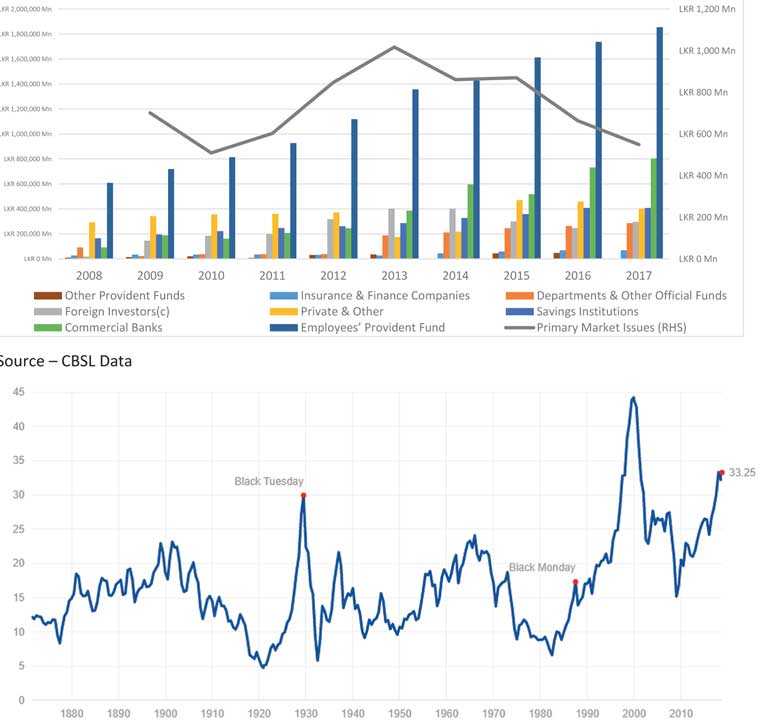
chart shows the holding of Government Treasury bonds.
As can be seen by the line graph the amount of Government issuance of
Treasury bonds is going down. This in conjunction with the amount of
funds that by regulatory decree have to hold government funds are
growing bigger. In my opinion this should then result in lower rates for
Government debt.
As there is little opportunity for me to share in the returns gained in
trading in this market I lack the drive to learn about it. The Central
Bank which recently claimed itself to be a knowledge society is actively
preventing me from seeking this knowledge. However as seen from the
data there has been a decline in rates.
2. Psychological
This rate announcement comes surrounding the buzz around the recent
decline the USD/LKR exchange rate. One must admit that certainty and
thereby confidence in the economy is slightly lacking. Many notable
economists argue that the Central Bank could have prevented a lot of
this speculation by offering government debt that guarantees a USD
computed return in locally denominated currency. That is to offer the
USD Treasury rate plus a risk premium paid in the equivalent LKR terms
made accessible to jittery exporters.
Though the Governor has done a commendable job in terms of communication
he must now also realise that his role is also motivational. The graph
tracks Robert Shiller’s PE ratio. Robert Shiller, of predicting the
housing bubble fame, now advises people to exit US equity markets as
they are overvalued.
It has never been a better time to invest in emerging markets as the
dollar is strong and those markets are currently highly undervalued.
People buy shares for their earnings and the US is currently very
expensive. Shiller argues that the growth in the US markets is due to
‘irrational exuberance’. This is driven by the Trump phenomenon.
Smart money would be leaving the US economy as we speak and Sri Lanka
should place itself to receive US funds when this madness eventually
crashes but in the meantime it would be beneficial to maintain some
level of stability. In this regard as Indrajit lacks the charisma to be a
motivational speaker, he could use interest rate movements to signal
confidence in the currency.
3. Because I said so
Both the Prime Minister and Mangala Samaraweera have publicly called for
a reduction in interest rates. Members of the Monetary Board would be
well served by heeding this call. Rates are invariably going to be lower
when targeting inflation becomes the objective of monetary policy and
the Central Bank has quite unequivocally stated that this will be coming
in early next year.
Rumour has it that the current Governor is not in good favour with the
two powerful green members and this would be an easy olive branch to
offer.
