Waves
of asylum seekers emerging from conflict zones in Myanmar, Syria,
Sudan, Iraq, Yemen and elsewhere are expected to add more than one
million people to global resettlement needs this year.
As concerned researchers, we are interested in how information technologies could help refugees resettle. Our work with organisations assisting refugees has shown that having access to timely information about Australian life is essential.
We’re in the early stages of building an ecosystem of digital services
that aggregates and delivers this kind of information to refugees – and
to the organisations involved in supporting, employing, educating and
caring for them. To guide our work, and avoid reinventing the wheel,
we’ve looked at comparable experiences in Germany, which has a high intake of refugees.
Information chaos
In Germany, there are a number of national and international agencies
that provide assistance for refugees, each with regulations and
responsibilities that differ from region to region. Accessing basic
services, such as the internet, money transfer, health care and
schooling, presents a new challenge to already traumatised people.
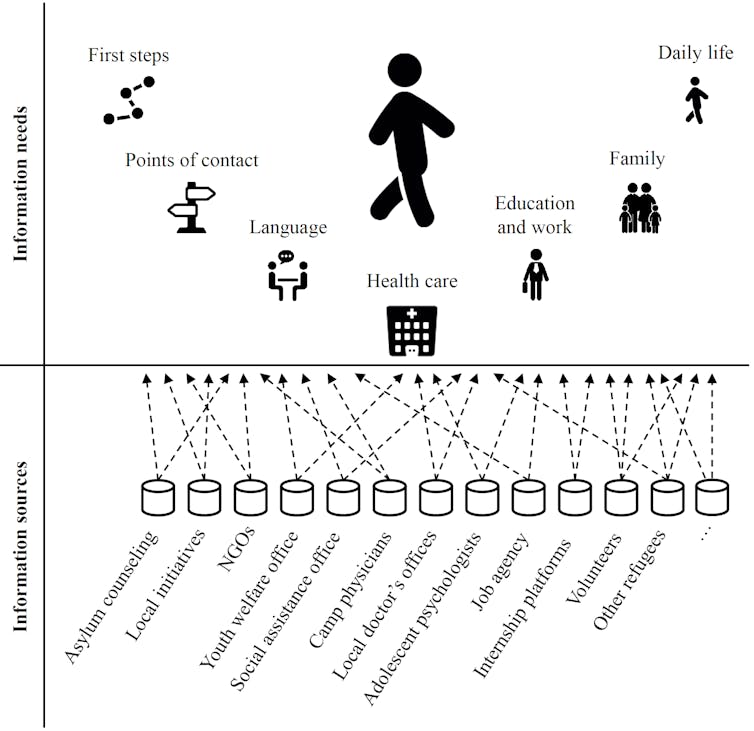
The information refugees need is distributed among asylum
counsellors, social assistance offices, youth welfare offices, local
non-government organisations, volunteers and more. In some cases, this
information is quickly outdated.
Getting access to the right information in a timely manner is difficult
given the multitude of information sources, language barriers and
geographical complications. This situation encourages new refugees to
seek information from those who have arrived earlier, leading to the
spread of outdated or misinterpreted information.
Going mobile
One difference between this refugee crisis compared to earlier ones is
the ubiquity of information technology. Because the overwhelming
majority of refugees have access to smartphones, a number of mobile initiatives have emerged to provide support.
Hackathon volunteers in Germany built a mobile guide for refugees called Moin, as well as a tool that helps refugees with administrative processes called bureaucrazy.
Unfortunately, these apps required volunteers to keep the information
up to date, which was challenging over an extended period.
Still, some initiatives have produced sustainable outcomes by
eliminating the need for third-party updates. Instead, these apps allow
information providers to update information themselves.
For example, the Integreat project
is a mobile application for refugees living in a particular German
municipality. It provides information on the asylum process, local
points of contact and aspects of daily life. The municipality and local
NGOs maintain Integreat’s information through a content management
system accessible via web browsers.
The platform’s design means it can easily be extended to other
municipalities, which can mirror existing content and reuse translations
into different languages. This further reduces the effort required to
gather and maintain relevant information, providing a helpful addition
to asylum programs.
Housing and employment matchmaking
While applications such as Integreat can help refugees during their
first few months in the host country, things get more complicated when
refugees try to relocate to permanent housing.
In Germany, language barriers, high demand for apartments among locals
and resistance from some property owners who don’t want to rent to
refugees has made finding accommodation a significant problem. Some
German municipalities invested a substantial effort to house refugees by
contacting landlords directly.
In some cases property owners would like to support refugees, but they
do not know how to approach them. A digital platform that connects
property owners and refugees, such as the Berlin-based digital platform Flüchtlinge-Willkommen (Refugees Welcome), could help alleviate such problems.
Similar matchmaking services have been built to match German employers
who have difficulty finding qualified employees with refugees who are
looking for work. Workeer is available in Germany, and refugeetalent is a similar initiative operating in Australia.
But matchmaking is only one side of the story. German and Australian
labour regulations limit the options for refugees, who might not be
legally eligible to work straight away or hold qualifications that
aren’t recognised in their new homeland. So digital platforms should
also offer information for employers and refugees on labour regulations,
vocational training and how to transfer qualifications.
What else can be done?
Everyone can help contribute to refugee resettlement solutions. Our work suggests the following actions would be helpful:
governments should allocate more funding for IT projects that support the resettlement of refugees
researchers, organisations and volunteers should collaborate to create
an ecosystem of digital services that connect and improve current
solutions
information systems researchers should evaluate the impact of proposed
solutions. The benefits of new technologies such as blockchain or
machine learning, for example, could be evaluated with little risk
universities should engage with nonprofit refugee organisations to
create opportunities for refugees who want to further their studies or
skills
companies – particularly those in the IT industry – should engage in IT projects that support refugees, such as the Handbook Germany, which was initiated by German telecommunications company Deutsche Telekom.
We take inspiration from stories like what happened in Eltham.
In this Melbourne suburb, residents welcomed the arrival of Syrian
refugees and supported them in settling into a different culture,
getting a job and learning English.
In doing so, Eltham’s residents created a positive experience for both
the refugees and the Eltham community. There is room for hope in our
humanitarian responses and we believe we can and should do more.




 Waves
of asylum seekers emerging from conflict zones in Myanmar, Syria,
Sudan, Iraq, Yemen and elsewhere are expected to add more than one
million people to global resettlement needs this year.
Waves
of asylum seekers emerging from conflict zones in Myanmar, Syria,
Sudan, Iraq, Yemen and elsewhere are expected to add more than one
million people to global resettlement needs this year.