Peace for the World World ! Your War Our Lives

The Dalai Lama
A Brief Colonial History Of Ceylon(SriLanka)
Sri Lanka: One Island Two Nations
A Brief Colonial History Of Ceylon(SriLanka)
Sri Lanka: One Island Two Nations
(Full Story)
Back to 500BC.

Thursday, September 27, 2018
R. Panuthevan – An Intellectual, St. John’s College Jaffna Was Blessed With
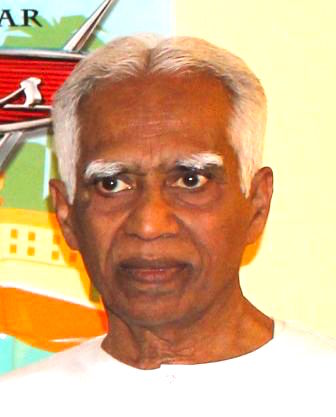
R. Panuthevan

S. Sivathasan
 An
arts graduate of the highest caliber, Panuthevan Master as we called
him, joined the teaching staff of our College in 1954 at the tender age
of not even two months past 21 years. An old pupil of Central College
Jaffna – the oldest Mission School in the country (202 years now) – and a
product of the Jennings era at Peradeniya University, he made his mark
instantly. It did not take even two weeks for his reputation to spread
to the whole College, evoking admiration from the student community. As
students we were keen observers, sharp in our judgement and accurate in
our assessment. His work was confined to SSC and University Entrance
classes. His favourite subjects were, History, Civics, Tamil and
Government. His proficiency in both English and Tamil, making for an
easy flow of words, made the young yearn to be his students.
An
arts graduate of the highest caliber, Panuthevan Master as we called
him, joined the teaching staff of our College in 1954 at the tender age
of not even two months past 21 years. An old pupil of Central College
Jaffna – the oldest Mission School in the country (202 years now) – and a
product of the Jennings era at Peradeniya University, he made his mark
instantly. It did not take even two weeks for his reputation to spread
to the whole College, evoking admiration from the student community. As
students we were keen observers, sharp in our judgement and accurate in
our assessment. His work was confined to SSC and University Entrance
classes. His favourite subjects were, History, Civics, Tamil and
Government. His proficiency in both English and Tamil, making for an
easy flow of words, made the young yearn to be his students.
In the fifties, the College had developed a name for science studies.
The Principal Rev. JT Arulanantham with his farsightedness, placing
emphasis on science built up a fine staff – local best and Kerala talent
– to develop the human resources. He supported it with well-equipped
labs and lecture theatres in an aesthetically pleasing complex.
Education received the expected fillip. Stunning results had an electric
effect in the North.
The arts stream had its experienced and competent staff. Even so a
Panuthevan was needed to complement the ensemble. Producing brilliant
results was the target and it came about from the late fifties.
Admission to the University was in fair numbers. More striking was
selection at competitive examinations to the Administrative and other
Services. This was a tribute to the teachers and Mr. Panuthevan like all
others declined to acknowledge the honour. To go in for high tribute,
quite a few were more than deserving. Then how does one single out a
particular teacher.
R. Panuthevan
The photo that portrays him may depict an image of great simplicity or
of careless civility. But behind it is a man of sterling worth, of
unimpeachable character, of steadfast principles and of great ways
inside out. Rousseau in his inimitable style said “Richness in apparel
may proclaim the man of fortune and elegance the man of taste, but true
health and manliness are known by different signs”. A Tamil poem said it
1,600 years earlier. It is the feeling of goodness at heart with mental
poise to match, that is real beauty. The measure of his caliber was in
his objective presentations. Hence my frequent visits to his home for
lengthy discussions, till I entered public service. Needless to say, I
profited a great deal.
To this writer, it was his intellectuality that lay at the fount of his
knowledge. Though excellently endowed to develop his versatility of
interests, and even as he made the best use of the enticing volumes at
college, neither the country nor its economy provided quite an enabling
environment. Yet he made finest use of limited resources to cast out our
sentimental propensities and mental cobwebs. With minds well prepared,
he stretched our imagination, made it fertile and promoted
detached and rational thinking. For our benefit he made the best use of
the college library and more than supplemented it with the excellent
resources of the Jaffna Public Library.
Teaching apart, broadening our horizons was his primary concern. Both in
class as well as in the Hall talks, he dwelt at length on the
significance of the Bandung Conference in February 1955. An event that
might have bypassed us unnoticed. For two weeks it was said that Bandung
became the capital of Afro – Asian nations. The seed was planted for
the beginning of Non – Aligned solidarity and the growth of the emergent
countries. It was in the nature of international relations that after
the end of the cold war, non – alignment lost its rationale for its
existence. Some of us saw it well ahead on account of the clear
understanding we had had.
On account of the best mentor for the subject of Government, we
imperceptibly made it our favourite subject. He took us through the best
of thinkers and writers like Harold Laski, CF Strong, Sir Ivor
Jennings, Professor I D S Weerawardena and for Ceylon History Dr. Colvin
R de Silva. We were battered at that time by the emotionally charged
issue of Sinhala Only. When Prof. Suntharalingam threatened to meet the
Queen for her intervention to forestall Sinhala Only, our teacher quoted
the relevant sections of the constitution and showed the untrammeled
power the nation had. So with wishful thinking regarding the bases of
Trincomalee and Katunayake.
