Peace for the World World ! Your War Our Lives

The Dalai Lama
A Brief Colonial History Of Ceylon(SriLanka)
Sri Lanka: One Island Two Nations
A Brief Colonial History Of Ceylon(SriLanka)
Sri Lanka: One Island Two Nations
(Full Story)
Back to 500BC.

Monday, September 24, 2018
Rajani’s Questions The Tamil Elite Have Refused To Answer
Dr. Rajan Hoole
 Rains
and early gloom harbinger the dying year. Fields are ploughed and sown
in readiness for the earth’s renewal and the yield of her bounty. It was
at such a time that Rajani Thiranagama was
killed by the LTTE twenty-nine years ago. Her questions and aphorisms
often challenged our assumptions at their core. The following Appeal
authored by her in October 1988 appeared in Laying Aside Illusions signed by 50 academics in the common room of the University of Jaffna:
Rains
and early gloom harbinger the dying year. Fields are ploughed and sown
in readiness for the earth’s renewal and the yield of her bounty. It was
at such a time that Rajani Thiranagama was
killed by the LTTE twenty-nine years ago. Her questions and aphorisms
often challenged our assumptions at their core. The following Appeal
authored by her in October 1988 appeared in Laying Aside Illusions signed by 50 academics in the common room of the University of Jaffna:
“We have to examine not only our relations with the Indian and Sri
Lankan States, but also ourselves. Our obeisance to terror within the
community, our opportunism and lack of principles in the face of many
internal killings, have made it easy for external forces to use the same
weapons to control us. In the face of our acquiescence to
anti-democratic tendencies within the community, our plea for democracy
becomes a meaningless exercise. Many individuals and young persons who
voiced criticism of the political forces have been victimised, driven
away, or killed while we looked on.”
Displayed in that very common room are photographs of our late academics
since the inception of the University. The exclusion of Rajani’s
picture has been commented upon by visitors for many years. The
university authorities in 2014 (I think in retrospect it is wrong to
single out the Vice Chancellor) blocked the observance of the 25th Anniversary
of her murder while in harness. Her conducting examinations to a
timetable made it easy for the killers to plan her murder.
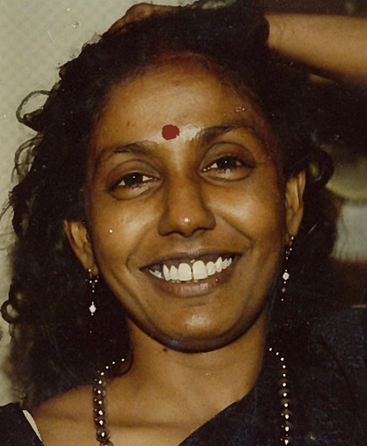
Rajani
A short stroll away from the common room, the 31st Anniversary
of the LTTE’s Thileepan, whose ‘Gandhian’ fast to death under duress,
to enable the Leader to snatch a political prize, was, this fall,
celebrated as act of martyrdom in a grand ceremony; where the Vice
Chancellor gave the lead. A few days later the installation of a
monument to the LTTE-inaugurated ‘Tamils Arise’ (Pongu Thamil), was
likewise graced by senior university officials.
The result is surreal. These proceedings take place under the tolerant
eye of the Sri Lankan security forces, the same forces that in 2014
stopped the Medical Students Union’s commemoration of Rajani by issuing a
threat to the Dean by phone.
The same university officials, who are prominent at current ceremonies
glorifying the brutal extreme of Tamil Nationalism, put on a different
face when dealing with the powers that be in Colombo, by whose tolerance
the University continues its course of congenial decay. Its keeping out
well qualified academics in order to reinforce a closed tradition of
mediocrity, is in keeping with Pongu Thamil and its cult of heroism by
which the most intimate and poignant aspects of our history have been
reduced to gossip. That is one reason why Rajani is anathema.
As a medical doctor in 1982, when hardly anyone else was willing, Rajani
readily went in the night to nurse and save the life of Seelan, a
favourite of the LTTE leader, who suffered an accidental gunshot injury
(see Palmyra Fallen). About two years later in England, she learnt of
the internal brutality and intolerance of the movement, and how Seelan
was driven to harbour a death-wish, bitterly regretting his actions: In
particular his murder of PLOTE’s Sundaram (‘who was a freedom fighter
like me’) at the Leader’s behest. Seelan had remained in a marked camp
in Themaratchy despite urgent entreaties to vacate and was ambushed by
the Army in July 1983.
