Peace for the World World ! Your War Our Lives

The Dalai Lama
A Brief Colonial History Of Ceylon(SriLanka)
Sri Lanka: One Island Two Nations
A Brief Colonial History Of Ceylon(SriLanka)
Sri Lanka: One Island Two Nations
(Full Story)
Back to 500BC.

Tuesday, September 18, 2018
SL’s Indian Ocean Diplomacy amidst shifting power alignments
 m
m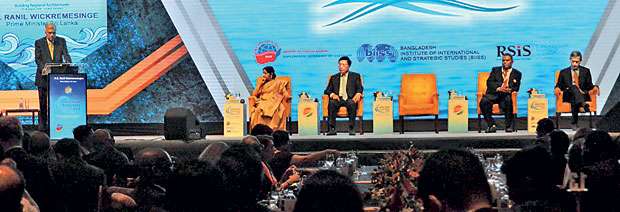
Premier Ranil Wickremesinghe addresses at the Inaugural Session of the Indian Ocean Conference 2018 in Hanoi, Vietnam
 2018-09-17
 The
Indian Ocean has been the focus of frequent and intense diplomatic
activity in the past few years. These interactions have had a regional
character, while the involvement of external players in the discussions
has also been notable. These developments, while they highlight the
centrality of the Indian Ocean to big power competition in an evolving
multi-polar world, at the same time demand critical appraisal. Smaller
players like Sri Lanka especially need to be mindful of who’s setting
the agenda at these deliberations, and alert to the ever-shifting power
equations between and among the big players.
The
Indian Ocean has been the focus of frequent and intense diplomatic
activity in the past few years. These interactions have had a regional
character, while the involvement of external players in the discussions
has also been notable. These developments, while they highlight the
centrality of the Indian Ocean to big power competition in an evolving
multi-polar world, at the same time demand critical appraisal. Smaller
players like Sri Lanka especially need to be mindful of who’s setting
the agenda at these deliberations, and alert to the ever-shifting power
equations between and among the big players. "US foreign policy particularly under the Trump administration is rooted in the idea of US ‘exceptionalism’ – which it uses to bully the rest of the world into compliance with its wishes, using the threat of sanctions"
With its pivotal geographical location in the Indian Ocean, Sri Lanka
has naturally been an active participant in these forums. Prime Minister
Ranil Wickremesinghe has addressed three Indian Ocean Conferences
(IOCs) – in Singapore (2016), Sri Lanka (2017) and Vietnam (2018) and
this month participated in a panel discussion of the World Economic
Forum on ASEAN, again in Vietnam, where he spoke on ‘Asia’s geopolitical
outlook.’
The Prime Minister in his speeches at the three IOCs has, to his credit,
adopted a somewhat independent stance rather than uncritically ‘toeing
the line’ of any big power. Although he supports ‘freedom of navigation
and overflight’ – which is the rallying call of the US, endorsed by its
allies in the face of ever-growing Chinese maritime influence -
Wickremesinghe has consistently made a case for the littoral states to
play a more assertive role in setting the rules. “The littorals, by
geographic design, are integral partners in this process” he said at the
conference on ‘Building regional architectures’ in Ha Noi last month.
Another consistent thread in his presentations has been his questioning
of the concept of ‘Indo-Pacific,’ a US creation. He asserts that the
Indian Ocean and the Pacific Ocean are distinct entities. India too has
been careful in its use of terminology in this respect.
At the inaugural IOC in Singapore (2016), PM Wickremesinghe called for
“an inclusive, multilateral strategic security order” warning that there
will be “resistance to any country unilaterally trying to shape the
strategic order of the region.” He further said “This order should be
built on a consensual agreement and no singular state should dominate
the system.”
"The US has been strengthening naval ties with strategically located states, encouraging its allies to do likewise (joint exercises of the ‘Quad’ for example), renaming the Pacific Command as ‘Indo Pacific Command,’ etc.,"
The question for analysts would be how the PM proposes to reconcile the
laudable goal of a democratic, consensus-based order, with the hegemonic
stance adopted by the world’s superpower. US foreign policy
particularly under the Trump administration is rooted in the idea of US
‘exceptionalism’ – which it uses to bully the rest of the world into
compliance with its wishes, using the threat of sanctions. This
belligerent approach is most apparent in its policies towards Russia and
China. In a statement last month to the Senate Foreign Relations
Committee on the subject of ‘US strategy towards the Russian
Federation,’ Assistant Secretary for European and Eurasian Affairs Wess
Mitchell is reported as saying:
“Russia and China are serious competitors that are building up the
material and ideological wherewithal to contest U.S. primacy and
leadership in the 21st Century. It continues to be among the foremost
national security interests of the United States to prevent the
domination of the Eurasian landmass by hostile powers.”
Last year, former Secretary of State Rex Tillerson in a speech in Washington named China as the cause for the US’s intensified interest in the Indian Ocean, and as the reason for its deepening defence ties with India.
Last year, former Secretary of State Rex Tillerson in a speech in Washington named China as the cause for the US’s intensified interest in the Indian Ocean, and as the reason for its deepening defence ties with India.
‘Joining’ the Indian and Pacific Oceans at the conceptual level by using
‘Indo-Pacific’ terminology is but one of the devices serving US
strategic interests in the IOR. The US has been strengthening naval ties
with strategically located states, encouraging its allies to do
likewise (joint exercises of the ‘Quad’ for example), renaming the
Pacific Command as ‘Indo Pacific Command,’ etc., etc. But the littorals
of the Indian Ocean would not want to be bullied by the US any more than
the littorals of the South China Sea resent being bullied by China.
"At the inaugural IOC in Singapore (2016), PM Wickremesinghe called for “an inclusive, multilateral strategic security order” warning that there will be “resistance to any country unilaterally trying to shape the strategic order of the region"
India-US strategic ties got a boost recently when the inaugural round of
talks among their respective ministers of defence and foreign affairs
(dubbed ‘2 + 2 talks’) culminated with a defence agreement in Delhi,
hailed as a breakthrough by both parties. The COMCASA (Communications
Compatibility and Security Agreement) signed after years of negotiation
on Sept. 6 would align India’s military communications systems with
those of the US and facilitate ‘interoperability’ between their forces,
according to reports. It is the second of three ‘foundational
agreements’ the US expects to conclude with India, designated a ‘major
defence partner’ of the US.
What is interesting is that the agreement was signed in spite of India having gone ahead with its deal with Russia to purchase S-400 missiles, according to reports, in defiance of US sanctions under a recent US law designed to punish third parties having dealings with its adversaries. Under the ‘Countering America’s Adversaries Through Sanctions Act’ (CAATSA) as it is called, the US would impose penalties on countries buying oil from Iran or having military transactions with Russia. This refusal to submit to US pressure has been praised by Indian analysts, who feared India’s foreign policy was tilting too much towards the US. The US would now have to find ways of granting India a waiver of sanctions, it would seem.
What is interesting is that the agreement was signed in spite of India having gone ahead with its deal with Russia to purchase S-400 missiles, according to reports, in defiance of US sanctions under a recent US law designed to punish third parties having dealings with its adversaries. Under the ‘Countering America’s Adversaries Through Sanctions Act’ (CAATSA) as it is called, the US would impose penalties on countries buying oil from Iran or having military transactions with Russia. This refusal to submit to US pressure has been praised by Indian analysts, who feared India’s foreign policy was tilting too much towards the US. The US would now have to find ways of granting India a waiver of sanctions, it would seem.
"The littorals of the Indian Ocean would not want to be bullied by the US any more than the littorals of the South China Sea resent being bullied by China"
“.. the CAATSA provides an underpinning for the US’ global hegemony,
which is far beyond its stated purpose of sanctioning Russia over the
Crimea” wrote Melkulangara Bhadrakumar, commenting on the COMCASA on
‘Strategic Culture Foundation’ website. “Simply put, without India
realizing it, a point will be reached when it gets “locked in” and
becomes an ally of the US, playing second fiddle to Washington in its
Indo-Pacific strategies” he warned.
Indian Analysts have also noted that PM Modi’s policy towards China has become more nuanced, particularly since his informal and cordial April summit with China’s President Xi Jinping in Wuhan. Senior Analyst at the IDSA (Institute for Defence Studies and Analysis) P. Stobdan referring to Modi’s keynote speech at the Shangri La dialogue in June noted that his remarks “seemed a calibrated move to prevent India falling into a dangerous geopolitical trap vis-à-vis US, Russia and China.” He said the speech was ‘welcomed by everyone including China.”
Indian Analysts have also noted that PM Modi’s policy towards China has become more nuanced, particularly since his informal and cordial April summit with China’s President Xi Jinping in Wuhan. Senior Analyst at the IDSA (Institute for Defence Studies and Analysis) P. Stobdan referring to Modi’s keynote speech at the Shangri La dialogue in June noted that his remarks “seemed a calibrated move to prevent India falling into a dangerous geopolitical trap vis-à-vis US, Russia and China.” He said the speech was ‘welcomed by everyone including China.”
"Indian Analysts have also noted that PM Modi’s policy towards China has become more nuanced, particularly since his informal and cordial April summit with China’s President Xi Jinping in Wuhan"
In Ha Noi last week, responding to a question from Indian defence
analyst Nitin Gokhale on the ‘new Indo-Pacific structure,’ PM
Wickremesinghe reportedly said “We are Asian so we have a common
identity, but I think the distinct nature of the Indian Ocean and the
geo-politics of this ocean must function as it is and you can’t use the
Pacific issues to cover the Indian Ocean issues. But together we can all
work for a stable order and to ensure freedom of navigation.” It
remains to be seen whether his optimism was warranted.
