Peace for the World World ! Your War Our Lives

The Dalai Lama
A Brief Colonial History Of Ceylon(SriLanka)
Sri Lanka: One Island Two Nations
A Brief Colonial History Of Ceylon(SriLanka)
Sri Lanka: One Island Two Nations
(Full Story)
Back to 500BC.

Sunday, September 16, 2018
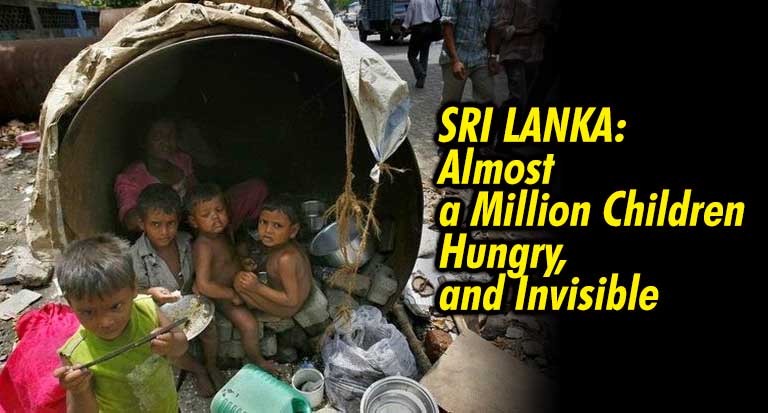
SRI LANKA: Almost a Million Children Hungry, and Invisible
 (Lanka
e News - 13.Sep.2018, 7.35PM) Sri Lanka repeatedly tops the ranks in
South Asia when it comes to hunger. It in fact has mostly sat with the
much better doings middle-income countries in global hunger indexes. Not
any more despite the fact that it was found to be the most food-safe
country in South Asia in the 2017 Global Hunger Index (GHI) by the
International Food Policy Research Institute. It also performed well on
several indicators like affordability (54.8), availability (52.8) and
quality and safety (49.5).
(Lanka
e News - 13.Sep.2018, 7.35PM) Sri Lanka repeatedly tops the ranks in
South Asia when it comes to hunger. It in fact has mostly sat with the
much better doings middle-income countries in global hunger indexes. Not
any more despite the fact that it was found to be the most food-safe
country in South Asia in the 2017 Global Hunger Index (GHI) by the
International Food Policy Research Institute. It also performed well on
several indicators like affordability (54.8), availability (52.8) and
quality and safety (49.5).
The rosy picture ends there. The same GHI also found alarming rates of
WASTING among the children of the country. With 14.7 percent of the
country’s children stunted and 21.4% of children under 5 years already
wasted, Sri Lanka finds itself among only four countries in the world to
have every fifth child of the country wasted! The other countries with
over 20 percent wasting rates are India, Djibouti and South Sudan.
The country has not only seen its hunger level stagnating at 25.5
percent in 2017 as it was in 2016; it has also seen a rapid rise in
prevalence of wasting among its children. Over the five-year period
2012-2016, the prevalence of wasting in Sri Lankan children under five
years has increased to 21.4 percent, as against only 13.3 percent in
2006-2010.
So how can Sri Lanka be both food secure and have such wasting rates at
the same time? How can it be performing so well on affordability and
availability of food and still let so many children fall through the
safety net into chronic malnutrition and wasting?
Further exploration into the data complicates the picture even more. The
paradox of food security in the face of such high figures of wasting is
further evidenced by the poverty profile of the country. So many
children seem to go to sleep with empty stomachs despite the country
doing much better than its neighbours even on poverty estimates! The Sri
Lankan government listed only 4.1 percent, or 843,913 people as poor in
2016, down from 6.7 percent in 2012/13. India, the only other country
in the region with wasting among children over 20 percent for
comparison, still has 21.92% of its total population officially living
in poverty.
Further, translating the data into numbers brings out even stranger
facts. Let us change the percentage points into real numbers for
instance: at 14.7 percent a total of 256,000 children are stunted, at 21
percent 373,000 children are wasted. Now the question becomes, are
these children counted among the official poverty estimates? Are they, a
total 629,000 children, included in those 843,913 people Sri Lanka
officially recognises as poor? If NO, why not? If YES, what about their
parents? And WHO are the poor then...
Further, though one still struggles with data, the demography of hunger
in the country suggests it to be widespread and not confined to remote,
underdeveloped parts of the country. Wasting among children in Colombo,
for instance, is still a high 12 percent, down only one percentage point
from 2006.
The relapse of high levels of wasting and malnutrition in Sri Lanka, a
country which has made spectacular achievements in snatching its
population away from hunger is particularly worrisome. It is time for
the Authorities to wake up and pull their act together, before it
becomes totally unmanageable.
A Statement by the Asian Human Rights Commission
---------------------------
by (2018-09-13 14:15:08)
by (2018-09-13 14:15:08)
