Peace for the World World ! Your War Our Lives

The Dalai Lama
A Brief Colonial History Of Ceylon(SriLanka)
Sri Lanka: One Island Two Nations
A Brief Colonial History Of Ceylon(SriLanka)
Sri Lanka: One Island Two Nations
(Full Story)
Back to 500BC.

Friday, September 28, 2018
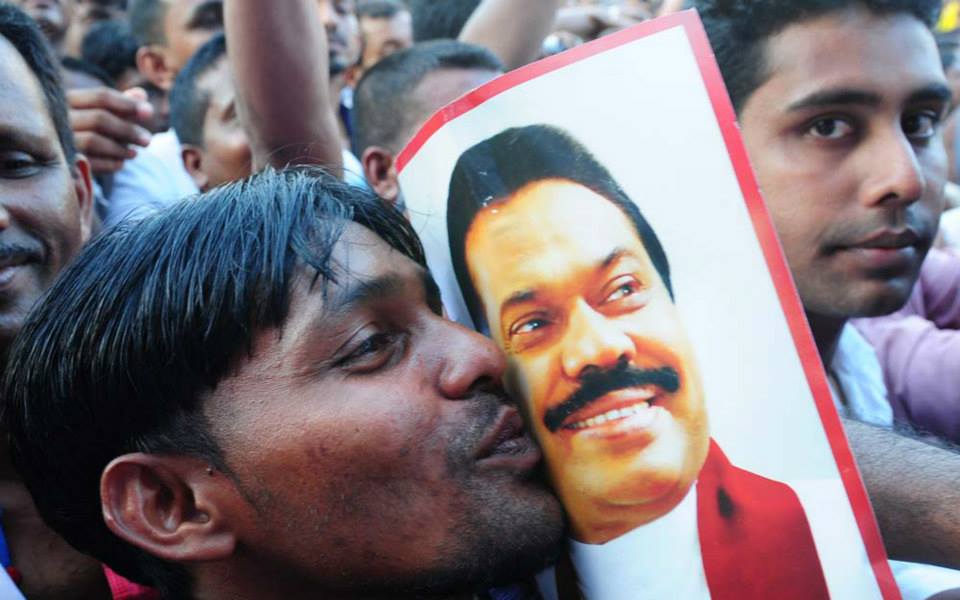
Theoretical Model Of Rajapaksa Populism By Kumar David: Critical Commentary

Dr. Siri Gamage
 Kumar David’s delineation of this subject (Colombo Telegraph 23 September 2018)
deserves some comment/response as his analysis as well as
recommendation for left unity plus alliance with some liberals pose
serious questions in terms of the political trajectory in the near
future. After writing about what’s happening around the world in terms
of neo populism, he focuses on the Rajapaksa populism. He says, ‘in the
case of Rajapaksa Populism (RP), the strands that intertwine and
converge to a focus are; “the proposed separatist constitution”, “the
betrayal of war-heroes”, “sacrilegious persecution and imprisonment of
Buddhist monks” and “lurking terrorism in the North”. Intertwined they
evoke a single vision; bigotry on which masses feed and politicians
breed’. He further writes that ‘In the eyes of the adoring masses
Rajapaksa is socialist, anti-imperialist and authentically nationalist;
the government is capitalist and pro-Western. That Lanka’s elite and the
UNP leaders communicate in English while the JO and Rajapaksa clansmen,
with few exceptions, struggle to do so, settles it emotionally’.
Furthermore, ‘Rajapaksa Populism is intrinsically hostile to
internationalism and its institutions’.
Kumar David’s delineation of this subject (Colombo Telegraph 23 September 2018)
deserves some comment/response as his analysis as well as
recommendation for left unity plus alliance with some liberals pose
serious questions in terms of the political trajectory in the near
future. After writing about what’s happening around the world in terms
of neo populism, he focuses on the Rajapaksa populism. He says, ‘in the
case of Rajapaksa Populism (RP), the strands that intertwine and
converge to a focus are; “the proposed separatist constitution”, “the
betrayal of war-heroes”, “sacrilegious persecution and imprisonment of
Buddhist monks” and “lurking terrorism in the North”. Intertwined they
evoke a single vision; bigotry on which masses feed and politicians
breed’. He further writes that ‘In the eyes of the adoring masses
Rajapaksa is socialist, anti-imperialist and authentically nationalist;
the government is capitalist and pro-Western. That Lanka’s elite and the
UNP leaders communicate in English while the JO and Rajapaksa clansmen,
with few exceptions, struggle to do so, settles it emotionally’.
Furthermore, ‘Rajapaksa Populism is intrinsically hostile to
internationalism and its institutions’.
Material Basis of Ideologies
Ideologies arise from dialectical material conditions in societies,
class contradictions and deprivations, existential challenges. They are
articulated by leaders in terms of language and categories easily
understood by their followers. However, we need to recognise that
ideologies emerge from material contexts and structural contradictions
prevailing in a given society.
In my view, it is far more important to understand what gives rise to
Rajapaksa Populism under the conditions of current global economy,
polity and the unequal relations of production and exchange that have
been created by the new economy in the country. Though Kumar has been
reluctant to use class analysis for this purpose, there is no way that a
deep analysis of ideology can be conducted without looking at class
formation and class relations arising from the emerging and new
enterprises, state-market relations, local-global networks in terms of
labour, capital and communication (to use a suggestion by Sujata Patel)
in our cities and countryside as well as the declining share of
agriculture compared to the rest of economy. Otherwise, we fall into the
trap of not only using political rhetoric as substance but
inadvertently consuming them also.
Though essential, Kumar does not look at the material basis including
class contradictions arising from the expanding neoliberal, free market
economic policies of the government for Rajapaksha populism. Without
analysing this basis, it is not possible to engage in sound and valid
analysis of ideology merely looking at political rhetoric and key ideas
embodied in the Rajapaksa project as listed by him. Analysis of an
ideology like Rajapaksa populism and its similarities to populisms
elsewhere in the world-though good for a start of a discussion- remains
abstract and remote from what is happening materially on the ground or
at the base. To use a Marxist term, such analysis remains at the ‘super
structure’ level rather than ‘infrastructure level’. A
question arising from such analysis is whether ideology (set of ideas)
can be analysed by using selected components of ideology alone?
Material Deprivations, Classes and Class Analysis
In this context, we need to analyse how the economic and social
disparities created by the new economy – based on information and
service provision; privatisation of key sectors such as education,
health, communication, energy; loss of traditional livelihood methods;
mega projects and their impact on communities, and internationalised
operations of capital accumulating ventures in tourism, trade,
supermarkets, increased taxes; rising costs of living give rise to
severe competition among classes and class fractions while creating
collective frustrations among those at the bottom and middle of class
hierarchy?
In the case of the middle class, its two layers (upper and lower) seem
to be struggling to move forward and fulfil personal and family
aspirations even though a fraction seems to be able to access better
incomes, services and consumer goods. This fraction-young and stable-
seem to visit supermarkets in cars with their kids, undertake foreign
tours, send children to international schools and entertain themselves.
However, contrary to the rhetoric of some leaders, the majority of those
in the middle class (both vernacular and Western-oriented) seem to
struggle without being able to be absorbed by the new economy in their
and their children’s case or being able to connect with the services
available from local and foreign companies in areas of human need. This
sort of unequal material conditions give rise to a situation where those
suffering look for economic, political, religious and symbolic
alternatives including a charismatic saviour or a messiah gifted with
supernatural powers.
