Peace for the World World ! Your War Our Lives

The Dalai Lama
A Brief Colonial History Of Ceylon(SriLanka)
Sri Lanka: One Island Two Nations
A Brief Colonial History Of Ceylon(SriLanka)
Sri Lanka: One Island Two Nations
(Full Story)
Back to 500BC.

Sunday, September 16, 2018
Violence Directed Against The Muslim & Other “Minority” Communities

Dr. Upatissa Pethiyagoda
 With
Hitler, Prabakaran, Dictatorships, LTTE and Sinhala Buddhism cluttering
political discourse, and a visible resurgence of indiscipline, things
do not portend well for integration, reconciliation and progress.
Hypocrisy all round us is dominant. The terror unleashed and suffered by
the previous dispensation and the nearly thirty-year period of extreme
horror, have apparently not taught us much. The rumblings of imminent
disaster are all too real. Incendiary and hateful speech is still
prevalent. No sector is innocent. Prompt action is vital.
With
Hitler, Prabakaran, Dictatorships, LTTE and Sinhala Buddhism cluttering
political discourse, and a visible resurgence of indiscipline, things
do not portend well for integration, reconciliation and progress.
Hypocrisy all round us is dominant. The terror unleashed and suffered by
the previous dispensation and the nearly thirty-year period of extreme
horror, have apparently not taught us much. The rumblings of imminent
disaster are all too real. Incendiary and hateful speech is still
prevalent. No sector is innocent. Prompt action is vital.
We marked the end of the Moslems holy month of Ramadan fasting. Eid al
Fitr celebrates the occasion with Ifthar Banquets .Our political
big-shots rivaled each other in hosting the event at the plushest
hotels. The hospitality is not of the host but on State (that is yours
and mine) Funds. It should be an opportunity to reflect upon the place
of Muslims within the World Order and how it impacts on us.
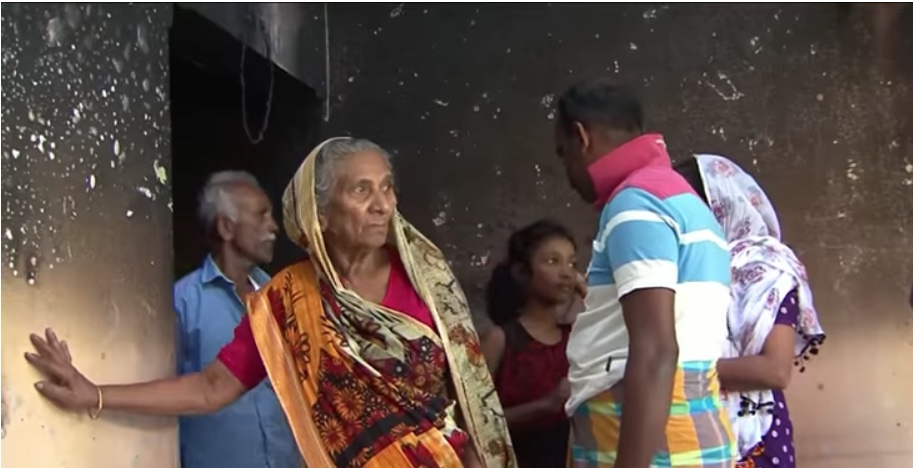
In so doing, we can only deplore the violence directed some time ago at the Muslim community, beginning with the Beruwela and Darga Town incidents, and surfacing subsequently at Ampara, Digana,
Akurana and other places in proximity to Kandy. While condemning this
barbaric behavior most vehemently, we may re-visit these events to seek
possible reasons that may underlie the violence. Mercifully, the heat
has subsided. Complacency cannot be allowed to obscure reality, and the
incidents should serve as an opportunity to realistically assess the
causes and seek possible remedies. However painful, this is the only
rational way to heal the wounds, dispel misconceptions and prevent
recurrence. It is simply unwise to ignore the causes for this enmity and
pretend that nothing untoward has happened. This will only mean that we
trot along to the next disaster.
Signs are that rumblings are still there and could lead to disaster if
not addressed urgently and vigorously curbed. If the media is correct,
there are dark hints. As usual, politicians are the main culprits. In
Jaffna there are moves to prevent alleged settlement of Sinhala persons,
in Wilpattu,
protected lands are being raped to accommodate Muslims displaced by
LTTE terrorists and we are told of similar attempts elsewhere.
All too often, violence erupts from fears, real or imagined. The
inconvenient reality is that perceptions and prejudice often over-ride
facts and figures. Popular
perceptions are often wrong and supported by questionable “evidence”.
While rejecting the plainly absurd – such as the male sterility story,
it is only reasonable that other concerns be sensibly addressed. In our
context, it must be admitted that certain practices could inflame
emotions among misguided zealots, ever ready to exploit an over-heated
opportunity. In this matter, a major responsibility lies with the Moslem
Leadership. They should, jointly with representatives of the majority
community, seek sensible ways to eliminate any provocative factors that
may have prompted the resort to violence. It must be admitted that some
anxieties and ill-will do exist. This is an attempt to identify some
potential flash points – whether justified or not.
It has been pointed out that one of the worst things that a minority
wishing to integrate with a majority could do, is to set itself apart by
residence (Ghettos), dress, occupation or custom. Thus Moslem ladies
who identify themselves by black uniform cloaks, Hindus with ash or
pottus on foreheads, while perfectly within their rights, may be seen by
misguided extremists as an alien threat. Particularly during periods of
heightened emotion, a genuine bonding with the majority would be
prudent insurance.
It is worth reflecting on the existence in all religions, the twin
factors of philosophy (or content) and ritual (or symbolism). Buddhism
labels them as “Prathipatti puja” (respect to the
teachings: spiritual) and “Amisa Puja” (adherence to custom: material).
These are not mutually exclusive, but more correctly, symbiotic or even
synergistic. There
is remarkable congruence and commonality in the underlying rules of
conduct laid down in the different religions that we profess. They are
best encapsulated in the universal injunction, “Do unto others as you
will that others do unto you”.
As a Buddhist, I feel more at ease being critical of my own. In our
tutoring, we often learn to parrot Stanzas (or Gathas), without an
understanding of what they mean. I have been made aware that in his
final words, addressed to Bhikkhu Ananda, he said “The best homage to
the Buddha is to follow the Dhamma” .It is incumbent on the Buddhists to
critically examine our present day practices in the light of this
advice. The Kalama Suthra was also a brilliant exposition of the true
role of custom and teaching. In a remarkable exposition of
enlightenment, the Buddha was bold enough to encourage critical
evaluation of even his own teachings. There is thus no such concept as
“blasphemy”. How much more liberal can anyone get?
Read More
