Peace for the World World ! Your War Our Lives

The Dalai Lama
A Brief Colonial History Of Ceylon(SriLanka)
Sri Lanka: One Island Two Nations
A Brief Colonial History Of Ceylon(SriLanka)
Sri Lanka: One Island Two Nations
(Full Story)
Back to 500BC.

Friday, September 7, 2018
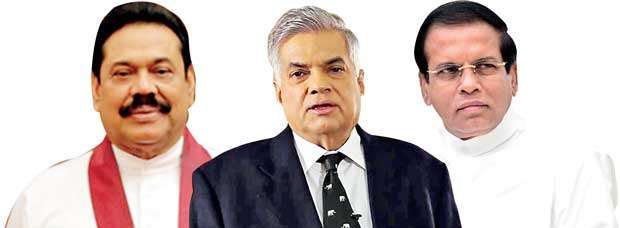
- Sri Lankan voter, though highly literate, lacked the ability to apprehend the true nature of politics
- If so happens, it could be worse than the present animosity, enmity and bitterness among the heads
 “Nothing is so exhausting as indecision, and nothing is so futile.”
—Bertrand Russell
 2018-09-04
Quite a few politicians from both sides of the divide have expressed their views on the conduct of Presidential Elections stating that for any candidate aspiring to become the Executive President of Sri Lanka, needs to obtain 50% plus one vote out of the valid votes counted, as the minimum requirement for the Commissioner of Elections to declare the candidate winner.
The latest to make this claim in a ‘voice cut’ was none other than the
former General Secretary and current National Organizer of a main
political party. He even went a step further describing the process and
said if each of the three main parties fielded a candidate; no one would
be able to achieve this minimum requirement causing a stalemate– and
the country would become unable to elect a President!
This is a fallacy.
Let’s refer to- Presidential Elections Act, No. 15 of 1981-
[Presidential Elections (Amendment) Act, No. 16 of 1988--does not deal
with counting and declaration of a winner]
PART IV --THE COUNT , [quoting the above In a nutshell]
Sections 56,57,58,59 and 60 :
The Commissioner ascertains if any
candidate has received more than 50% of valid votes and the candidate
receiving more than 50% declared elected. If no candidate receives
absolute majority—where there are three candidates, eliminate the last
candidate and count the second/third preferences of eliminated candidate
as a vote in favour of other two; or if there are more than three
eliminate the rest leaving first and second to count the second
preference of eliminated as a vote in favour of remaining candidates;
and where the second preference is not counted, to count the third
preference for one or the other of the remaining two candidates, as a
vote in favour of such remaining candidate. Returning officer to add
preferences and prepare a fresh statement. The returning officer shall
prepare a statement indicating the number of second preferences and
third preferences specified in favour of the remaining two candidates.
Sec. 61. The Commissioner shall, on
receipt of the statements thereby ascertain which of the remaining two
candidates has received the majority of the votes so counted and
forthwith declare the candidate who has obtained such majority to be
elected to the office of President.
It is obvious that there is no necessity for the winner to obtain “50% plus one vote.”
In fact a candidate receiving a percentage even as low as 10% can be
elected President, if there are more than two candidates and say each
receiving, 9.8, 9.8, 8.6, 8.3…., in any descending order to total 100%,
and if one of the first two after adding the eliminated candidates
second and third preferences, yet there is a strong possibility that the
percentage revolves around 10% or less.
There is no minimum cut-off point: take a hypothetical case, if there
are 30 or 40 candidates who are almost equally popular, a 2 to 3 per
cent of valid votes would be sufficient for one to become the Executive
President of Sri Lanka.
Elections before December 9, 2019
As per Article 31(3) of the Constitution, December 9, 2019, is the last day by which Presidential Election will have to be held because it says, one month ahead of the end of President Sirisena’s term, which ends on January 9, 2020.
Who will represent POHOTTUWA?
The battle [indecision] over SLPP candidate heats up. Former President Mahinda Rajapaksa’s new party is divided among Mahinda Chintana, Viyath Maga and Chamal factions. [It is not clear if there is a move to promote Basil too, making it a four-cornered contest]
President Sirisena made a reference to the SC seeking its view if he
could serve for six years. He sought the Court’s interpretation whether
there is any obstacle to him to continue his term of office for six
years as President as described in the Article 31 of the 19th Amendment,
in terms of Article 129(1) of the Constitution.
The AG arguing in support of President Sirisena stated that the election
was held on January 8, 2015, and the incumbent President Sirisena won
and assumed duty on January 9, 2015, for the term of office for six
years. He proposed that the incumbent President was elected by the
voters for the office, to the term of six years.
He said:
“It is the sovereignty of the citizens who exercise their franchise to
choose by ballot him as President. The power originated from the
franchise of the people. The beginning of his office should be measured
from the date on which he is elected.”
He further said it is the Constitutional structure where the sitting
President was elected. The 19th Amendment is operative after the
President was elected for a term of six years.
“There are no provisions in the 19th Amendment to operate same with
retrospective effect. Constitutions cannot be amended with retrospective
effect,” the Attorney General said making submissions.
He asserted that any adjustment would affect and isolate the Sovereignty of the voter.
President Sirisena’s request to the Apex Court came as a surprise for
many as he made arrangements in 2015 through the 19th Amendment to prune
the Presidential term from six to five years, in fact, the President
sought to make it four, but others intervened and proposed five.
The SC took up the reference to make a ruling on the vagueness over the
question of the term of office. The five-member bench of the SC
unanimously ruled that his term was restricted to five years.
President Sirisena’s appeal to the Supreme Court caused quite a rouse,
when former President Rajapaksa declared that he could contest again if
the court ruled in favour of Sirisena.
Gamini Laxman Peiris, the leader of SLPP [Pohottuwa] and former Law
Professor will move the District Court, in terms of the Article 125 of
the Constitution seeking an elucidation as regards Chandrika
Bandaranaike’s and Mahinda Rajapaksa’s eligibility to hand over
nominations for the presidential election in 2019.
The District Court, as he believes could refer the matter to SC for a
ruling. According to him, within two months the Supreme Court will have
to make its decision known to the District Court.
GL Peiris said that the office of President under the 19th Amendment was
entirely different from the powers granted to it by the 1978
Constitution.
The Chairman of the new party said that it would be relevant to mention
that the Presidency established under Article 30 of the 1978
Constitution couldn’t be weighed against with the Article 3 of the 19th
Amendment, which repealed Article 30.
Wide-ranging and comprehensive changes had been initiated in the office
of President in respect of the appointment of the cabinet, the number of
portfolios the President could hold, dissolution of Parliament,
dismissing PM among them.
However, the truth is that former President Rajapaksa’s camp is looking
for a Supreme Court ruling on 19th Amendment against the background of
his family’s failure to reach a consensus and compromise on who or which
Rajapaksa is going to be the Opposition’s candidature for the next
Presidential Election due in end 2019, or even earlier if the incumbent
president who becomes eligible to call for a poll any time after the
lapse of four years, that is on 9th January 2019.
For the first time since 2005, Rajapaksa family who ruled as a team is experiencing the darker side of such groupings.
Family problems come in all forms, shapes and sizes; some are
short-lived and easily administered, while others are more chronic and
complicated. We do not know if Rajapakas’ are short-lived or chronic,
but it cannot be allowed to extend beyond Medamulana and out into the
national arena in the event of a victory to one of them at the next
poll; If it so happened, it could be worse than the present animosity,
enmity and bitterness among the heads of two partners of Unity
Government, which has resulted in drastic consequences to the smooth
operation of governance.
President Maithripala Sirisena’s Sri Lanka Freedom Party and Ranil
Wickremesinghe’s United National Party, while ruling together, flexed
muscles and competed against each other that ended with both suffering
humiliating losses in the hands of novice [A world record?— emerging
victorious defeating two established parties] in February’s elections;
Will the governing coalition aspire to repeat the mistake in 2019?
More than ten names of potential UNF candidates are being rumoured to
come forward if the leader, as he did twice in 2010 and 2015, backs out
at the last moment. The strategy of a surprise, like in 2015, is
unlikely to make an impact on the electorate any more.
For seventy years, the two political parties backed by the majority race
dominated the political arena alternating power between them to rule
the country. They cashed in on racial and religious emotions resulting
in the nation suffering untold misery.
Sri Lankan voters, though highly literate, lacked the ability to
apprehend the true nature of politics; especially through perceptive
understanding.
With their moral values eroded, had taken decisions fashioned by the
circumstances that prevailed. This allowed the roguish politicians and
religious racists to make strides in politics.
The writer can be contacted on kksperera 1@gmail.com
