Peace for the World World ! Your War Our Lives

The Dalai Lama
A Brief Colonial History Of Ceylon(SriLanka)
Sri Lanka: One Island Two Nations
A Brief Colonial History Of Ceylon(SriLanka)
Sri Lanka: One Island Two Nations
(Full Story)
Back to 500BC.

Sunday, September 30, 2018
When gold prices go up, so does the cost of a dowry – and baby girl survival rates in India fall
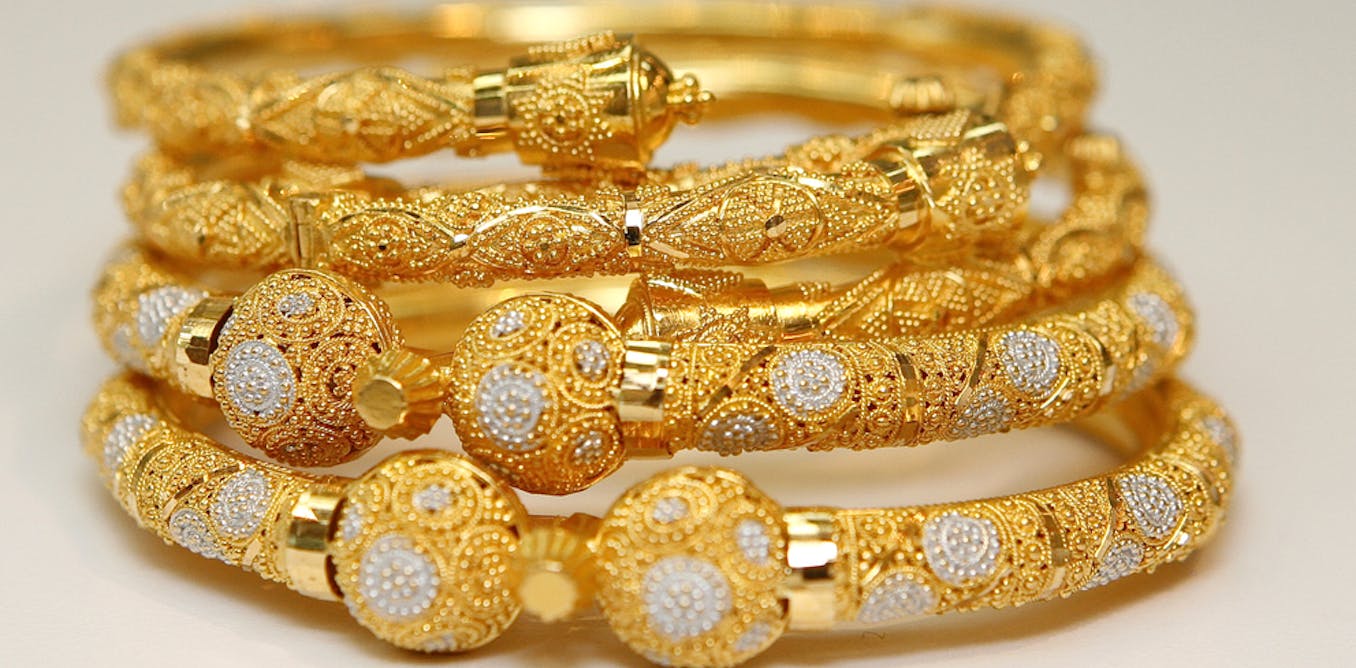
Gold jewellery has traditionally been central to dowries in India. witty234/Shutterstock
-

Professor of Economics, University of Essex-
 When world gold prices go up, fewer girl babies in India survive the first month of life, according to our new research.
My colleagues and I suggest that this is linked to gold often being
part of bridal dowries in India – so when gold prices go up, the cost of
raising girls rises and families tend to neglect or abort them.
When world gold prices go up, fewer girl babies in India survive the first month of life, according to our new research.
My colleagues and I suggest that this is linked to gold often being
part of bridal dowries in India – so when gold prices go up, the cost of
raising girls rises and families tend to neglect or abort them.
Dowry, a transfer at marriage from parents to daughters, is an ancient tradition thought to date back to
at least 200BC, and was widely prevalent in medieval Western Europe.
While it has virtually disappeared in most of the rest of the world, it
persists in contemporary India – despite prohibition since 1961 – and
has become increasingly commonin Bangladesh, Pakistan, and Sri Lanka.
While dowry payments originally acted as a bequest to daughters that
afforded them financial protection after their marriage, dowries are now often appropriated by the groom or his parents rather than retained by the bride.
Dowries impose a considerable tax on girls’ families, with estimates indicating that in South Asia it is six times the
average annual household income. As a result, even though dowry is
banned and can result in prosecution, families in India often start
saving for dowry as soon as a girl is born. Previous research has
also suggested that dowry costs contribute to a preference among Indian
parents for sons rather than daughters, but there is no previous causal
quantitative evidence of this.
While there is no consistent time series data on dowry transactions
across India, my colleagues and I analysed variation in the financial
burden of dowries over more than three decades, based on fluctuation in
gold prices on the world market. Gold, typically in the form of
jewellery, is an integral part of dowry in India and since India
imports more than 90% of its gold, fluctuations in the international price translate into fluctuations in the cost of dowry.
Girl babies neglected
We merged monthly data on international gold prices between 1972 and
2005 with monthly birth cohort data, and analysed whether gold price
changes influenced the sex ratio at birth and the survival of a newborn
girl up to the age of one month. Using this large data set with more
than 100,000 births, we found that in months where the gold price went
up, the chances of a girl surviving through the neonatal period were
significantly lower than for boys. In fact, gold price inflation was
correlated with an improved survival chance for boys.
Between 1972 and 1985, our analysis showed a 6.3% increase in the
monthly price of gold was accompanied by an increase in girl neonatal
mortality of 6.4%. During the same period, there was no significant
corresponding change in male neonatal mortality.
We also found that those women who were born in months when the gold
price was increasing were shorter in adulthood. This is consistent with
previous research which has established that nutritional deprivation in early life leads to lower stature in adulthood, and that some parents in India deprive girls of nutritional inputs. In this case, it could be that lower levels of breastfeeding led
to girls born in months of gold inflation being shorter as adults. We
found that those girls that survived carried a marker of relative
neglect into adulthood, compared to boys born in months of gold price
inflation.
We separated out the results for children born between 1986 and 2005, as
ultrasound technology became widely available across India after the
mid 1980s. My previous research showed that
in this period parents shifted away from neglecting girls after birth
to aborting unwanted girls before birth. For potential births after
1986, we found that a 2.6% increase in the price of gold during
pregnancy was accompanied by a statistically significant 0.3 percentage
point decline in the probability that a girl rather than a boy would be
born.
Focus on gold
By one means or the other, parents seem to be reacting to gold price
increases by trying to reduce the chance of having a surviving girl
child. Clearly, to respond in this way parents need to be aware of
changes in gold prices. Given the importance of gold in India, gold
prices regularly feature in the media but people also talk frequently
about gold prices and dowry costs. If Indians were not aware of the gold
price fluctuations, it would be hard to find an alternative explanation
of our findings.
We conducted various tests of our results, to determine how strongly we
can link these back to dowry costs. For example, it could be that gold
price increases are a proxy for a decline in real income because those
who want to buy gold have less money to spend on other things and this
may have an impact on girl survival rates. However, after investigating
these possibilities statistically, we concluded that the evidence points
to dowry costs as the driver of our findings.
One may imagine that parents react to increases in gold prices by
reducing the amount of gold given in dowry while maintaining its value.
But, using a rural survey containing
information on dowry, we found that its value tends to rise more or
less proportionately with gold prices, suggesting that social norms may
make it hard to adjust quantities downwards.
Recent government figures from India’s Census Office suggest
that only 900 girls were born for every 1,000 boys between 2013 and
2015, indicating a continuing trend in the abortion of girl foetuses.
This is despite persistent high economic growth and declining poverty in
India over the past three decades.
Policies to strengthen the monitoring of dowry prohibition in India are
unlikely to work because social norms lead families to support tradition
and to co-operate in violating the ban. But there is room for hope: the
equalisation of property rights for women and rising levels of
education for both men and women may slowly but spontaneously loosen the
dowry tradition.
