Peace for the World World ! Your War Our Lives

The Dalai Lama
A Brief Colonial History Of Ceylon(SriLanka)
Sri Lanka: One Island Two Nations
A Brief Colonial History Of Ceylon(SriLanka)
Sri Lanka: One Island Two Nations
(Full Story)
Back to 500BC.

Friday, October 19, 2018
Don’s Diary III: Kilinochchi


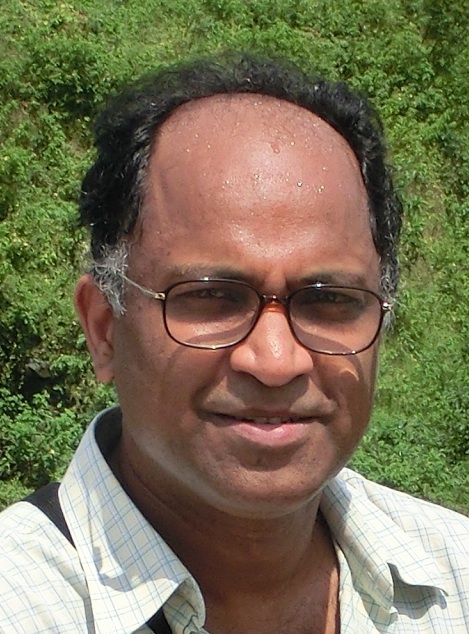
Prof. Mahesan Niranjan
Last week, I travelled to Sri Lanka on a very short trip. My task was to
conduct a review of a degree programme in the recently established
Faculty of Engineering at the University of Jaffna, as part of an
accreditation exercise. It was a poorly planned trip on my part, too
short to visit friends and family. Before travelling, I had to set aside
my prejudices relating to quality assurance processes in higher
education. These, pioneered in the UK and adopted elsewhere, add
excessive bureaucracy to the job of scholarship the likes of me came to
pursue. I have often stated that quality assurance processes are necessary but not sufficient indicators of quality,
but never managed to wake my own University Senate from its deep
slumber on the topic. But this week, I had a job to do. So I keep
private views private.
Monday: Arrive
in Colombo. Sri Lankan airlines makes welcome announcements in three
languages. The Tamil she reads sounds funny, clearly not a speaker of
the language but is making an effort by writing it out in Sinhala script
and reading it: “ongo lukku nal vaa ravu kooru kiraar, ([the
captain] welcomes you)” splitting the syllables in all the wrong
places. Just as Hindu priests would do, writing out Sanskrit mantras in
Tamil font and memorising them. Lucky for them, it is unlikely they will
have a Sanskrit speaker in the congregation. And God has so far not
commented on it either.
I take an airport taxi to the hotel in Fort. As on previous occasions, I
start a conversation with the driver who expresses delight that an
expatriate, settled in London (for the whole of the United Kingdom of
Great Britain and Northern Ireland is referred to as London here) would
come back to teach here (for that is what I told him I was here to do —
translating “accreditation by professional body” into Sinhala was
somewhat beyond me). He says Tamils and Sinhalese are very similar
people. Our Gods are also the same, he claims. Kataragama is his example
of our common God. For us, mortals, being the same, he picks as example
some leader whose son is married to the daughter of another leader. He
cannot recall who these leaders are and stammers, “Eh ara mahaththaya (that Sir)…” I help him with the polysyllabic names of Vigneswaran and Nanayakkaara.
Then he makes his strongest argument towards the need for unity. His
trump. His Conclusive Proof. “The real problem are the Muslims,” he
claims. “Unless we Tamils and Sinhalese are united, we are in serious
trouble,” he predicts. I felt uncomfortable nodding, the desire to reach
my destination taking priority over making a political statement.
Interesting Monday night. The hotel puts on a Sri Lankan cultural event.
A devil dancer who was chasing ghosts away and a young Chinese lady
showing off a bit of martial arts movements. It was pretty basic stuff,
lacking in skill, subtlety or even synchrony with the drummer. Perhaps
having a Chinese national in the team was significant. She could take
over a piece of the Hotel’s land, should they fail to pay her salary on
time. The two for one beer deal was, however, a nice enough compensation
to suffer the show. Tuesday: Train
journey. I leave at 5.30 from Fort and reach Kilinochchi at 11.30.
Early parts of the journey had the train showing off six degrees of
freedom in its movements, far better than what the young lady managed
the previous evening. From about Vavuniya and beyond, however, the
tracks are on concrete sleepers and the ride was smooth.
Tuesday: Train
journey. I leave at 5.30 from Fort and reach Kilinochchi at 11.30.
Early parts of the journey had the train showing off six degrees of
freedom in its movements, far better than what the young lady managed
the previous evening. From about Vavuniya and beyond, however, the
tracks are on concrete sleepers and the ride was smooth.
Tuesday: Train
journey. I leave at 5.30 from Fort and reach Kilinochchi at 11.30.
Early parts of the journey had the train showing off six degrees of
freedom in its movements, far better than what the young lady managed
the previous evening. From about Vavuniya and beyond, however, the
tracks are on concrete sleepers and the ride was smooth.
At Kilinochchi is a new campus of the University of Jaffna, with the
Faculties of Agriculture and Engineering. There is also a new addition –
Faculty of Technology – of which I have not managed to learn much. I
think of the last time I visited here, back in 2014. Then, a temporary
building had just been set up, a gravel access road cut through dense
shrubs and the first batch of 35 students sent letters of admission.
There now is a fully fledged campus with teaching laboratories, lecture
halls, student accommodation, keen students and committed young staff.
They have done an amazing job in just four years.
It is difficult not to reflect when you are here, for this place was the
centre of attention during the long running dirty war in our country.
Of blind carpet bombings. Of killings. Of conscriptions of children. Of
rebels running their own government. Of callousness of a chauvinistic
political class. Of warped logic of hope from nationalistic thought.
There is only one conclusion you can reach. One theorem you can prove.
In peace, our people will prosper.
Read More
