Peace for the World World ! Your War Our Lives

The Dalai Lama
A Brief Colonial History Of Ceylon(SriLanka)
Sri Lanka: One Island Two Nations
A Brief Colonial History Of Ceylon(SriLanka)
Sri Lanka: One Island Two Nations
(Full Story)
Back to 500BC.

Sunday, October 21, 2018
Ending poverty; Not charity, but justice
 2018-10-20
The day after the United Nations World Food Day which we observed on
Tuesday, October 16, the world body on Wednesday marked the
International Day for the Eradication of Poverty with the significant
theme being “Coming together with those furthest behind to build an
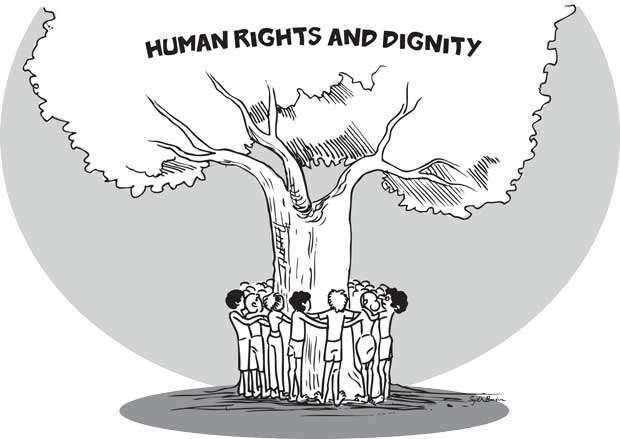
inclusive world of universal respect for human rights and dignity.”
In a statement, the UN’s Economic and Social Affairs Department said
2018 marked the 70th anniversary of the proclamation of the Universal
Declaration of Human Rights and it was important to recall the
fundamental connection between extreme poverty and human rights, and
that people living in poverty were disproportionately affected by many
human rights violations.
World poverty fighter and French Catholic priest, Fr. Joseph Wresinski
was the first to highlight this direct link between human rights and
extreme poverty. In February 1987, he appealed to the Human Rights
Commission to examine the question of extreme poverty and human rights
and eloquently captured the nexus between human rights and extreme
poverty with his profound observation: “Wherever men and women are
condemned to live in extreme poverty, human rights are violated. To come
together to ensure that these rights be respected is our solemn
duty.”
According to the UN, government policies alone cannot create the social inclusion that is fundamental to reaching those left furthest behind and overcoming poverty in all its dimensions. The commemoration of October 17 each year, when people living in poverty take the floor and share their experiences, demonstrates how we can achieve greater social inclusion by enabling people from all walks of life to come together to respect the human rights and dignity of people living in poverty.
According to the UN, government policies alone cannot create the social inclusion that is fundamental to reaching those left furthest behind and overcoming poverty in all its dimensions. The commemoration of October 17 each year, when people living in poverty take the floor and share their experiences, demonstrates how we can achieve greater social inclusion by enabling people from all walks of life to come together to respect the human rights and dignity of people living in poverty.
It underscores the importance of reaching out to people living in
poverty and building an alliance around their priorities with citizens
from all backgrounds to end extreme poverty. It recognizes the important
mutual roles and relationships we have with each other based on our
common and equal dignity. The persistence of poverty, including extreme
poverty, is a major concern for the UN and at its 72nd session, the
General Assembly launched the Third United Nations Decade for the
Eradication of Poverty (2018–2027), under the theme “Accelerating global
actions for a world without poverty.” It is important that the Third
Decade’s inter-agency, system-wide plan of action to coordinate the
poverty eradication efforts of the UN system includes an effective
partnership with people living in poverty.
The International Day for the Eradication of Poverty can strongly
complement such initiatives because it aims to ensure that the active
participation of people living in extreme poverty and those furthest
behind is a driving force in all efforts made to overcome poverty,
including in the design and implementation of programmes and policies
which affect them. Only by creating and nurturing a genuine partnership
with people living in poverty will it be possible to build an inclusive
world where all people can enjoy their full human rights and lead lives
with dignity, the UN says. “Let us remember that ending poverty is not a
matter of charity but a question of justice,” UN Secretary General
Antonio Guterres says in a message to mark the occasion.
In Sri Lanka, the shaky Coalition Government as often stresses that its’
mission is to build a just, peaceful and all inclusive society, much in
line with the UN theme for poverty eradication this year. Although
there was a delay of about a three and a half years, the government
appears to be going all out to implement major eco-friendly and
sustainable development projects such as Gamperaliya, Grama Shakthiya,
Enterprise Sri Lanka and several hundred schemes to build houses with
basic facilities and a small piece of land for homeless people. As the
UN says, just giving some charity like Janasaviya or Samurdhi is not the
answer for those trapped in poverty. Instead what need to be done is to
give them houses and properties of their own, with provision being made
to provide well-paid, productive jobs for one or two members of each
family. That will restore their human dignity and their human rights to
be responsible citizens who play a role in development and whose voices
are heard in decision-making.
