Peace for the World World ! Your War Our Lives

The Dalai Lama
A Brief Colonial History Of Ceylon(SriLanka)
Sri Lanka: One Island Two Nations
A Brief Colonial History Of Ceylon(SriLanka)
Sri Lanka: One Island Two Nations
(Full Story)
Back to 500BC.

Thursday, October 18, 2018
EXCLUSIVE: Saudi Arabia bars Palestinian refugees in Lebanon from visiting Mecca
#HajjSome fear new visa restrictions are part of broader Saudi pressure to push forward US 'deal of the century'

Nearly 175,000 Palestinians are estimated to be affected by the decision effectively preventing them from performing the Hajj pilgrimage (AFP)


Saudi Arabia has stopped issuing pilgrimage visas for Palestinians in
Lebanon who hold refugee travel documents, effectively barring tens of
thousands of Palestinians from visiting Mecca and Medina, the two most
important religious sites for Muslims, Middle East Eye can reveal.
An official at the Saudi consul's office in Beirut confirmed to MEE that
following a decision by the Saudi Foreign Ministry in Riyadh, they had
informed tourism companies in Lebanon that no Hajj and Umrah visas would
be issued to Palestinians on their refugee travel documents - a
decision that became effective on 12 September.
"The Palestinian refugees [in Lebanon] can now get visas on a Palestinian Authority passport," the official said.
"There are Palestinians who already applied for Umrah visas on their PA
passports after the decision was made and they got visas to travel [to
Saudi Arabia]. I do not have an exact number for them," the official
added.
The official said that the Saudi Foreign Ministry had informed the occupied West Bank-based PA of its decision.
It is not true that we will issue Palestinian passports for any refugee in Lebanon to get a visa for Umrah or any other sort of visa. The PA did not issue a decision to issue passports for Palestinians in any Arab states- Ashraf Dabbour, PA ambassador to Beirut
Ashraf Dabbour, the Palestinian Authority ambassador in Beirut told MEE
that the embassy knew about the Saudi visa decision through unofficial
channels by word of mouth from Palestinian local figures.
But he denied that the PA would issue travel documents for refugees in Lebanon wishing to travel to Saudi Arabia.
"It is not true that we will issue Palestinian passports for any refugee
in Lebanon to get a visa for Umrah or any other sort of visa. The PA
did not issue a decision to issue passports for Palestinians in any Arab
states," Dabbour told MEE.
Dabbour said that the Palestinian embassy was "surprised" by the Saudi
decision and that it was "solving this matter" with the Saudi embassy in
Beirut, as well as through the Palestinian ambassador in Riyadh, Basem
Abdullah al-Agha, who he said has been in contact with the Saudi Foreign
Ministry.
Palestinian refugees in Lebanon are estimated to number 174,422, according to the country's first and only census of the community in December last year.
They hold refugee travel documents issued by Lebanon's General
Directorate of the General Security and currently have no access to any
other form of travel documents allowing them to go to Saudi Arabia.
They could apply for a Lebanese travel document that is valid for one,
three or five years, and the application fees are similar to that of the
Lebanese passport, which costs $40 for each valid year.
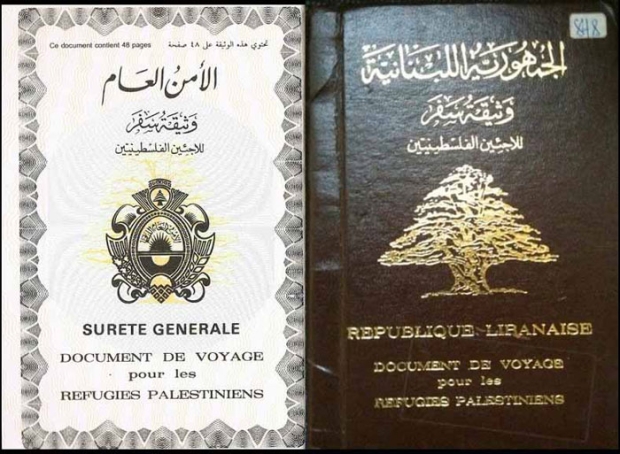 Palestinian refugees in Lebanon hold a travel document issued by the General Directorate of the General Security (Screengrab)
Palestinian refugees in Lebanon have no political rights of citizenship to vote for parliament or local municipalities.
They are also prohibited from practising 20 professions including
law, medicine and engineering, and are not allowed to work in
government institutions because they are designated as "foreigners"
under Lebanese law.
The Lebanese political system is based on a sectarian structure dividing power among the main religious communities.
While a number of Christian Palestinians who fled to Lebanon in the wake
of the creation of the state of Israel and the Nakba in 1948 were
granted Lebanese citizenship, Lebanon has been particularly reluctant to
integrate Palestinian refugees and alter its population's already tense
confessional makeup.
The PA's Dabbour said that the Palestinian embassy in Lebanon had
previously issued PA passports for undocumented Palestinians in Lebanon,
known also as non-ID refugees, whose numbers are estimated at around
5,000, to facilitate their travel abroad and obtain visas and residency
in other foreign countries.
"This is a particular case in which we issued Palestinian passports
because those non-ID refugees were not registered with the UNRWA nor the
Lebanese state, and they could not travel anywhere," Dabbour explained.
The Palestinian embassy has not yet issued a statement regarding the outcome of its talks with Saudi officials.
Saudi Arabia is one of the funders of the Palestinian Authority, and it uses its financial leverage to put political pressure
on the PA. In 2017, the kingdom contributed $92.1m to the budget of the
PA - a nearly 50 percent decrease from its $180m contribution a year
earlier.
'It is not practical'
Speaking to MEE, several Lebanese tourism companies confirmed that they
have not been able to obtain visas for their Palestinian clients who
hold refugee travel documents.
The decision was conveyed to them by the Saudi consulate through the
Lebanese Committee for Hajj and Umrah Affairs. Ibrahim Itani, the
director of the committee, told MEE that the Saudi consul, Palestinian
ambassador and the Lebanese General Security all confirmed to him that
Palestinian refugees needed Palestinian Authority passports to enter
Saudi Arabia.
Itani was asked by several tourist companies to speak with the Saudi embassy to see if the decision could be reverted.
"The case is now with Abu Mazen," Itani told MEE, referring to PA
President Mahmoud Abbas. "I have been told that this is an issue between
states, that was the answer."
 Bourj al-Barajneh refugee camp in Beirut, home to thousands of Palestinian refugees (MEE/Dominika Ożyńska)
In September 2017, Saudi
Arabia backtracked in a similar case over visa issues for Palestinians
on their refugee travel documents, following pressure from the PA and
some Palestinian figures in Lebanon.
An owner of a Hajj and Umrah travel office in the southern Lebanese city
of Saida, who wished to remain anonymous, told MEE that the Saudi
decision was "not practical," and they were looking for the cancellation
of this decision.
"If you issue a Palestinian passport, you then need to apply for a
residency in Lebanon and this is another problem for Palestinian
refugees," he said. "You could then apply for a visa for Saudi Arabia,
but then the refugee travel document will become void."
Palestinian refugee problem
MEE reported in September that
Saudi Arabia had banned Palestinians holding temporary Jordanian
passports from entering the country, a measure directly affecting
almost 634,000 Palestinians living in Jordan and Israeli-occupied East Jerusalem.
Several travel agents who spoke to MEE at the time said they had been
told at the start of September that they should not apply for visas for
anyone seeking to travel on a temporary Jordanian passport, although no
official Saudi announcement had been made.
The Jordanian temporary passport is a document valid for five years
issued to Palestinians who live in occupied East Jerusalem by the Civil
Status and Passports Department in Amman.
The holders of temporary passports do not have a national identification
number and are therefore not entitled to the full rights of Jordanian
citizenship.
Read more ►
Palestinians living in East Jerusalem use the passport merely as a
travel document to move from one country to another, especially in the
majority of Arab states that do not recognise Israel or Israeli-issued
travel documents.
Some Palestinian and Arab media have linked the Saudi move to US President Donald Trump's as-yet-unannounced "deal of the century" proposal,
amid rumours that Washington sought Saudi support for measures that
would revoke the right of return of Palestinian refugees displaced by
the creation of Israel in 1948 and subsequent Arab-Israeli wars.
The measures would see Palestinian refugees in Lebanon and Jordan fully naturalised and granted national ID numbers.
Israel Katz, Israel's minister of transport, tweeted on
11 September welcoming Trump's "initiative" regarding the issue of
Palestinian refugees, saying that the Palestinian refugee
"problem" in Jordan, Syria, Lebanon, and Iraq "would be good to
disappear from the world".
MEE could not confirm if Katz's tweet was related to Saudi Arabia's new
restrictions on Palestinian refugee and temporary travel documents.
