Peace for the World World ! Your War Our Lives

The Dalai Lama
A Brief Colonial History Of Ceylon(SriLanka)
Sri Lanka: One Island Two Nations
A Brief Colonial History Of Ceylon(SriLanka)
Sri Lanka: One Island Two Nations
(Full Story)
Back to 500BC.

Friday, October 19, 2018
Government’s cohabitation stuck in the past or what?

 Friday, 19 October 2018
The appointment of career judge Nalin Perera as the new Chief Justice, who has served in the judiciary for over 30 years, provides a snapshot into President Maithripala Sirisena’s thought process, amidst various stories of clashes with his coalition partners.
The new Chief Justice like his predecessor has maintained a relatively low profile and has been non-controversial. Before sending his name to the Constitutional Council it is reported that President Sirisena, considered several other high-profile names, including those of Attorney General Jayantha Jayasuriya and Eva Wanasundara, the senior-most judge in the current Supreme Court. In fact, two separate groups were strongly backing both Jayasuriya and Wanasundara for two completely different reasons.
 Appointments
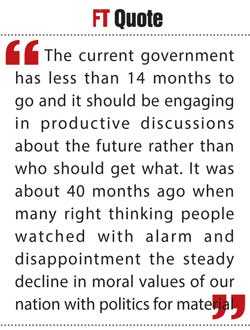
to the Supreme Court must have bipartisan consensus. It is unworthy of
democracy to be otherwise. The current government has less than 14
months to go and it should be engaging in productive discussions about
the future rather than who should get what. It was about 40 months ago
when many right thinking people watched with alarm and disappointment
the steady decline in moral values of our nation with politics for
material benefit overtaking cherished values.
Appointments
to the Supreme Court must have bipartisan consensus. It is unworthy of
democracy to be otherwise. The current government has less than 14
months to go and it should be engaging in productive discussions about
the future rather than who should get what. It was about 40 months ago
when many right thinking people watched with alarm and disappointment
the steady decline in moral values of our nation with politics for
material benefit overtaking cherished values.The breakdown of our religious values, traditions and culture, the level of politicisation of the public administration reached new heights, which led to nepotism, bribery and corruption never seen before in our history.
The election of President Sirisena gave Sri Lanka an opportunity for real change. Many people hailed the election of Sirisena as a victory for liberty, justice and democracy, as against autocracy and nepotism. The new government went out of its way to protect the newfound political and social freedom. Many people are slowly getting disillusioned with the style of governance, largely because the Government has done very little to educate the public about the challenges it is facing and the negativity largely driven by inaction and some people in authority not knowing what their roles and responsibilities are in the administration. As a result, to the diehard supporters of Yahapalanaya these are days of fading hope and overwhelming despair and those who toiled hard for Yahapalanaya are slowly giving up and many of them are openly venting their frustration on social media. Therefore, it is important that the people who have put their future in the Government are not let down by an underperforming government and thereby undermine the January 8 mandate. Moreover, people are now lamenting that the Government has no backbone to deal with national issues.
Achievements
Pre-2015, the Executive Presidency in Sri Lanka was strengthened by the dictatorial powers added on by the 18th Amendment. As a result the entire State administrative machinery of the country in all aspects of functioning was politicised beyond redemption.
The 18th Amendment not only led to a gradual and systematic destruction of liberty and democracy, but also destabilised the economy by creating an opportunity for corruption and free spending of public money without accountability, destroying the very social fabric of our society.
The Sirisena Government passed the 19th Amendment in record time and that paved the way to establish law and order and an independent public service.
The promise to establish an accountable parliamentary system, strengthening democracy with accountability and transparency, was delivered after 18th August 2015.
In addition, the Government worked tirelessly to restore human values, human rights, rule of law, decency and economic freedom. The question now is has the Government gone overboard and created a culture of indiscipline and lethargy? The general view is the Government needs a rapid and major course correction. They need to stop taking party and progressive voters for granted and make challenging the status quo a top priority.
Need for change
People are seeing that the Government’s policies are a continuation of the past. Rather than challenging the cronies and poorly-performing public servants, the Government is seen to be rewarding them. The priorities for the Government should be debt management, healthcare, housing and jobs. The UNP and SLFP should not take their voter base for granted assuming they have nowhere else to go. They will pay a hefty price and the price will get higher if they do not learn the obvious lessons: excite the base, challenge bureaucracy and business and demonstrate a change in direction by remaking the government.
The Government needs to reach outside, to get a clear reading of the mood of the country. From most of their appointees they will not hear the right message. It is time to clean the house, restart and set a new direction more consistent with the President’s promise to change the way government operates and delivers on the promises made.
If the President and Prime Minister really want to bring hope and change, they need to become progressive populists. The Government in the remaining 14 months needs to create a conducive climate to do business. Rebuilding business confidence amongst investors, both locally and internationally, must be a top priority. By continuing to depoliticise the system a lot of the demotivated business leaders can be rejuvenated and re-energised. The stock exchange must be supported to ensure the exchange attracts genuine investors and also provides opportunities for a broader group of investors to benefit by investing in the stock exchange.
To ensure this the Government should only act as a facilitator and that requires better regulation and governance. Therefore the message that is required is that business will only be done by the private sector and the Government will provide a level playing field and provide long-term investment-friendly policies that will benefit all businesses, irrespective of their affiliations.
Therefore many regulations and tax and fee structures that are perceived as a deterrent to investment and doing business must be removed via a consultative process between the public and private sectors. The tax system must be fit for the purpose. Special emphasis also needs to be given to the welfare of the weak, disabled, elderly and unemployed as well as environmental conservation.
However, to do this it is important that people with the right competence and credibility are appointed to key government positions; the mistakes of the past should be avoided. Those secretaries and head of public institutions who have failed miserably must be removed immediately.
The Government today is on the wrong side of a battle between certain government cronies and voters.
There are signs across the country that young people are galvanised by new non-political people who are willing to fix the mess created by politicians.
The Government should not get caught up in a political gridlock that will further heighten the political drama. That can only result in policy instability and intensifying bitterness in the political sphere, leaving the government machinery impotent.
(The writer is a thought leader)
