Peace for the World World ! Your War Our Lives

The Dalai Lama
A Brief Colonial History Of Ceylon(SriLanka)
Sri Lanka: One Island Two Nations
A Brief Colonial History Of Ceylon(SriLanka)
Sri Lanka: One Island Two Nations
(Full Story)
Back to 500BC.

Wednesday, October 17, 2018
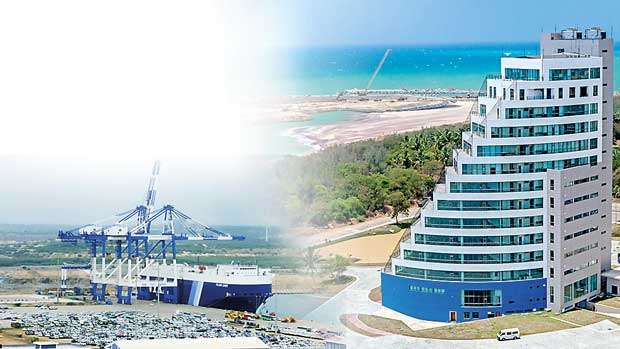
Hambantota as forward Chinese military base: Distraction from real problem
 2018-10-16
 America’s
Vice-President Mike Pence has warned that Hambantota ‘may soon become a
forward military base’ for the PLA Navy. In a speech at Hudson
institute, Pence launched a broadside against China’s ‘predatory’ trade,
‘debt diplomacy’, ‘coercion’ and military ‘aggression’; he referenced
to the Chinese-funded Hambantota port, of which the majority stake is
owned by China’s state owned port operator, China Merchants. Though
these concerns are usual American refrain, the latest might have much do
with buttressing President Trump’s plan to levy taxes on an additional
US $ 250 billion of Chinese imports and play the tough guy before
America goes to the mid- term elections. After all America under Trump
is retreating from AsiaPacific, and slapping taxes on its alliance
partners, and is sending mixed signals on its
America’s
Vice-President Mike Pence has warned that Hambantota ‘may soon become a
forward military base’ for the PLA Navy. In a speech at Hudson
institute, Pence launched a broadside against China’s ‘predatory’ trade,
‘debt diplomacy’, ‘coercion’ and military ‘aggression’; he referenced
to the Chinese-funded Hambantota port, of which the majority stake is
owned by China’s state owned port operator, China Merchants. Though
these concerns are usual American refrain, the latest might have much do
with buttressing President Trump’s plan to levy taxes on an additional
US $ 250 billion of Chinese imports and play the tough guy before
America goes to the mid- term elections. After all America under Trump
is retreating from AsiaPacific, and slapping taxes on its alliance
partners, and is sending mixed signals on its alliance commitments.
Prime Minister Ranil Wickremesinghe has rebuffed those claims - Some
people are seeing imaginary Chinese naval bases in Sri Lanka, he had
said speaking at the Oxford Union.
American concerns of China manipulating regional geopolitics through its
construction spree date back to the early 2000. In 2004, American
defence contractor Booz Allen Hamilton argued that China is building
‘spring of pearls’, potentially turning littoral states (such as Sri
Lanka, Maldives, Bangladesh and Pakistan) into outposts of a maritime
design. Since then this argument has been liberally deployed to
characterize the Chinese construction activities in the region. China
has in fact undertaken major port building projects and construction
activities such as Gwadar in Pakistan, Hambantota and a shallow water
port in Chittagong. China’s flagship project in Pakistan,China-Pakistan
Economic Corridor ( CPEC) among other amenities, offers, China an all
-weather land route to the Arabian sea, via Chinese built Karakolum
highway. However, China’s investment in headline- grabbing geostrategic
projects are a fraction of the total Chinese investment in the region.
For instance, over 75% of China’s official development assistance to
Pakistan during 2000 to 2014 was spent on power plants. Similarly, in
Sri Lanka,67% of Chinese development loans obtained during 2010-2015
were spent on roads, and another 15% on power and energy.
Predatory or not, Chinese loans are less concessionary in nature. The
lion’s share of Chinese loans does not count as official development
assistance, which need to be ‘concessional in character and conveys a
grant element of at least 25%’ The ODA component of Chinese development
assistance extended during the period of 2000-2015 to Sri Lanka,
Bangladesh, Nepal and Pakistan is 7, 15, 27 and 9% respectively, based
on data available on Aid data project.
However, mercantilism of loans and alleged claims of geopolitical
designs of projects are quite apart. Countries borrow from China not
just because money comes with no strings in the form of preconditions of
political and economic reforms, attached. China is, in fact, filling a
gap in demand and supply for infrastructure funding. The western
financing for infrastructure projects have declined steadily since early
2000, and there exists an approximately US $2 trillion deficit in the
global infrastructure budget. South Asia itself has to invest around US $
2.5 trillion by 2020 to upgrade its infrastructure.
In each country that China cultivated a thaw, that relationship has unravelled with the domestic political change. In SL, the collapse of the Rajapaksa regime saw the suspension of Chinese funded projects
Sheer scale of the Chinese economy and extent of its loans provides for
greater economic presence for China in the region. However, the process
of converting the material power into influence is not linear. Power
resources in their utilization to achieve preferred state goals are
subjected to and are conditioned by rigours of other extraneous details
such as quarrelsome domestic politics, popular impulses and electoral
calculations etc. That is where much of the fear- mongering over the
Chinese presence is faulty. In each country that China cultivated a
thaw, that relationship has unravelled with the domestic political
change. In Sri Lanka, the collapse of the Rajapaksa regime saw the
suspension of Chinese funded projects. Recently in the Maldives, the
defeat of pro-Beijing former president Yameen in the recent election saw
the Indian Ocean atolls renewing its vows of allegiance to India. In
Malaysia, Dr. Mahathir Mohammed is scrapping a multi-billion dollars
worth Chinese funded rail project.
However, it is also the weak states, their capricious fiscal policies
and domestic institutions that make these countries potential targets of
geopolitical designs. Giving Hambantota port on a 99- year lease was
not a Chinese demand, but was a decision made by the current government
in the pretext of easing debt service cost. That was after the same
government, increased public sector salaries by Rs. 10,000 causing an
implosion of government spending. Implications of those populist
decisions are still felt. A saner economic policy could have saved the
country from these troubles and their potential geo political
complications.
South Asia’s political duopoly also makes it easier for the incumbent
government to borrow as much as they want, and build vestige projects,
and pass the buck of debt servicing to its predecessor. Mahinda
Rajapaksa invested a sizeable portion of Chinese loans in projects which
lacked immediate to medium term economic viability. And boisterous
public reactions also make it harder to undertake requisite adjustments
to turn such projects into profitable ventures. South Asia has a track
record for protesting against its own economic interests. However, these
domestic impulses, and Indian security concerns also tend to push back
against China whenever it digresses from the implied economic role.
South Asia’s domestic systems do not create conducive domain conditions
for enhanced defence cooperation with an eye on balance of power
manoeuvering.
However, the preponderance of Chinese economic presence and influence
is worrying for that it cultivates an exceeding level of dependency on
China by small countries, which are often forced to do so due to the
absence of other alternatives. As things stand, neither America , nor
Europe is in a position to offer a substantial economic balancing to
China in South Asia. From Chinese merchandisers to mega construction
projects, this influence is growing day by day. New Pax Sinica is more
likely to be heralded by those commercial ventures than gunboats.
Whether that new order would serve the interests of smaller states would
be decided by how those states strategize their relationship with China
for mutual gain. But, small countries, Sri Lanka being a classic case,
lack a long term vision, and cohesive and effective apparatus to
implement policy. This aggravates the unequal status quo in their
relationship with China, and relative gains of their partnership. More
than the prospect of Chinese gunboats in Hambantota, Sri Lankans ( and
South Asians) should worry about their weak states and feeble
institutions, which give them a raw deal in their workings with China.
