Peace for the World World ! Your War Our Lives

The Dalai Lama
A Brief Colonial History Of Ceylon(SriLanka)
Sri Lanka: One Island Two Nations
A Brief Colonial History Of Ceylon(SriLanka)
Sri Lanka: One Island Two Nations
(Full Story)
Back to 500BC.

Tuesday, October 16, 2018
How the US invents enemies to maintain its dominance
2018-10-12

Enemies are really friends. This oxymoron serves as a secret motto of
some countries, particularly the United States. One wonders whether US
Vice President Mike Pence’s broadside last Thursday at China was part of
a bid to fast track the process to make an enemy out of China, if it
has still not become one. It came against the  backdrop
of President Donald Trump taking a series of anti-China measures,
including a dangerous trade war, and provocative US warship manoeuvres,
like what happened last week, when a US warship in the South China Sea
veered into what China calls its territorial waters but the US regards
as international waters.
backdrop
of President Donald Trump taking a series of anti-China measures,
including a dangerous trade war, and provocative US warship manoeuvres,
like what happened last week, when a US warship in the South China Sea
veered into what China calls its territorial waters but the US regards
as international waters.
backdrop
of President Donald Trump taking a series of anti-China measures,
including a dangerous trade war, and provocative US warship manoeuvres,
like what happened last week, when a US warship in the South China Sea
veered into what China calls its territorial waters but the US regards
as international waters.
In his broad attack, Pence accused China of “predatory” economic
practices, military aggression against the US and of trying to undermine
President Trump and harm his chances of winning re-election.
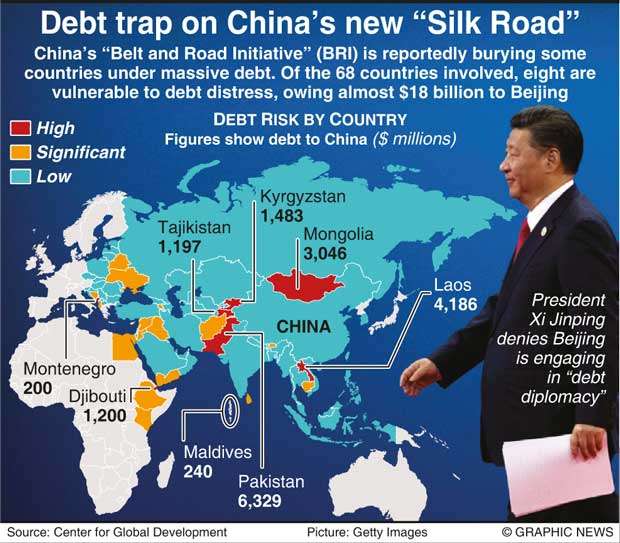
Though he cited what he called US intelligence reports, he offered no solid evidence to back up his claim, except to cite China’s alleged military designs in countries such as Sri Lanka. He said Beijing was using billions of dollars in infrastructure loans to countries across the world to tie them to the Chinese government and described this practice as “debt diplomacy.”
“The terms of those loans are opaque at best, and the benefits flow
overwhelmingly to Beijing,” he said and, referring to Sri Lanka’s
Hambantota Port, he added that it was commissioned by Sri Lanka with
Chinese funds in 2010, but when Sri Lanka was unable to pay back its
loans, a Chinese state-owned company took ownership. “It may soon become
a forward military base for China’s growing blue-water navy,” Pence
warned.
Pence’s tirade against China raises a question as to why the US wants to
make China a hostile nation. It also gives credence to claims that the
US needs an enemy to survive. As a matter of fact, it has always had
one, two or more enemies at any given time. The US is not alone. The
enemy creation is part of statecraft. The behaviour of Israel and, in
our neighbourhood, of India and Pakistan, indicates that states gain
many advantages by having an enemy. Once the enemy is found or
invented, the enemy perception is whipped up in the minds of the
populace while the state seeks to achieve its geopolitical goals. There
are domestic political advantages, too. At election times, it is not
uncommon to see heightening tensions between enemy states, with campaign
speeches full of real or imagined threats from the enemy. Because the
enemy exists, politicians are able to inflate their egos and project
themselves as the only leaders who could give the enemy a fitting
reply.
At the macro level, the bogey factor helps rulers to divert the people’s
attention from real issues; from the secret deals and immoral wars they
wage with ulterior motives. Remember George W. Bush’s wars?
Communism as an ideology, and the Soviet Union as its ‘evil’ face, had
been the enemy of the US for some 45 years since the end of World War
II. The US fought many wars and propped up dictators in Africa, Asia
and Latin America in the name of containment or to prevent Communism
from gaining ground, or, in other words, to help capitalists plunder the
global resources and to make the rich richer and the poor poorer.
With the collapse of the Soviet Union and the end of the Cold War in
1991, the US wanted a new enemy to continue its domination of the world
through military means and cover up its blatant aggressions, subtle
regime change campaigns and profiteering through wars. Imagine the US
without an enemy. For a short period after the end of the cold war, it
was without an enemy. It was the sole superpower and it came under
immense pressure from within and outside the country to give leadership
to a world order where peace and justice would prevail and international
law would be respected. The post-cold war elation became a rallying
point for greater democracy and improving human rights. It was during
this period that the campaign for the setting up of a world criminal
court gained momentum. Sadly, such a world order was not on the US
realpolitik agenda.
Then the US invented an enemy. Radical Islamists, Islamic extremists,
Islamic terrorists and jihadists, whatever name one calls them, became
the enemy, though they were once the United States’ allies, armed,
trained and financed to take on the rival superpower, the Soviet Union,
in Afghanistan during the cold war. They were fondly called the
Mujahideen, the plural of Mujahid meaning Jihadist. The Americans
called them freedom fighters and compared them with those who fought for
US independence.
The friends became foes, just as George Orwell explains in his famous
dystopian novel ‘1984’. The 9/11 attacks carried out by the enemy led
to the undoing of the progress the world was making in strengthening
democracy and human rights. The enemy helped the sole superpower to
invade Afghanistan and Iraq, and create chaos in Libya, Syria and the
rest of the Arab world.
Now that the so-called Islamic terrorist is on the run or, more or less,
wiped out, it is time to find a new enemy. China fits the bill. To put
it in a more US-friendly way, while Washington was on the hunt for the
Islamic terrorist, China emerged, without much noise, as a possible
contender for the US.
Alarmed by China’s assertive diplomacy in the South China Sea and, of
late, in the Indian Ocean, the US is now in a hurried attempt to prepare
the American people for a bigger and more intensified campaign against
China. It need not be military.
Pence’s Thursday’s speech was largely an attempt to take the case
against China to the American people. “The American people deserve to
know…” he underlined.
According to Thucydides’ theory, the dominant world power will not give up its number one position without a fight. Are we witnessing a preamble to such a major confrontation? The only solace is that nuclear powers do not go to war if they are ruled by rational leaders.
According to Thucydides’ theory, the dominant world power will not give up its number one position without a fight. Are we witnessing a preamble to such a major confrontation? The only solace is that nuclear powers do not go to war if they are ruled by rational leaders.
It appears that China is doing in the South China Sea and parts of the
Indian Ocean what the US did in the Caribbean and the Pacific in the
19th century. The 1823 Monroe doctrine, named after the then US
President James Monroe, was a virtual warning to European powers,
especially Britain, that they should not return to the Caribbean to
dominate the region through colonialism or through client states. Just
as the US in the 19th century ousted Britain, the then superpower, from
the Caribbean or from the US neighbourhood, without a fight and while
maintaining friendly relations, China is now on a campaign to oust the
US from the seas in China’s neighbourhood, while maintaining ‘friendly’
relations. Just as the US resorted to the ‘dollar diplomacy’ and
economic hegemony, China is now resorting to ‘Yuan diplomacy’ and trying
to become a world power through its belt-and-road initiative.
The US is not unaware of these moves. The US will not let the fate that
befell Britain in the Caribbean befall it in the South China Sea region.
That is the reason why the US keeps challenging China’s sovereignty
over islands and coral reefs in the South China Sea. But at present, the
conflict is more a battle of wits than military.
