Peace for the World World ! Your War Our Lives

The Dalai Lama
A Brief Colonial History Of Ceylon(SriLanka)
Sri Lanka: One Island Two Nations
A Brief Colonial History Of Ceylon(SriLanka)
Sri Lanka: One Island Two Nations
(Full Story)
Back to 500BC.

Monday, October 22, 2018
Khashoggi killing: We can’t worship God and money

2018-10-19
The United States and Britain killed tens of thousands of innocent
civilians in Iraq and faced no punishment. China has sent one million of
its Uyghur population to  forced
‘brainwashing’ camps and dismisses with contempt worldwide criticism.
Saudi Arabia massacres children and starves millions of famine-stricken
people in Yemen and yet stands tall in world fora. In this horror of
rich and arrogant nation’s crimes, the killing of one journalist may
look like no major matter.
forced
‘brainwashing’ camps and dismisses with contempt worldwide criticism.
Saudi Arabia massacres children and starves millions of famine-stricken
people in Yemen and yet stands tall in world fora. In this horror of
rich and arrogant nation’s crimes, the killing of one journalist may
look like no major matter.
forced
‘brainwashing’ camps and dismisses with contempt worldwide criticism.
Saudi Arabia massacres children and starves millions of famine-stricken
people in Yemen and yet stands tall in world fora. In this horror of
rich and arrogant nation’s crimes, the killing of one journalist may
look like no major matter.
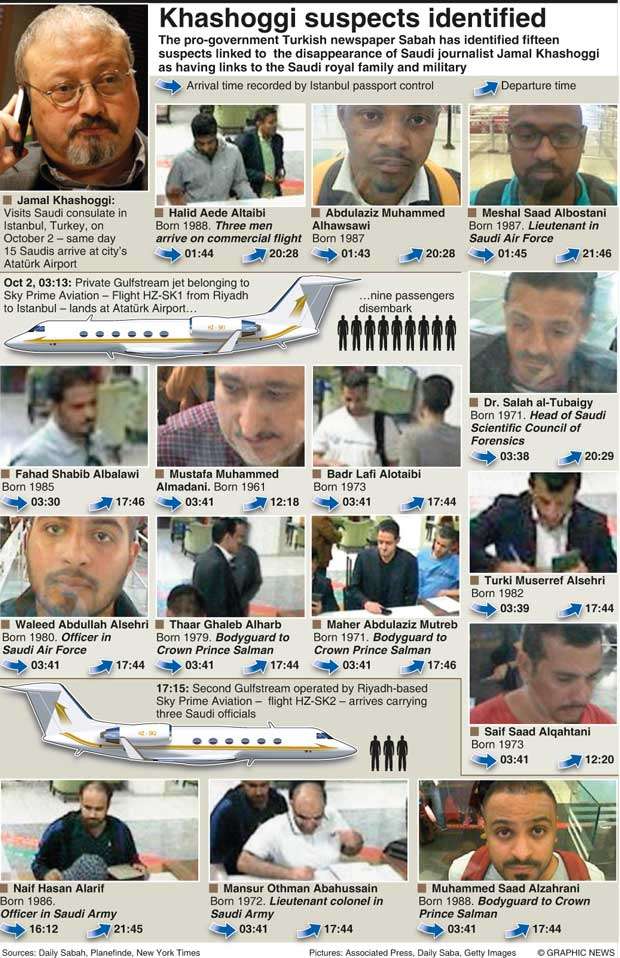
The October 2 gruesome killing of Saudi journalist Jamal Khashoggi at
Saudi Arabia’s Istanbul consulate underscores the despicable reality
behind rules in world politics: The rich and powerful can commit war
crimes, kill thousands of people and still strut around as civilised
nations commanding respect. International law, rules, United Nations
resolutions and sanctions are largely for third world countries like Sri
Lanka, Rwanda and Iran.
But mark our words; Saudi Arabia will wriggle out of the crisis, as it
has done in the past whenever it had been pushed into a corner. The
monarchy loathes democracy and is no respecter of human rights. Even an
innocuous tweet can land a Saudi national in jail. Yet every western
nation courts its friendship, with an eye on the kingdom’s US$ 750
billion reserves.
Since Khashoggi disappeared on Oct 2, no Saudi citizen has opened her or
his mouth to condemn the killing though the Saudi journalist was
speaking up on their behalf to bring about an element of democracy into
the one-family-led feudal form of governance. The Saudis simply say they
believe that Khashoggi is still alive somewhere although in their
hearts-of-hearts they know the ‘messenger’ was tortured and killed. They
also fear the fate that befell Khashoggi, who was once a close advisor
to the royal family, could befall them if they utter a word that does
not go with the official statement.
A critic of Saudi Arabia’s war on Yemen and Crown Prince Muhammad bin
Salman’s reform process, Khashoggi was named the 2018 Muslim Democrat of
the Year by the US-based Centre for Islamic Studies and Democracy. In
his acceptance speech in April, he said Saudi Arabia’s rejection of
democracy stemmed from a deep belief that absolute monarchy was the best
way of governance.
Khashoggi said democracy in the region was under attack from salafists,
extremists, and terror groups like ISIS and Al-Qaeda and stressed that
the only way out in the Middle East was choosing the path of democracy
and getting over sectarianism. Khashoggi said the Gulf nations would
keep opposing any democratic movements as the rulers believed that they
were “hired by God” to save these countries.
These views also appeared in his regular column in the Washington Post.
Saudi Arabia does care about its world image. But instead of correcting
its ways, it often resorts to hubris, threats and oppression.
In 2006, Saudi Arabia gave the Tony Blair government just ten days to
stop a corruption probe launched by Britain’s Serious Fraud Office. The
probe began after evidence emerged that British Aerospace had paid 6
billion pounds to Saudi Royal family members as commissions, to secure a
multibillion pound arms deal.
Fearingthe cancellation of the contract described as “the biggest [UK]
sale ever of anything to anyone”, Blair invoked national interest
provisions and stopped the probe.That was not the only occasion that
Saudi Arabia had flexed his money muscle and political clout. In
November last year, Saudi Arabia abducted the prime minister of another
country. Lebanese Prime Minister Saad Hariri was summoned to Riyadh and
kept incommunicado in an undisclosed location until France intervened
and secured his release.
In 2016, Saudi Arabia warned the UN that Saudi aid to UN programmes
would be stopped if it did not remove Saudi Arabia from a list of
nations that had committed war crimes against children. Saudi Arabia
has come under severe criticism in human rights circles for its war on
Yemen, the poorest Arab nation, where children are caught up in a war
that had, in addition to horror and destruction, brought about a famine
described as the worst in one hundred years.
Saudi Arabia’s latest warning is aimed at US President Donald Trump, who
is coming under Congressional pressure to take tough action against
Saudi Arabia over the murder of Khashoggi. In a puerile bid to show
that he was committed to value-based international relations, Trump
initially said if the allegations were true, Saudi Arabia would be
punished. When Saudi Arabia warned whatever measures the US would take
would be met by more severe measures – meaning Saudis by curtailing oil
production can let world oil prices shoot up to as much as US$ 400 a
barrel – the US President yielded to pressure. He seemed to endorse now
the Saudi Arabia’s narration that Khashoggi could have been killed by
rogue killers during the interrogation that went wrong. He dispatched
Secretary of State Mike Pompeo to Riyadh for talks with King Salman and
Crown Prince Muhammad, may be to work out a way out of the crisis, and
to ensure that the Saudi contracts, especially the arms deals, are
safe. When urged to stop arms sales to Saudi Arabia, Trump rejected the
call, saying the Saudis would then go to Russia or China.
In a strange coincidence, the day Khashoggi walked into the consulate
and into the trap set up by his killers, President Trump in an insulting
tone told a campaign rally in Mississippi that Saudi Arabia and its
King would not last “two weeks” in power without American military
support and urged the kingdom to pay more for its own defence.
Trump meant business and wanted Saudi money, more of it. Trump’s first
visit overseas as US president was to Saudi Arabia where he signed US$
400 billion worth of deals, of which arms purchases accounted for US$
110 billion. In all probability, the rich nations which salivate over
Saudi billions will make sure that Saudi Arabia is left off the hook,
may be with mild censure, though this does not augur well for a
rule-based international order.
Though the Saudi king carries the title of the servant of Islam’s
holiest places to give some legitimacy to the royal family’s claims for
the divine right to rule, the rulers have long deviated from the Islamic
principles of peace, justice, human rights and good governance. Can
they justify the killing of children in Yemen as Islamic? Saudi clerics
who are quick to condemn other forms of Islam as bid’a or latter day
innovations, conveniently forget that monarchical rule does not conform
to the Prophet Muhammad’s teachings and the practice of his immediate
successors, who upheld meritocracy and the spirit of democracy.
