Peace for the World World ! Your War Our Lives

The Dalai Lama
A Brief Colonial History Of Ceylon(SriLanka)
Sri Lanka: One Island Two Nations
A Brief Colonial History Of Ceylon(SriLanka)
Sri Lanka: One Island Two Nations
(Full Story)
Back to 500BC.

Tuesday, October 16, 2018
Liberalisation of shipping: Fact or fiction?
 Monday, 15 October 2018
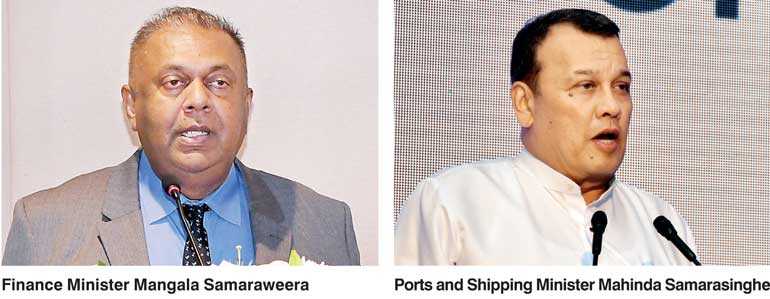
 Sri Lanka’s Finance Minister Mangala Samaraweera wrapped up the 2018 budget debate promising to end the country’s ‘nanny state’ approach, and expressed his determination to press ahead with radical liberalisation. He went on to say, “To do this we must be open to global trade, embrace competition and take on the world and win. Whilst the government will not be a nanny state, we do not forget the vulnerable and those who need the support of the State.”
Brave words no doubt, heralding a much needed change in overall
approach. Among the industries targeted by the Minister for
liberalisation was the shipping sector. What would this entail?
The protectionist era
 In
the 60s and 70s, protection in shipping was the name of the game.
Developing countries were eager to develop their national merchant
fleets, and their efforts were encouraged and supported by UNCTAD’s Code
of Conduct for Liner Conferences, that proposed a cargo split of
40:40:20, with the higher proportion to the respective fleets of the
trading partners, and the lower percentage to third flag carriers. It
was a radical move.
In
the 60s and 70s, protection in shipping was the name of the game.
Developing countries were eager to develop their national merchant
fleets, and their efforts were encouraged and supported by UNCTAD’s Code
of Conduct for Liner Conferences, that proposed a cargo split of
40:40:20, with the higher proportion to the respective fleets of the
trading partners, and the lower percentage to third flag carriers. It
was a radical move.
Sri Lanka was in the forefront of this development, with the
establishment of the Ceylon Shipping Corporation (CSC) in 1971 and the
Central Freight Bureau (CFB) in 1973. The CFB was the first organisation
among the developing countries to have a mechanism in the form of a
central freight booking office, which had the ability to allocate cargo
following the guidelines of the UNCTAD Code. The CFB model was adopted
by several developing countries with the technical assistance of CFB
officials. CSC modernised its fleet from break bulk to containers and
dominated the Sri Lankan market, and also performed creditably in the
India- Pakistan to Europe Trade against fierce foreign competition.
However, with the winds of change ushering in open economic policies in
Sri Lanka as well as in many developing countries, protection for
shipping in international trades began to lose its lustre. Sri Lankan
policymakers adapted to the change, and the CFB was disbanded in the
early 90’s. CSC was unable to weather the heightened level of
competition (a period in which several carriers ceased to exist) and
departed from liner shipping in the mid-90s.
Sri Lanka’s import & export trades were fully opened up for free
competition. Any shipping line was able to call at Sri Lankan ports, and
shippers were free to make their choice of carrier at freight rates
determined by market forces, and the lines were permitted to select a
local agent of their choice. Shipping was liberalised.
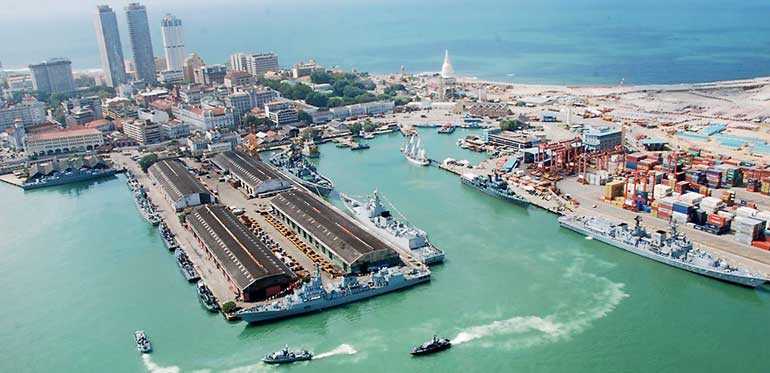
Ports and terminals
Not to be outdone, Sri Lanka’s Ports & Terminal sector also ushered
in change. The Sri Lanka Ports Authority (SLPA) was formed in 1979, and
controlled all port & terminal activity. In 1999 the SLPA agreed to a
30 year BOT concession agreement with a consortium of foreign and local
investors to set up the South Asia Gateway Terminal (SAGT). This was
one of the largest foreign investments in Sri Lanka and was completed in
three phases in 2003. The investors in SAGT were: A.P. Moller Group;
Evergreen International SA; Peony Investments SA; John Keells Holdings
PLC; and Sri Lanka Ports Authority.
SLPA is a minority shareholder. With this development, the ports and terminal sector was liberalised.
SLPA went one step further, signing a 35 year BOT agreement which saw
the Colombo International Container Terminal (CICT) come on stream in
2013. China Merchants Port Holdings Company owns 85% of CICT’s shares,
with SLPA holding the balance.
In December 2017, SLPA agreed to a 99 year lease of the Southern Port of
Hambantota to China Merchants Ports Holding for $ 1.12 billion - Sri
Lanka’s largest foreign direct investment in the maritime sector.
In the first half of 2018, Colombo had the highest growth level of any
global port compared to the same period in the prior year. Its
transshipment volumes during this period had an impressive growth of
19.8%.
The downside to this feel-good story is that the Port of Colombo is
almost at full capacity with no room for expansion until the East
Container Terminal is operational. The country’s desire for greater
foreign earnings and investment would be satisfied if this project is
fast-tracked.
Nine foreign investors have expressed an interest in investing in the East Container Terminal.
SLPA has an ambitious expansion project on the drawing boards that could attract further foreign investment.
What remains to be liberalised?
All the ballyhoo about liberalisation comes down to a relatively
insignificant aspect of shipping - the shareholding of local shipping
agents.
The global container shipping industry has been highly unprofitable in
the past few years. Earnings have been exceptionally volatile despite
volume growth. Some of the pain is self-inflicted through the penchant
to gain market share by adding capacity through often unneeded new and
larger vessels. This scenario has forced several carriers to merge with
their larger brethren for survival. Some such as Korean giant Hanjin did
in fact go out of business, stranding thousands of laden containers
throughout the world.
Carrier consolidation has led to the TOP 6 having a market share of over 70%.
Carrier market share
APMMaersk 17.8%
Mediterranean Shipping Company 14.4%
COSCO Group 12.3%
CMA-CGM Group 11.7%
Hapag Lloyd 7.1%
ONE (Ocean Network Express) 6.8%
Consequently, when blame is cast on local shipping agents for
cartelisation, the reality is that carrier consolidation has forced the
concentration of agencies among a few companies - a development
completely out of the control of local companies.
The Ceylon Association of Shipping Agents (CASA) has over 130 members,
and competition for agency business is fierce and ever present, bearing
in mind that large carriers require agents with the required
organisation to support their business. The proposed liberalisation
would raise the current limitation of foreign ownership of local
shipping agents from 40% shareholding up to 100%.
Should this proposal be implemented, it would kill the local agency
business that has been the cornerstone of maritime development in the
country for the past 50 years. It is an industry that Sri Lanka should
be proud of, and could continue to be a catalyst for enhancing Colombo’s
status as a maritime hub.
The following results detrimental to the national interest are likely to occur, should the agency business be liberalised:
- With the absence of a national shipping line to speak of - the local shipping agencies have been the bastion for the nurturing of maritime talent & expertise. Foreign carrier owned agencies which function as cost centres (as opposed to profit centres) are likely to have non-nationals in management positions and outsource back office functions to cheaper locations in India.
- The country would earn less than presently by way of income tax with no discernible foreign investment as the agency business involves people and systems and not much more.
- Local agents, mainly SMEs, provide many support services that are essential for a maritime hub. Foreign-owned agencies would have no interest in providing these services. These SMEs too will be wiped out: i.e. sea marshal transits, ship supply services, ship to ship transfers, marine surveys, chandelling, ship lay-up services, hull cleaning services, P & I correspondent services etc.
- Increase manning of Sri Lankan seafarers in foreign liner and non-liner vessels
- Stymie the progress in maritime education & training fostered by institutions owned by local shipping agents (CINEC etc.)
- Regress the successful efforts of local agents to gain foreign port and terminal management contracts
It is clear that the negatives far outweigh any positives in allowing foreign control of agencies.
All the major carriers are already present in Sri Lanka. Liberalisation would not bring in any newcomers.
Furthermore, local agents have no authority to fix freight rates.
Pricing is the exclusive preserve of the Principals. Hence,
liberalisation will not intensify competition or lower freight rates.
The converse maybe true as local agents do currently espouse the cause
of shippers with their Principals for favourable treatment based on the
merits of the case.
Foreign influence
It is clear that the European Union is funding the lobbying efforts for
agency liberalisation, as four of the six major carriers are European
companies. It is important to recognise that protection in shipping is
alive and well in several EU countries in the area of Cabotage, which is
very detrimental to connectivity and efficiency in container shipping.
So is the case with the United States, China, and several other
developed market economies. Hence, the Ministry of Finance may wish to
re-think the subject before killing the goose that lays the golden egg!
The writer is Principal, Cranford Consulting Inc., and a former
President of United Arab Shipping Company (North America) and General
Manager of the Central Freight Bureau of Sri Lanka and the Ceylon
Shipping Corporation.