Peace for the World World ! Your War Our Lives

The Dalai Lama
A Brief Colonial History Of Ceylon(SriLanka)
Sri Lanka: One Island Two Nations
A Brief Colonial History Of Ceylon(SriLanka)
Sri Lanka: One Island Two Nations
(Full Story)
Back to 500BC.

Sunday, October 21, 2018
Mahinda Rajapaksa’s fringe factor
It is common knowledge that the JO is nothing without the Rajapaksas
Now the momentum is with those who exist outside the parliament
One simple truism is that people have lost faith in traditional institutions
 2018-10-19
D.B.S. Jeyaraj, writing on the meeting between Mahinda Rajapaksa and Maithripala Sirisena held some three weeks ago, suggests that in the coming weeks, G. L. Peiris, the de jure leader of the Sri Lanka Podujana Peramuna (SLPP), will hand over the party leadership to Rajapaksa, the de facto leader. This will, he further
 opines,
give the man enough clout to negotiate and, presumably, to settle those
personality clashes that have widened the rifts within the SLPP. All
things considered, these three months hence would probably be determined
by the moves the joint opposition makes and the retaliatory measures
the United National Party takes. In that sense, the tête-à-tête between
the President and his erstwhile rival is both an expedient move and an
exercise in futility.
opines,
give the man enough clout to negotiate and, presumably, to settle those
personality clashes that have widened the rifts within the SLPP. All
things considered, these three months hence would probably be determined
by the moves the joint opposition makes and the retaliatory measures
the United National Party takes. In that sense, the tête-à-tête between
the President and his erstwhile rival is both an expedient move and an
exercise in futility.
It is common knowledge that the JO is nothing without the Rajapaksas. G.
L. Peiris is the most eloquent parliamentarian we have, but eloquence,
no matter how much of an advantage it may be inside parliament, pales in
comparison to popularity from outside that hallowed institution. It is
of course convenient to say that the SLPP doesn’t have much of a
presence within the confines of the Diyawanna Oya and that what little
parliamentary prestige it has managed to conjure up for itself has been
due to the Rajapaksa Factor. And yet, that is the truth.
Given these reduced circumstances, what is out there for the SLPP?
In 2015, the political dichotomies were clear: the SLFP and the UNP on
one side, the Rajapaksa Proxies on another, the JVP and the TNA on yet
another. When the TNA took over the Opposition and the leader of the JVP
became Chief Opposition Whip, those were reduced to two; those for the
Rajapaksas and those against them.
What 2015 did was create a gulf between parliamentary prestige and
populist protest. The lack of disregard for parliamentary procedure, the
emphasis on rhetoric over substance, and the demonstrations against the
legislature (as an institution, not just a party-driven political body)
echoed and spearheaded by the JO made it clear that the real fight was
between the MPs, who had been elected, and the stalwarts of the old
order, who were being supported on the sidelines. There was a fatal
rift, for the latter, between numerical strength and popular appeal.
That rift continues even today.

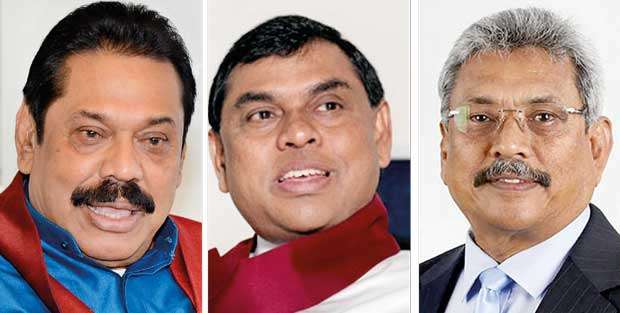
The Rajapaksas were smart. They still are. With each of the three main
brothers, the organisers of their party sought to appeal to three
different interests. Mahinda’s appeal was with the rural peasantry.
Gotabaya’s appeal was with what I alluded to in certain articles last
year as the “professional nationalists”, the milieu which had supported
the Hela Urumaya and was now disenchanted with the likes of Patali
Champika Ranawaka. Basil Rajapaksa’s appeal, on the other hand, was with
a business class touted as “nationalist” by some, but which in reality
idealised a blend of ruthless authoritarianism and efficiency that the
Rajapaksas as a whole (allegedly) stood for. In other words, Mahinda
would get the village, Gotabaya would get the suburbs around Colombo,
and Basil would plan out everything with business moguls and financiers,
to the dot.
Obviously, this formula did not and could not work in a context where
people looked up to the policies of the current government and their
implementation. From 2015 to the latter half of 2016, those who had
idealised the government on the basis of how it privileged policy over
rhetoric really believed it could deliver. That was why, when Ranil
Wickremesinghe and his cohorts contended that Sri Lanka was in danger of
falling into a middle income trap and the Rajapaksas had empowered the
middle class without setting barricades against the inflationary
pressures this would result in, we placed our faith in the Cabinet he
and the President had formed.
But then, so in 2017, that rift between mass popularity and parliamentary presence began to work the other way around, for the JO.
But then, so in 2017, that rift between mass popularity and parliamentary presence began to work the other way around, for the JO.
It began when the people realised that the current government was not implementing those policies it had harped on and was content on spreading its own gospel
It began when the people realised that the current government was not
implementing those policies it had harped on and was content on
spreading its own gospel. A population that had been taught about good
governance, constitutional reforms and ‘sanhindiyawa’ began to grow
tired. The middle class, the force behind the campaign to get
Maithripala Sirisena elected, shifted gears. It had taken a risk and
rooted for a maverick, when traditionally it had opted for stability and
continuity. That maverick had clipped his own powers and handed over
the legislature to a party that had NOT won a mandate to govern from
that institution. Worse, his programme, overseen by that very same
party, had begun to unravel itself badly.
Our middle class thus did what it was destined to do. Hedge its bets on
the only movement that could take us back to the way things were. That
movement was not the JVP. It was not the TNA, not the JHU or for that
matter not the Frontline Socialist Party either. It was the joint
opposition. Having re-branded itself as the Podu Jana Peramuna, it thus
soon began to capture the middle class, hitherto the preserve of the UNP
and, at least with respect to its more nationalist segment, the Hela
Urumaya.
The apathy of the government, the even more pathetic apathy of the
Opposition (to call it an Opposition would be to insult the legacy of
poorly equipped Oppositions the UNP bequeathed to this country during
the Rajapaksa years), and the silence of those ideologues hostile to the
Rajapaksas and their brand of nationalism all conspired to empower the
SLPP to get in more and more of this particular demographic.
The mainstream polity ridiculed the JO and the SLPP for not having the
numbers. That is a problem it is still afflicted with. But as the local
elections showed, parliamentary presence can be a poor barricade against
popular revolt.
It took an entire week for the storm, that the SLPP’s upset victory
brought about, to go away. A complacent government that had prepared
itself for an insignificant margin of defeat (even those rooting for the
Podu Jana Peramuna prepared themselves for a UNP victory) saw the front
against the Rajapaksas that had held them together wear away, and
eventually collapse. Never again would the President and the Prime
Minister look at each other. After their clash, each would let it out
that the other would be nothing without him politically: the Prime
Minister, because he had to depend on the President for his return to
parliament; the President, because without the UNP, he could not have
been the common candidate. Talk about the power of fringe parties.
There was another factor. The rise of the Alt-Right. Whether or not
commentators are correct in terming Gotabaya Rajapaksa a neo-fascist who
should be condemned on the same terms that (neo)liberals condemn Hitler
and Caligula with, there’s no denying that Donald Trump, Nigel Farage
and Boris Johnson made it possible for people to see things differently.
The world, until then, had been largely determined by globalist
financiers who supported centrists no different to the warmongers they
were opposed to (a claim made not just by right wing conspiracy
theorists and outfits like Breitbart, by the way). A world in which
Obama was championed as a President for Peace thus grew disenchanted
when, even with the hullaballoo against Donald Trump, it became evident
this peace-loving leader of the free world had vastly expanded his
country’s drone program. The movement against the interests he stood
for, predictably, emerged from outside the Congress, even outside the
Republican Party. We know by now what happened later to both ends of the
mainstream political spectrum.
What does all this amount to? One simple truism; the people have lost
faith in the traditional institutions. In 2015, the momentum around the
world was such that it was inconceivable that people could vote for a
Donald Trump. The faith reposed on the three arms of the state, so
strong then, was a legacy of the liberal tradition of the West, the same
tradition the UNP sought to impose here in the name of democracy,
freedom, and a better deal for everyone. In the end, tragically, all
that failed.
The rift between fringe popularity and parliamentary presence befitted
the political establishment in a world where liberalism trumped
everything else. But we live in different times. Now the momentum is
with those who exist outside the parliament. It is with those who can
compensate for lack of parliamentary prestige with numbers drawn from
outside the legislature. For now at least, that momentum belongs to the
SLPP. And behind them, supporting them, there is, not the peasantry the
Rajapaksas have always counted on, but a terribly disillusioned middle
class.
UDAKDEV1@GMAIL.COM
