Peace for the World World ! Your War Our Lives

The Dalai Lama
A Brief Colonial History Of Ceylon(SriLanka)
Sri Lanka: One Island Two Nations
A Brief Colonial History Of Ceylon(SriLanka)
Sri Lanka: One Island Two Nations
(Full Story)
Back to 500BC.

Thursday, November 29, 2018
The Constitution, the Judiciary, and Citizens
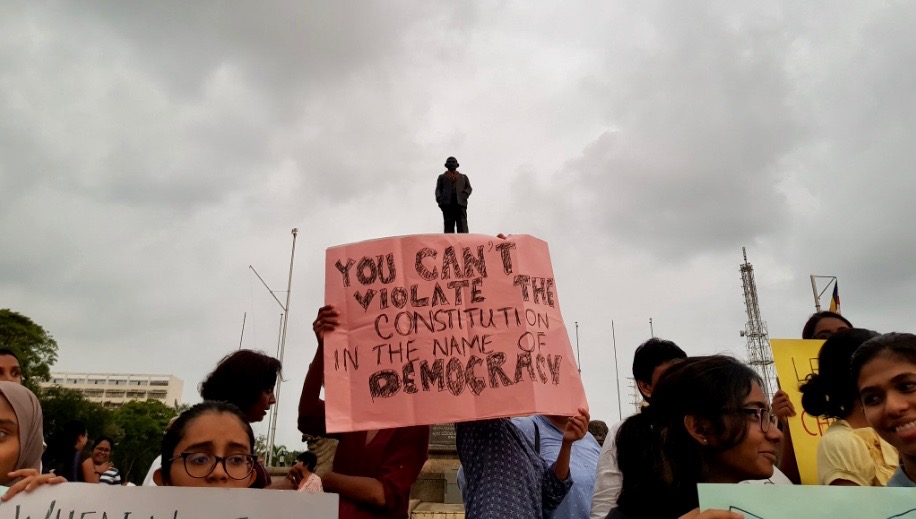

My wife, like many of her fellow citizens these days, has become very interested in learning about our Constitution and its 19th Amendment.
She even borrowed from me a copy of the Constitution to read. The other
day, she forwarded to me a social media post that carried a quote from
Abraham Lincoln. It read as follows: “We the people are the rightful
masters of both Congress and the Courts, not to overthrow the
Constitution, but to overthrow the men who would subvert the
Constitution.”
Meanwhile, a friend, who is in regular touch with the Tamil and Muslim
political parties, told me: “ You know, they (the minority parties) are
extremely worried about the way in which President Sirisena is treating
the constitution. Minorities cannot fully trust politicians and their
promises, whether they are in the UNP, SLFP or any other party. They can
only trust the Constitution; therefore, for them it is the Supreme Law
of the land. That is why they feel that the constitution should be held
inviolable. “ I agreed. “If the Constitution is abused so blatantly and
interpreted so haphazardly by people in power, what is the state
institution they can trust?” asked my friend to whom I answered: “Well,
the Supreme Court is the last bastion of democracy for all citizens. If
it fails, we all will fail, both the majority and the minorities ”
Citizens as Third Party
Sri Lanka’s political crisis has now come before the courts –the Supreme
Court and the Court of Appeal – for arbitration. Each side engaged in
the ongoing power struggle obviously expects the judiciary to rule in
its favour.
Yet, there is a third party, a silent party, to this litigation that is
not represented by counsel. That party are the citizens, ‘rightful
masters’ of the executive, parliament and the judiciary, according to
Articles 3 and 4 of the constitution, which will no doubt be cited in
these cases quite fervently by the lawyers on behalf of their clients.
Citizens can only expect that the judges are the counsel for the
citizens and their rights, unsolicited defenders of their rights,
freedom, democracy, and ultimately the democratic future of generations
to come.
This unique role for Sri Lanka’s judiciary, as expected by citizens, has
come into being under specific circumstances that have also provided
the political context for the current constitutional controversy. The
sudden removal of a sitting prime minister and appointment of a new one,
and a week later, the dissolution of parliament by the head of the
executive, by virtue of the authority given under general clauses of the
constitution, and ignoring other substantive clauses that defined the
ways in which the executive powers should really be exercised in
concrete circumstances, created a massive constitutional confusion.
From Confusion to Havoc
This confusion soon led to a situation of havoc when some leading
lawyers and a retired chief justice explained and justified the three
actions of the President by arguing that some ‘loopholes’ in the 19th Amendment had opened the doors for such unilateral action on technical grounds.
Now, citizens who have earlier been told by legal scholars, such as
former law professors, to view the country’s Constitution as the
‘supreme law of the land’ and hold it as embodying ‘a sacred covenant’
between the rulers and the ruled, were perplexed by this approach to the
constitution. Is a constitution to be understood in relation to its
linguistic or technical loopholes, or on the basis of its normative
foundations and core conceptual assumptions? What is so supreme or
sacred about a constitution, which we learn in the secondary school to
right with capital ‘C’, if it is interpreted with reference to its
so-called loopholes? Obviously, this is an issue that will come before
the judges for contemplation and determination in the days ahead.
Core Values
Now, delineating the normative foundations and core values of Sri
Lanka’s present constitution is also a task before the court given the
conflicting approaches to the constitution pursued by different parties
to the present controversy. Core values of a democratic constitution
define not only powers of each organ of the state and individual who
hold political power, but also limits of the scope as well as the
exercise of constitutionally authorized power.
The absence of an intellectual tradition of constitutional values and
constitutional morality in our country, unlike in the neighboring India,
makes the task all the more difficult.
This in a way offers a historical opportunity for our Supreme Court to
make use of the current constitutional litigations to at least lay down
the basic principles of constitutionalism and constitutional morality
that should govern the rues and limits of the exercise of political
power by those who hold it.
Two Approaches
There are two main approaches of constitutional interpretation in
contention. The first, advanced on behalf of the head of the executive,
is to interpret the clauses of the 19thAmendment as a minor tinkering the original 1978 Constitution as well as the 18th Amendment. This approach makes the argument that the 19th Amendment
retains unaltered the basic framework of the executive presidential
system, introduced by the 1978 original constitution and later enhanced
by the 18th Amendment,
and therefore the three actions by President Sirisena in late October
and early November were well within the presidential powers entitled to
him.
This approach, in effect, seeks to bring back, and revalidate, the 18th Amendment,
through the backdoor. That, of course, is also the objective of those
who vehemently opposed the constitutional reforms brought about by the
19th amendment in 2015. The other approach proposes the view that the 19th Amendment
(a) substantially reduced the powers of the President as defined by the
original 1978 constitution and enhanced by the 18th Amendment, and (b) created a Cabinet and a Parliament, free from arbitrary and unilateral control by the head of the executive.
In other words, the 19th Amendment
is credited to having created a new balance of institutional power
between the President, Prime Minister and Government, and Parliament,
while retaining a limited range of transitional powers for the office of
the President until his terms comes to an end. In this new balance of
institutional power, presidential action in appointing a Prime Minister,
removing a Prime Minister from office, and dissolving Parliament are
not discretionary or absolute, but conditional to limits that are set
out in the constitution itself.
Full Circle
As citizens, we do not know how the Court will respond to these two
contending approaches to the present constitutional controversy. But
citizens, as holders of sovereignty, have every right to expect that the
Court’s determination will advance the interests of the country’s
contemporary democratization process that began with a widely held
political argument that Sri Lanka’s presidential system, introduced by
the 1978 Constitution, should be either totally abolished, or
substantially reformed.
Meanwhile, the enhancement of Presidential powers through the 18th Amendment
was not the outcome of a popular demand on grounds of democratization.
On the contrary, it was a wish fulfillment of one leader who happened to
be the country’s President at the time. And it damaged Sri Lanka’s
democracy, and citizens’ rights and freedoms, and democratic
institutions, including the judiciary, in a manner that citizens still
struggle to forget.
Now, Sri Lanka’s stakes for democratization has come full circle. Should the country see the dreaded 18th Amendment
being brought back through the backdoor and watch how the gains of the
democratic struggle, however limited they are, reversed once again
because of the whims an fancies of another individual in power?
Citizens of Sri Lanka have a right to hope and pray that their judges,
in this moment in which their democratic destiny is at the crossroads,
will make the right decision.
