Peace for the World World ! Your War Our Lives

The Dalai Lama
A Brief Colonial History Of Ceylon(SriLanka)
Sri Lanka: One Island Two Nations
A Brief Colonial History Of Ceylon(SriLanka)
Sri Lanka: One Island Two Nations
(Full Story)
Back to 500BC.

Tuesday, January 29, 2019
Screen time 'may harm toddlers'
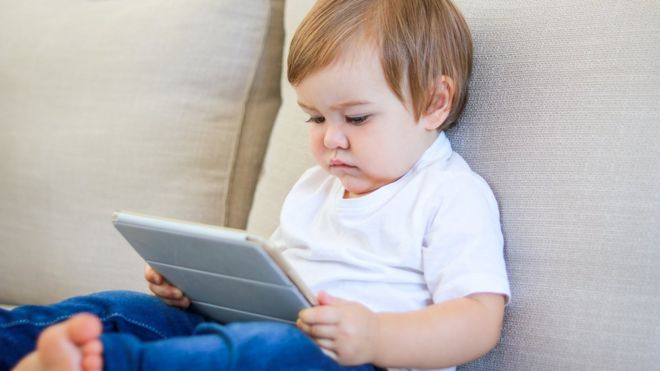

Letting a toddler spend lots of time using screens may delay their
development of skills such as language and sociability, according to a
large Canadian study.
The research, which tracked nearly 2,500 two-year-olds, is the latest
piece of evidence in the debate about how much screen time is safe for
kids.
In Canada and the US, experts say children should not use screens before they are at least 18 months old.
The Royal College of Paediatrics and Child Health says there is not
enough evidence, even when you include this new study, for a "direct
toxic effect".
- Why did child screen advice not go further?
- UK could ban social media over suicide images
- How to limit excessive screen time
- Parents 'struggle to get children off devices'
What did the new research find?
Mums were surveyed (between 2011 and 2016) about screen use, and filled
out questionnaires about their child's skills and development at ages
two, three and five.
Screen time included watching TV programmes, films or videos, gaming,
and using a computer, tablet, phone or any other screen-based device.
At the age of two, the children were clocking up around 17 hours of screen time per week.
This increased to around 25 hours a week by the age of three but dropped
to around 11 hours a week at the age of five, when the children started
primary school.
The findings, published in the JAMA Paediatrics, suggest
increased viewing begins before any delay in development can be seen,
rather than children with poor developmental performance then going on
to have more screen time.
But it is not clear whether screen time - including how much or what
type - is directly to blame. Screen use might just go hand-in-hand with
other things linked to delayed development, such as upbringing and how a
child's remaining leisure time is spent.
What do the researchers think?
When young children are observing screens, they may be missing important
opportunities to practise and master other important skills.
In theory, it could get in the way of social interactions and may limit
how much time young children spend running, climbing and practising
other physical skills - although they may still eventually catch up.
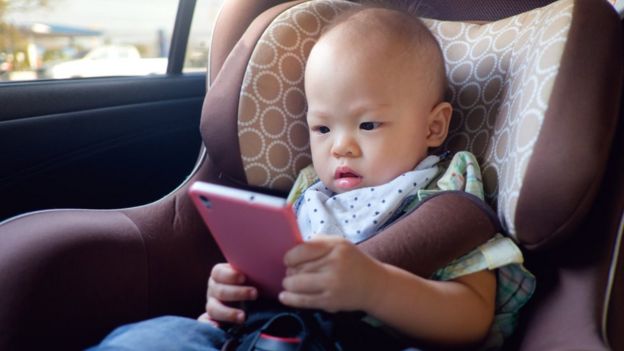
Even without solid proof of harm, Dr Sheri Madigan and colleagues say it
still makes sense to moderate children's screen time and make sure it
doesn't interfere with "face-to-face interactions or family time".
They also said that, with hindsight, perhaps they should have followed
the children from an even younger age because it is becoming
increasingly common for 12-month-old babies to be watching and using
screens.
How much is too much?
It is a good question, without a satisfactory answer.
The new study does not make any recommendation about how much is too
much. Some of the two-year-olds were getting more than four hours a day
or 28 hours a week of screen use, according to their mums.
The American Association of Paediatrics' (AAP) guidelines on screen time say:
- For children younger than 18 months, avoid use of screen media other than video-chatting
- Parents of children 18 to 24 months of age who want to introduce digital media should choose high-quality programming, and watch it with their children to help them understand what they are seeing
- For children ages two to five years, limit screen use to one hour per day of high-quality programmes. Again, parents should be watching it with their children.
- For children ages six and older, place consistent limits, making sure screen time does not get in the way of sleep and physical activity.
The Canadian Paediatric Society goes further, saying screen time for children younger than two is not recommended.
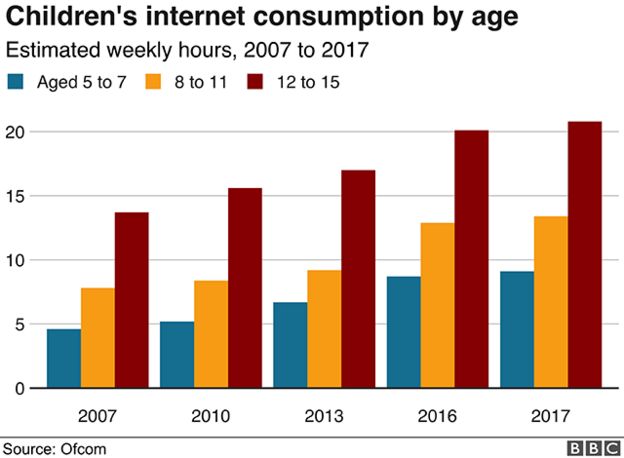
Data for the UK shows internet use among children has increased in recent years
The UK's Royal College of Paediatrics and Child Health (RCPCH) put out guidelines earlier this year, but sets no limit.
It says "evidence is weak for a threshold to guide children and parents
to the appropriate level of screen time, and we are unable to recommend a
cut-off for children's screen time overall".
Instead, it advises families to ask themselves:
- Is screen time in your household controlled?
- Does screen use interfere with what your family want to do?
- Does screen use interfere with sleep?
- Are you able to control snacking during screen time?
If a family can ask themselves these questions, and are satisfied with
the answers, then they can be reassured that they are "likely to be
doing as well as they can with this tricky issue", says the RCPCH.
Tips on cutting back
The AAP advises families to designate media-free times together, such as
dinner or driving, as well as media-free locations at home, such as
bedrooms.
The RCPCH says adults should consider their own use of screens and set a good example.
Most experts also advise that children are not exposed to screens for an
hour before bed, so that their brains have time to wind down for sleep.
