Peace for the World World ! Your War Our Lives

The Dalai Lama
A Brief Colonial History Of Ceylon(SriLanka)
Sri Lanka: One Island Two Nations
A Brief Colonial History Of Ceylon(SriLanka)
Sri Lanka: One Island Two Nations
(Full Story)
Back to 500BC.

Thursday, January 10, 2019
Sponge offers hope of 'less toxic' chemotherapy

Chemotherapy is a treatment for cancer that saves lives but it can also lead to severe side-effects
 9 January 2019
Scientists believe they may have found a way to make cancer chemotherapy treatment less toxic to the body.
They have begun testing a tiny sponge that sits inside a vein and
removes excess chemo drugs from the blood once they have attacked the
target tumour.
Experts say the early work, in the journal ACS Central Science, offers hope of avoiding treatment side-effects, such as hair loss and nausea.
So far, it has been tried in pigs, but researchers want to test it in people.
If all goes well, those trials could happen within a couple of years,
says scientist Dr Nitash Balsara, from the University of California.
How it works
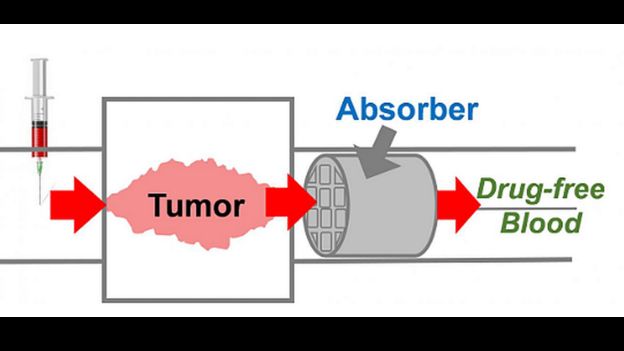
Doctors hope the 'drug sponge' could stop chemotherapy drugs from poisoning other organs in the body
The tubular device is 3D-printed - so it could be tailor-made to fit the patient.
Its mesh-like centre is covered with a special coating that absorbs the drug, but lets blood flow through the device unhindered.
Tests in pigs suggested it mopped up a chemotherapy drug called
doxorubicin, removing about 64% of the drug from the bloodstream.
And it appeared to keep hold of the drug permanently. Continuously
flushing out the device in the lab for a month after removal couldn't
dislodge the drug.
That means it shouldn't leak any drug when the device is taken out of
the body, say the researchers, who were funded by the National Institute
of Health and the National Cancer Institute.
The device would be inserted during chemotherapy and then removed after
the session has ended. Each chemotherapy session would require a new
device.
Dr Balsara says the early results are promising and the device should
work with other chemotherapy drugs if the coating is well matched.
"We feel that removing 50% of the drug will impact patient outcome substantially," he added.
Prof Steve Rannard, from Cancer Research UK, said: "This work is an
exciting new approach to reduce the side-effects of chemotherapy.
"Chemotherapy is a cornerstone treatment for cancer that saves lives,
but can have the unwanted impact of damaging healthy as well as
cancerous tissue, which can lead to severe side-effects.
"This study demonstrates this approach can extract drug molecules from
the blood and remove high levels of drugs that haven't been delivered to
the cancer in animals, which could be an effective approach to address
this challenge.
"We now need to build a greater body of evidence to ensure this
technique is safe before we can see if this could be an effective
approach in cancer patients."
