Peace for the World World ! Your War Our Lives

The Dalai Lama
A Brief Colonial History Of Ceylon(SriLanka)
Sri Lanka: One Island Two Nations
A Brief Colonial History Of Ceylon(SriLanka)
Sri Lanka: One Island Two Nations
(Full Story)
Back to 500BC.

Saturday, March 2, 2019
EXCLUSIVE: Sudanese spy chief 'met head of Mossad to discuss Bashir succession plan'
Munich meeting between Salah Gosh and Yossi Cohen took place with Saudi Arabia and allies seeking to install 'their man' in power in Khartoum, army source tells MEE Salah
Gosh, pictured at home in Khartoum in 2013 after he was released from
prison and pardoned over his alleged role in a coup plot (AFP)
Salah
Gosh, pictured at home in Khartoum in 2013 after he was released from
prison and pardoned over his alleged role in a coup plot (AFP)
Published date: 1 March 2019 12:54 UTC | Last update: 8 hours 59 min ago

Sudanese intelligence chief Salah Gosh held secret talks with the head
of Mossad in Germany last month as part of a plot hatched by Israel's
Gulf allies to elevate him to the presidency when Omar al-Bashir is
toppled from power, a senior Sudanese military source has told Middle
East Eye.
Gosh, the head of Sudan's National Intelligence and Security Services
(NISS), met Yossi Cohen on the sidelines of the Munich Security
Conference in a meeting arranged by Egyptian intermediaries with the
backing of Saudi Arabia and the United Arab Emirates, the source said.

The Saudis, the Emiratis and the Egyptians see Gosh as “their man”, the
source said, in a behind-the-scenes power struggle now taking place in
Khartoum after months of anti-government protests that many now see as
the beginning of the end of Bashir's three-decade rule.
“There is a consensus that Bashir will go within the ruling party and
the army. The battle is about who is coming after,” said the source.
“Gosh has strong links with the Saudis, the Emiratis and the Egyptians.
They want Bashir out, and they want their man in his place.”
A spokesperson for the Munich Security Conference confirmed that both
Gosh and Cohen had attended this year’s event which took place 15-17
February. Another diplomatic source spoken to by MEE corroborated
details of the meeting.
Gosh also met European intelligence chiefs, the head of the Common Media
Center, which is close to the Sudanese government, told MEE.
Why are Sudanese protesting against their government?
+ Show
According to the source, Bashir was unaware of the “unprecedented”
meeting between Gosh and Cohen in Munich. Its purpose was to highlight
Gosh as his potential successor and to bring Israel onboard to secure US
support for the plan.
“The Israelis are seen as their ally, the one they can depend on to open doors in Washington,” he said.
The Mossad, Israel's national intelligence, has played the role of
foreign ministry in dealing with officials of countries that do not have
a peace treaty with Israel, according to Israeli media.
"The Mossad is being used as a foreign ministry in ties with all the
states that do not have diplomatic ties with Israel," an Israeli
official told Channel 13 in a report on normalising ties between Israel
and Bahrain.
CIA's man in Khartoum
Gosh is well known in Washington where he earned a reputation during the
2000s as a spy chief with whom the CIA could work in the “war on
terror” against al-Qaeda, even visiting the US in 2005 when, as now,
Sudan was listed by the State Department as a state sponsor of
terrorism.
A report by the Africa Intelligence website
last month also said that the CIA had identified Gosh as its preferred
successor to Bashir if the Sudanese President’s position became
untenable.
Citing a report by a Gulf state embassy in Washington, the website said
that the CIA was not working to bring about regime change because the
Sudanese government was providing valuable intelligence on al-Shabaab in
Somalia, in Libya, and on the Muslim Brotherhood.
But the embassy report said the CIA would work to ensure that Gosh replaced Bashir if the protests could not be contained.
Bashir has sought to assert his authority in recent days by promoting
army officers to senior positions and introducing sweeping new emergency
powers by presidential decree in an effort to halt the countrywide
protests.
The government reshuffle came soon after Gosh had told reporters in
Khartoum on Friday that Bashir would step down as leader of the ruling
National Congress Party and would not contest presidential elections in
2020.
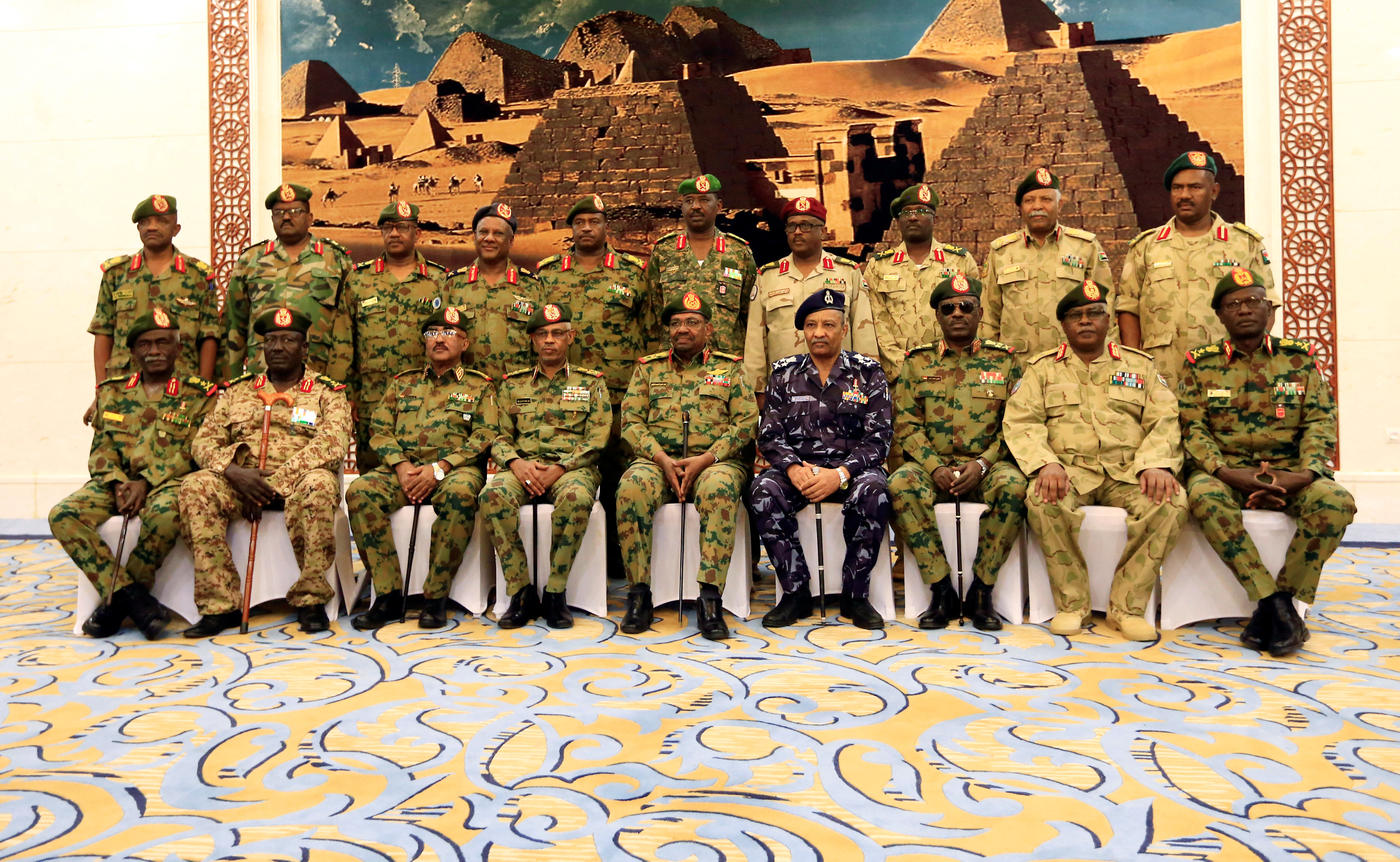
Bashir named his defence minister, General Awad Ibnou, as first
vice-president, and appointed 16 army officers and two NISS officers as
governors of the country's 18 provinces.
On Thursday night, he handed over leadership of
the NCP to his newly appointed deputy, Ahmed Harun. The NCP said in a
statement that Harun would serve as acting chief until a new president
was elected at the party’s next convention.
'Militarisation' of the state
Analysts in Khartoum told MEE this week that Bashir appeared to be moving towards the “full militarisation” of the state and elimination of all opposition within the ruling party.
But MEE's source said that the army remained wary of Gosh and Saudi and
Emirati influence in the country. He pointed to sympathetic coverage of
the protests in Saudi-backed media usually opposed to “popular change”.
“The media are very interested in these protests. That would not happen without a green light,” he said.

Gosh headed NISS between 2004 and 2009, when Bashir appointed him as his
national security adviser. He was sacked in 2011 and later arrested on
suspicion of involvement in a coup plot, but was released with a
presidential pardon in 2013.
He was reappointed as the head of NISS in February 2018. His return was
seen as a move by Bashir to crack down on dissent as the country faced
worsening economic problems and anti-austerity protests, and also to
build bridges once again with the US following the lifting of sanctions
in late 2017.
According to MEE's source, Gosh's return to NISS was also sweetened by
Saudi promises of financial support for the ailing Sudanese economy.
In January, Saudi Minister of Commerce and Investment Majid Al-Qasabi
said during a visit to Khartoum that Riyadh had provided 8 billion
riyals ($2.1 billion) to Sudan over the past four years.
'Fickle friend'
But Bashir has also sought to play the Saudis and the Emiratis off
against regional rivals Qatar and Turkey, which also have strategic
interests in Khartoum, costing him goodwill on all sides, according to a
regional analyst quoted by the Africa Confidential website.
“Riyadh and Abu Dhabi, as well as Doha, have regarded Bashir as a fickle
friend because of his tendency to play both ends against the middle,”
the unnamed analyst said.
“He has pledged allegiance in the past in return for subsidies and then gone his own way.”
MEE understands that American and British diplomats are also working to
persuade Bashir to step down in return for a promise of immunity from
prosecution at the International Criminal Court where he was charged
with war crimes in 2009 over alleged atrocities committed by government
forces and pro-government militias in Darfur.

Bashir is also reported to have discussed possible immunity with United
Nations Secretary-General Antonio Guterres on the sidelines of last
month’s African Union summit in Ethiopia.
Elements of the Sudanese political opposition, most notably its
figurehead, Sadiq al-Mahdi, have long proposed freezing the ICC
indictment in return for Bashir stepping down as a possible way forward.
However, rebel groups in Darfur, some of whose leaders have handed
themselves into ICC custody after also being charged with war crimes,
have said they would reject any such move and would abandon peace talks
as a result.
The Munich Security Conference has long provided a Bavarian backdrop for
discreet encounters between geopolitical antagonists and intelligence
chiefs, with Cohen a regular attendee at the event.
This year’s speakers included Egyptian President Abdel Fattah el-Sisi,
Iranian Foreign Minister Mohammad Javad Zarif, Qatari Deputy Prime
Minister and Foreign Minister Mohammed bin Abdulrahman Al-Thani.
