Peace for the World World ! Your War Our Lives

The Dalai Lama
A Brief Colonial History Of Ceylon(SriLanka)
Sri Lanka: One Island Two Nations
A Brief Colonial History Of Ceylon(SriLanka)
Sri Lanka: One Island Two Nations
(Full Story)
Back to 500BC.

Sunday, April 21, 2019
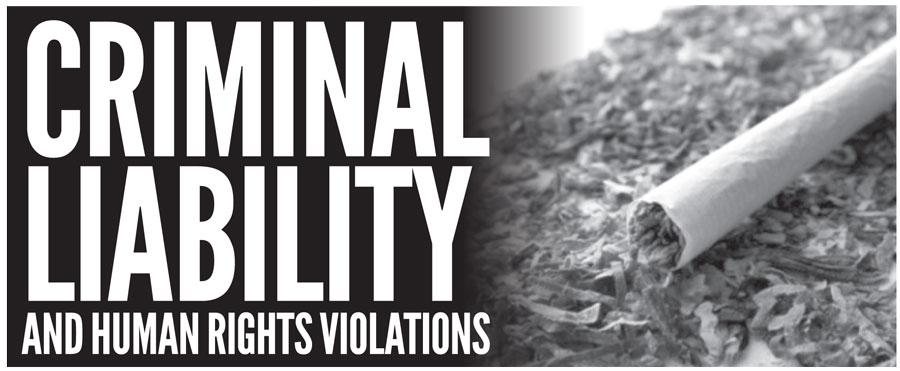
Criminal liability and human rights violations
20 April 2019

“To live up to their human rights obligations, governments have a duty
to protect the rights of their citizens by accelerating the full
implementation of the WHO FCTC” – Laurent Huber, Director US Action on
Smoking and Health.
 Tobacco
use is the leading cause of preventable death in the world. A human
rights approach to ending tobacco is unique because it implores or
requires governments to protect their citizens by implementing tobacco
control laws and strategies to end the tobacco epidemic based on
legally-binding human rights norms.
Tobacco
use is the leading cause of preventable death in the world. A human
rights approach to ending tobacco is unique because it implores or
requires governments to protect their citizens by implementing tobacco
control laws and strategies to end the tobacco epidemic based on
legally-binding human rights norms.
A human rights approach
Smoking negatively impacts the right to life, right to health, right to education, children’s rights, women’s rights, and many others. For instance, the tobacco industry often targets its marketing to specific populations based on gender, race, sexual identity and age. Some of these groups smoke at much higher rates than the general population, and they are all protected by various international and regional human rights treaties and instruments.
Smoking negatively impacts the right to life, right to health, right to education, children’s rights, women’s rights, and many others. For instance, the tobacco industry often targets its marketing to specific populations based on gender, race, sexual identity and age. Some of these groups smoke at much higher rates than the general population, and they are all protected by various international and regional human rights treaties and instruments.
Big tobacco specifically targets women and girls with advertising that
attempts to show smoking as glamorous and to portray smokers as
independent, successful and lean. Women often smoke or continue smoking
in order to lose or control weight. Big tobacco is well aware of this
and many companies have had advertising campaigns focused on weight.
Advertising that targets women and girls often highlights smoking as
glamorous, sophisticated or sexy, all of which are particularly
attractive to teenagers. Obviously, what is considered sexy or cool has
changed dramatically over time, but tobacco companies have kept up with
the trends, as a way to attract younger consumers. These advertisements
are often found in magazines, many with youth readership.
The lethal consequences of smoking have been known to the tobacco
industry for decades, yet they continue these activities, with full
knowledge that millions of deaths will be caused by the ordinary use of
cigarettes which are “the most dangerous product lawfully sold” to
consumers. Tobacco itself is not the primary problem; rather it is the
actions and inactions of tobacco companies that are causing widespread
death and disease. As a World Health Organisation (WHO) publication
pointed out “tobacco use is unlike other threats to global health.
Infectious diseases do not employ multinational public relations firms.
There are no front groups to promote the spread of cholera. Mosquitoes
have no lobbyists.” What crimes could they be held responsible for?
Tobacco products kill more than alcohol, AIDS, car accidents, illegal
drugs and suicides combined. Tobacco use will kill one billion people
this century. As one state Supreme Court recently noted, cigarettes
likely constitute “the most dangerous product lawfully sold” to
consumers. Tobacco itself is not the primary problem; rather it is the
actions and inactions of tobacco companies that are causing widespread
death and disease.
Mosquitoes have no lobbyists. What crimes could they be held responsible
for? Support for a criminal case: The exact crime and its definition
will depend on which state or country brings legal action; criminal law
varies from jurisdiction to jurisdiction. However, these are some of the
potential charges: The Oregon Supreme Court not only discussed the
‘possibility of severe criminal sanctions, both for the individual who
participated and for the corporation generally,’ but stressed that these
actions could ‘constitute at least second degree manslaughter.’
Tobacco itself is not the primary problem; rather it is the actions and inactions of tobacco companies that are causing widespread death and disease
The President of Uruguay stated – “In the world, eight million people
die each year from smoking tobacco. This is mass murder.” Former CEO of
the American Cancer Society John Seffrin - “We must begin to treat the
[tobacco] industry as the unpunished, unrepentant criminals they are.”
The industry itself - Ernest Pepples, an industry lawyers, wrote: If we
admit that smoking is harmful to heavy smokers, do we not admit that BAT
has killed a lot of people each year for a very long time? …might it
not be argued that we have been ‘willfully’ killing our customers…? I
foresee serious criminal liability problems. Manslaughter - recklessly
causing the death of another human being. Causing a catastrophe -
causing potentially widespread injury or damage (this charge is only
available in a limited number of jurisdictions). Reckless endangerment -
placing another person in danger of death or serious bodily injury.
Endangering the welfare of a child - knowingly endangering the child’s
welfare by violating a duty of care, protection or support (in some
jurisdictions, this only applies to a parent or guardian).
· Life: Tobacco is the leading cause of preventable death
· Children: Tobacco marketing targets youth
· Health: Tobacco use infringes on achieving the ‘highest attainable standard of health’
· Education: Child labour in tobacco production denies educational opportunities. Money spent on tobacco by poor families cannot be spent on education. Lack of pictorial graphic warning labels is a lack of information and education on the product
· LGBTQI: Tobacco companies use targeted advertising to normalise smoking in LGBTQI culture
· Environment: Cigarettes impact the environment through their entire life-cycle, from growing and manufacturing to second-hand smoke and litter
· Women: Complicates pregnancy
· Work conditions: Smoking at work impacts the health of all. Tobacco farmers often get sick from nicotine poisoning or Green Tobacco Sickness.
· Racial minorities and indigenous people: Heavily targeted by tobacco marketing (90% of African American smokers use menthol products)
The goal of Action on Smoking and Health (ASH) is to change the mindset of both the tobacco control and human rights communities so that they (and the rest of the world) view tobacco as a human rights issue.
· Children: Tobacco marketing targets youth
· Health: Tobacco use infringes on achieving the ‘highest attainable standard of health’
· Education: Child labour in tobacco production denies educational opportunities. Money spent on tobacco by poor families cannot be spent on education. Lack of pictorial graphic warning labels is a lack of information and education on the product
· LGBTQI: Tobacco companies use targeted advertising to normalise smoking in LGBTQI culture
· Environment: Cigarettes impact the environment through their entire life-cycle, from growing and manufacturing to second-hand smoke and litter
· Women: Complicates pregnancy
· Work conditions: Smoking at work impacts the health of all. Tobacco farmers often get sick from nicotine poisoning or Green Tobacco Sickness.
· Racial minorities and indigenous people: Heavily targeted by tobacco marketing (90% of African American smokers use menthol products)
The goal of Action on Smoking and Health (ASH) is to change the mindset of both the tobacco control and human rights communities so that they (and the rest of the world) view tobacco as a human rights issue.
The production, marketing and sale of cigarettes violate the right to
health and right to life of people around the world. Targeted
advertising also violates the rights of specific legally-protected
groups, such as women, children and racial minorities. A human rights
approach to ending the tobacco epidemic is unique as it implores or
requires governments to advance human development by implementing
measures that decrease smoking. Governments are obligated to protect the
health of their citizens through international and regional human
rights treaties. Tobacco control advocates can use these human rights
mechanisms to help end the tobacco epidemic.
There are several international human rights treaties on topics that are
relevant to tobacco control, and countries are obligated to report to
those treaties about the human rights situation in their countries.
However, those reports seldom include tobacco. The reports are submitted
to the committee for each treaty, which in turn makes recommendations
back to the county that submitted the report. Advocates have the
opportunity to submit reports to draw each treaty committees’ attention
to the way tobacco devastates the populations the treaties are bound to
protect.
Source of information: Action on Smoking and Health (ASH)
Source of information: Action on Smoking and Health (ASH)
