Peace for the World World ! Your War Our Lives

The Dalai Lama
A Brief Colonial History Of Ceylon(SriLanka)
Sri Lanka: One Island Two Nations
A Brief Colonial History Of Ceylon(SriLanka)
Sri Lanka: One Island Two Nations
(Full Story)
Back to 500BC.

Friday, April 26, 2019
The Constitutional Implications of the Easter Sunday Terror Attack
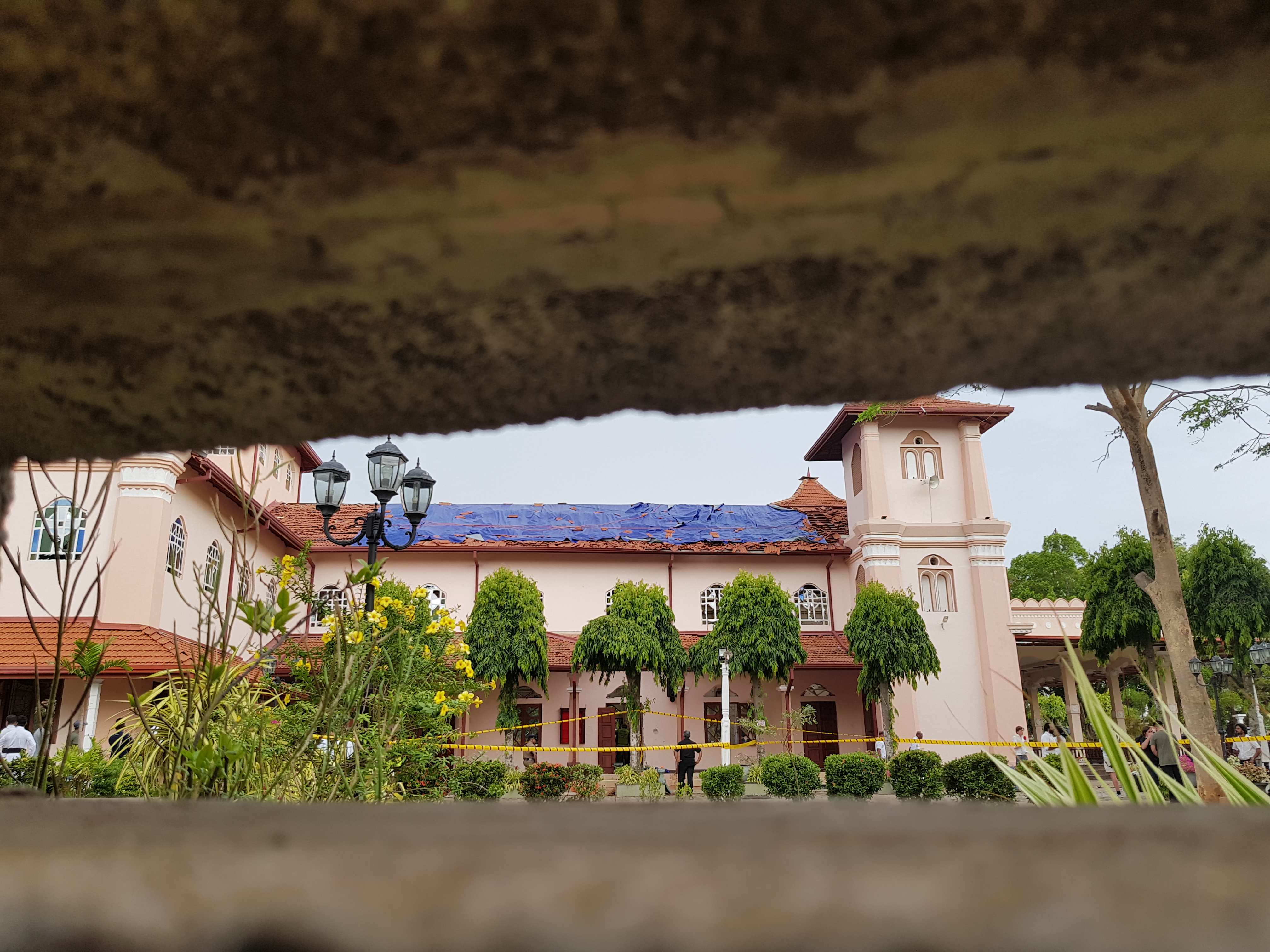
Featured image: St. Sebastian’s
Church in Katuwapitiya, Negombo, remains closed off under heavy military
watch as clearance operations continue. The blue tarpaulin has been
placed over the section of the roof damaged in the blast. Photo by
Amalini De Sayrah.

Sri Lanka experienced its worst terrorist attack since the end of the
war on 21 April 2019. The country is still reeling from the scale and
lethality of the multiple explosions, and there is no clarity yet as to
the perpetrators and their aims. But what is emerging piecemeal in the
aftermath of the attack is a picture of quite incredible incompetence
and negligence on the part of those vested with the responsibility for
the safety and security of citizens (and indeed, our guests) at the
highest levels of the state. The questions that arise inevitably as to
who is responsible and accountable, in turn raise some major
constitutional issues.
Security is the first and foremost responsibility of the state, the
basis on which it is given the monopoly of legitimate violence within
its territory. When it comes to the accretion of discretionary powers
and the evasion of scrutiny – not to mention self-aggrandising security
measures for themselves – Sri Lankan politicians are unusually adept at
invoking national security as a blanket justification. By the same
token, then, when a serious lapse of security has taken place as it did
last Sunday, we are entitled to use the same standard of importance
given to national security in order to hold those responsible for the
lapse accountable.
Accountability is most central value in a constitutional democracy, the
feature that distinguishes it from every other model of government.
Accountability not only requires that power is limited, confined,
structured, and that its exercise is checked and balanced, but also that
both governors and governed subscribe to a shared understanding that
power is legitimately exercised only when it is exercised legally with
reason, caution, responsibility, deliberation, prudence, restraint,
tolerance, and proportion. A state that is – or aspires to be – a
constitutional democracy designs all its institutions and procedures in
order to ensure that those who are temporarily entrusted with the powers
of the state to be used for the furtherance of the public good are
accountable. The government is accountable on a daily basis to a
legislature of elected representatives, to the courts, and periodically
to the people themselves at elections.
In Sri Lanka, we have not always succeeded in designing institutions
that meet these ideals of constitutional democracy, and even more
frequently, we elect political representatives who display little
understanding of these values and even less commitment to their
observance. Nevertheless, on occasion we do succeed in sending a message
to the political class and ensuring some reforms to meet our demand for
accountable and constitutional government. One such occasion was in
2015, when an administration more than usually contemptuous of
constitutional democracy was sent home by the electorate, which also
simultaneously mandated fundamental constitutional reforms to ensure the
realisation of democratic values. The result was the Nineteenth
Amendment to the Constitution (2015), which substantially reconfigured
the political executive of the state.
The new structure of the political executive requires a directly elected
fixed term President to work with a Prime Minister and a Cabinet of
Ministers chosen from and responsible to Parliament. The logic of the
system is rooted in a model of executive power in which power is shared
between the President and the Prime Minister and Cabinet. It follows
that the Constitution expects these two centres of power to work in
unity, even when the electoral basis of the President’s and the Prime
Minister’s powers derive from rival sources. Individuals elected to
these two offices therefore must be capable of working together
regardless of personal, party, or ideological differences. If it is not
to become a source of conflict and dysfunction, this model demands
maturity, intelligence, and a deep understanding of constitutional
democracy on the part of the President and Prime Minister, so as to be
able to work together in the public interest and not use their offices
to indulge in personal rivalries.
This is the model, but the practice departed from it spectacularly in
October 2018, when the President launched what is known in Latin America
and Africa as an autogolpe, or
self-coup. By trying to subvert his own government and attempting to
dissolve Parliament illegally, the President betrayed his mandate and
the trust of his electorate, and undid a great deal of the
constitutional progress made since his election. Fortunately, the very
egregiousness of his actions acted as the impetus for a legislative,
judicial, and popular fightback that saw the defeat of the coup attempt
in December. However, while the institutional checks during the coup
proved resilient enough after the reinforcements introduced by the
Nineteenth Amendment, and citizens showed an unprecedented willingness
to stand up for democracy, the unreformed political culture of the power
elites demonstrated its weakness when the President was allowed to
completely escape political and legal accountability for his otherwise
impeachable actions.
The President, ex officio the Commander-in-Chief, thus remains the
Minister of Defence as well as the Minister of Law and Order. The latter
ministry was in fact brought under the presidency after the coup crisis
in December 2018. Even though the Prime Minister apparently acquiesced
in the allocation of the Ministry of Law and Order to the President,
this has been legally questionable given that the Constitution by
express words only contemplates ministries falling under the subjects of
Defence, Mahaweli Development, and the Environment as being assignable
to the President. Notwithstanding that, the President was the minister
in charge of both defence as well as law and order on Easter Sunday, and
as such, all the armed forces, auxiliary forces, civil and military
intelligence services, and the Police Department came within his
purview. The President also chairs the National Security Council (NSC).
On Sunday morning when the attack took place, the President was overseas
on what appears to be a private visit.
In a press conference on Sunday evening, the Prime Minister noted that
while there was prior information about the attacks, he and other
relevant Ministers had not been made officially aware of it. In a
Cabinet press briefing on Monday afternoon, the Cabinet spokesman and
other Ministers were more detailed and explicit. The gist of the
information at the briefing telecast live was that there had been
several intelligence warnings about the high possibility of an attack of
a very similar nature, that these warnings had come in days and even
hours prior to the attacks, and that the Inspector General of Police had
been specifically informed of the threat. It was moreover revealed that
military and civil security command and coordination through and
outwith the NSC had been monopolised by the President through the two
relevant ministries. The President had not deigned to appoint an acting
Minister for either of the portfolios before he travelled overseas, and
neither had he appointed an Officer Administering the Government,
usually and logically the Prime Minister in the framework of the 1978
Constitution, for the duration of his absence from the country.
Shockingly, it also emerged that the Prime Minister and the Minister of
State for Defence had been excluded from meetings of the NSC since
October, with even the times and dates of meetings held secret to
prevent them from attending. In short, the entire set of governmental
levers we have to detect, apprehend, prevent, or combat the threat of
terrorism is in the jealously guarded hands of the President, and shared
with no other senior member of the political executive.
Individuals hold ministerial office not merely to carry out the
executive functions of a ministry but also to be accountable for all the
activities of that ministry, including acts and omissions of officials
and agents that the minister may not have personally undertaken. A
minister is accordingly entitled to take credit for the achievements of a
ministry, but the inescapable flip side of this coin is that the
minister is there to carry the can when things go wrong. In the face of
parliamentary or judicial scrutiny, the minister takes official
responsibility and is required to resign when the lapse or mistake or
wrongdoing is especially serious. The President is subject to all these
conventions of constitutional democracy when he assigns ministries to
himself, and all the more so when he has chosen to run those ministries
as if they were his personal fiefdom and deliberately excluded the
involvement of the Cabinet.
From such facts as are available in the public domain, it seems
reasonably clear that there was enough evidence and information to have
done something about the perpetrators of the Easter Sunday attacks
before they could inflict their diabolical carnage on the country. That
such action was not taken means there was a security breach. In a
constitutional democracy, there must be accountability for such lapses.
In the light of the circumstances outlined above, it is clear that it is
the President who is responsible and who must take responsibility. If
he does not, as is likely given the man’s track record, then he must be
made to take responsibility. This task lies firmly in the hands of
Parliament. From questioning the President, to a Select Committee
inquiry, and all way through to a formal process of impeachment, our
Constitution entrusts Parliament with holding the executive to account.
Parliament did not fail the people during the coup crisis of 2018 and it
must not do so now.
While the President’s conduct is both lamentable and culpable, it does
not exonerate the Cabinet, and in particular the Prime Minister, from
blame. If the Prime Minister pressed home the principle of the primacy
of office over personality and understood the dangers of not doing so in
matters relating to national security, there were steps that could have
been taken to ensure participation in the NSC, and going public if that
was thwarted. There was no need whatsoever to submit to the President’s
demand for the Law and Order Ministry, especially when he had attracted
such widespread opprobrium for undermining the Constitution and the
Rule of Law by instigating a constitutional coup. By complacently going
along with the President’s unreasonable and irresponsible behaviour –
when citizens who had fought for the preservation of constitutional
democracy instead demanded accountability – the Prime Minister cannot
escape the taint of incompetence and negligence after hundreds of people
have been killed and maimed. The Prime Minister was conspicuous in the
lack of interest he showed in pressing for the constitutional
accountability of the President following the 2018 crisis. In choosing
this path, presumably in the pursuit of some other strategic or tactical
political advantage, the Prime Minister cannot now hope to pin the
blame exclusively on the President.
The upshot is an unsavoury situation in which a besieged country
imploring statesmanship from its political elite is saddled with a weak
and divided leadership that has no understanding of the constitutional
tenets underpinning the republic. It is to be hoped that the law
enforcement machinery will prove robust enough to withstand the strains
of the attack and its aftershocks. But the events of Easter Sunday 2019
will not go down as a moment in which Sri Lanka showcased the vigour of
its constitutional democracy in the face of adversity.
