Peace for the World World ! Your War Our Lives

The Dalai Lama
A Brief Colonial History Of Ceylon(SriLanka)
Sri Lanka: One Island Two Nations
A Brief Colonial History Of Ceylon(SriLanka)
Sri Lanka: One Island Two Nations
(Full Story)
Back to 500BC.

Monday, April 22, 2019
The profoundly deaf girl who found her voice after brain surgery
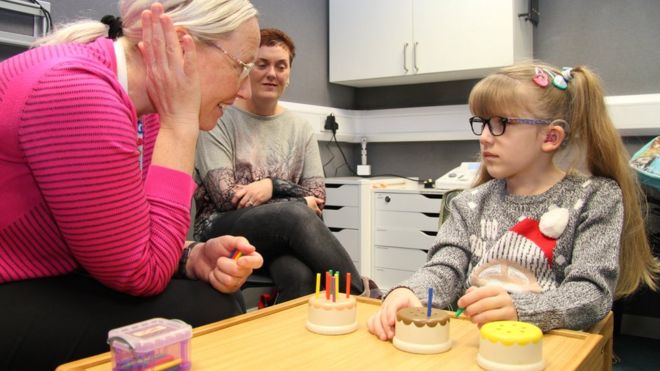
 21 April 2019
Seven-year-old Leia Armitage lived in total silence for the first two
years of her life, but thanks to pioneering brain surgery and years of
therapy she has found her voice and can finally tell her parents she
loves them.
"We were told you could put a bomb behind her and she wouldn't hear it
at all if it went off," said Leia's father, Bob, as he recalled finding
out their baby daughter had a rare form of profound deafness.
Leia, from Dagenham in east London, had no inner ear or hearing nerve,
meaning that even standard hearing aids or cochlear implants wouldn't
help her.
As a result, she was never expected to speak - but despite the risks,
her parents fought for her to be one of the first children in the UK to
be given an auditory brainstem implant, requiring complex brain surgery
when she was two years old.
NHS England calls the surgery "truly life-changing" and has said it will
fund the implant for other deaf children in a similar position.
It is estimated that about 15 children a year will be assessed for the procedure and nine will go on to have surgery.
Hear cars beeping
Bob says opting for this type of brain surgery was a huge decision for
them, but "we wanted to give Leia the best opportunity in life".
He and his wife Alison hoped that after the surgery at Guy's and St
Thomas' NHS Foundation Trust she would be able to hear things like cars
beeping their horns as she crossed the road - to make her safer in the
world.
However, in the five years since the surgery, her progress has been much greater than they ever expected.
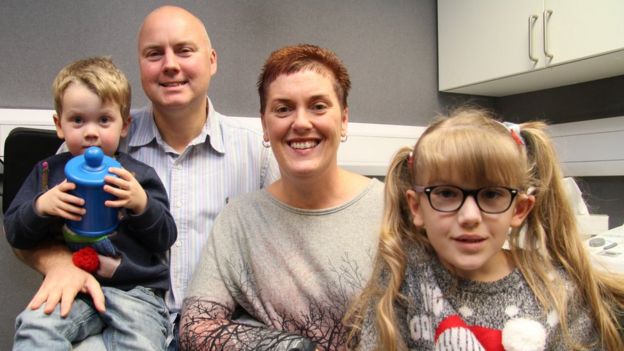
Leia with her parents, Bob and Alison, and brother Jacob
It started slowly, with Leia turning her head at the sound of train doors closing shortly after the operation.
Gradually, she started to understand the concept of sound while her
parents continually repeated words, asking her to mimic the sound.
Now, after lots of regular speech and language therapy, she can put full
sentences together, attempt to sing along to music and hear voices on
the phone.
"We can call her upstairs when we're downstairs and she will hear us," Bob explains.
'I love you'
But it's at mainstream school, in a classroom with hearing children,
where Leia is really flying, thanks to assistants using sign language
and giving her plenty of one-to-one time.
"She is picking up more and more and she's not far behind others of her age in most things," Bob says.
At home, using her voice is what pleases her parents most.
"'I love you Daddy' is probably the best thing I've heard her say," Bob says.
"When I'm putting her to bed she now says 'good night Mummy', which is something I never expected to hear," Alison says.
The cutting-edge surgery involves inserting a device directly into the
brain to stimulate the hearing pathways in children born with no cochlea
or auditory nerves.
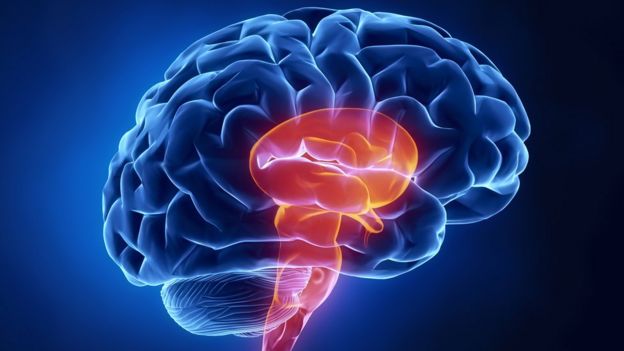
The implant is inserted directly into the brain next to the brainstem at the bottom of the brain
A microphone and sound processor unit worn on the side of the head then transmits sound to the implant.
This electrical stimulation can provide auditory sensations, but it cannot promise to restore normal hearing.
However, Prof Dan Jiang, consultant otologist and clinical director of
the Hearing Implant Centre at Guy's and St Thomas' NHS Foundation Trust,
said some children can develop a degree of speech.
"The outcomes are variable. Some will do better than others," he said.
"They have to adapt to it and younger children do better so we like to insert the implant early if possible."
Children under five are best placed to learn new concepts of sound and respond to intensive therapy, he said.
Susan Daniels, chief executive of the National Deaf Children's Society,
said: "Every deaf child is different and for some, technology like
auditory brainstem implants can be the right option and can make a huge
difference to their lives.
"With the right support, deaf children can achieve just as well as their
hearing peers and this investment is another important step towards a
society where no deaf child is left behind."
