Peace for the World World ! Your War Our Lives

The Dalai Lama
A Brief Colonial History Of Ceylon(SriLanka)
Sri Lanka: One Island Two Nations
A Brief Colonial History Of Ceylon(SriLanka)
Sri Lanka: One Island Two Nations
(Full Story)
Back to 500BC.

Sunday, April 28, 2019
The Social Media Block Isn’t Helping Sri Lanka
In a country with tight government controls on traditional media, social media is a double-edged but necessary sword.
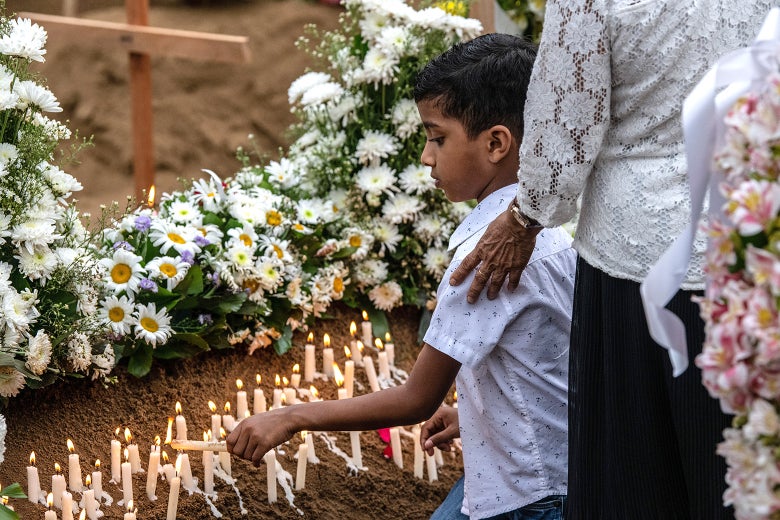
A young boy lights a candle at a grave after a funeral for a person
killed in the Easter Sunday attack on St. Sebastian’s Church, on
Thursday in Negombo, Sri Lanka.
Carl Court/Getty Images
 COLOMBO, Sri Lanka—Today
has been a bizarre day. In an ideal world, I should be working on a
project-funding proposal and trying to finish a short story about a
near-future police force. Instead, I’m pacing the office. I just
finished speaking with a journalist from a prominent media organization
about the block on social media imposed in Sri Lanka in the aftermath of the devastating recent terrorist attacks,
its effects, and the information flows in this country. I’ve been
digging into social media and politics for a while, so people think I
have answers.
COLOMBO, Sri Lanka—Today
has been a bizarre day. In an ideal world, I should be working on a
project-funding proposal and trying to finish a short story about a
near-future police force. Instead, I’m pacing the office. I just
finished speaking with a journalist from a prominent media organization
about the block on social media imposed in Sri Lanka in the aftermath of the devastating recent terrorist attacks,
its effects, and the information flows in this country. I’ve been
digging into social media and politics for a while, so people think I
have answers.
Now, the journalist is waiting for an Uber to take him to what is
effectively a high-security zone. He doesn’t have his press pass. He is a
foreign national, a brown man carrying two cameras and an enormous
backpack. The latter is the hallmark of a suicide bomber right now. If
the police detain him, he’s finished. If the neighbors see his backpack
coming out of our office, we’re finished.
The Uber driver, thankfully, is a Muslim. Right now, he understands more
than anyone else what it is like to be suspect. We have a small chat.
He reminds me of a guy I used to work for, back when I was selling
keyboards and mice at a mall retail store. Every other month someone
would start a thread on a popular local internet forum, railing at the
store for being Muslim-owned. The people who jumped into the cesspool of
hate included a semifamous ex-con who was fond of making death threats.
My boss would scroll up and down anxiously, but his store stayed open
regardless. The driver, likewise, intends to roll on. This is, I assure
the journalist, a bad time to be in Colombo, but it’ll get better. It
always does.
To understand Colombo, one needs to first grok how small it is—not just
in terms of size, but in terms of community, Colombo is one of those
places where everybody knows everybody else. Forget Facebook’s 3½ degrees of separation.
It’s near-impossible to meet someone without finding out immediately
after that they’re somehow connected to your father, mother, sister,
brother, cousin, batchmate, colleague, frenemy. Whereas other cities seem to offer casual anonymity, Colombo takes it away.
So take this tightly bound community. Rip out a few hundred people.
Hospitalize a couple of hundred more. What you get is a wounded,
panicked, screaming beast.
The first news of the wounds came to us through social media. Bhanuka
Harischandra, a friend of mine and a successful startup founder, put up
an Instagram post of the outside of the Shangri-La Hotel with a caption
about seeing bodies tossed out by a blast. He was there to meet a
potential business partner. His next post was from the Cinnamon
Grand—where the suicide bomber stood in the buffet line, according to
reports—with bits of ash and shrapnel in his T-shirt. Then came a flurry
of tweets asking what had happened to Kingsbury, another luxury hotel.
And a church in Batticaloa. And St. Sebastian’s. Then another church.
Photos were shared through Facebook.
Only then did news of the attacks break on television.
Media in Sri Lanka is tightly controlled by a very few people and often
riddled with political bias. It is customary in Sri Lankan politics to
steamroll, impugn, and commit character assassination on those who do
not join you in victory; journalists have traditionally been forced to
be instruments. Media might be freer now, but these bruises still
remain, entrenched by political power.
In a country with such tight government controls on traditional media,
social media is more of a boon than Western commentators would assume.
In October, the current president of Sri Lanka decided to violate the
Constitution, instigate a coup, and appoint the former president,
Mahinda Rajapaksa, as prime minister—while an elected prime minister sat in office.
Within minutes, Sri Lanka effectively had two governments and two prime
ministers. Parliamentarians were crossing over to opposing parties, and
some lesser minister’s bodyguard had fired into a mob. The videos of all
of these reached us a full 15 minutes before the news anchors started
their spiels, their political affiliations obvious. Without social
media, we would not have known what was going on during that volatile
political situation.
And this week, as chaos reigns, people in the West are celebrating the
decision to block access to social networks. As of Thursday, the block
is still in place. A state of emergency has been declared, and we have
no idea what time curfew will be tomorrow, let alone the fate of the
Facebook block. Official information sources are increasingly starting
to resemble hoaxes themselves.
In this zeitgeist, the few journalists who engage with the Colombo
community, such as Azzam Ameen, a reporter with BBC Sinhala and a
journalist with a fast thumb, are go-to sources. The text from Ameen’s
Twitter and Facebook pages is copied and shared in WhatsApp
groups—family and friends, entire school batches (or classes) from many
decades ago. The block—which is not a ban on people accessing social
networks so much as an easily circumventable order for internet service
providers to block the websites and apps—is making it harder for many
to access Ameen’s information. But it isn’t stopping rumors from
flourishing. I should know, since I’ve spent a great deal of my time
trying to help people verify information.
In the West, many praised the most recent social media block. Kara Swisher wrote in the New York Times,
“When the Sri Lankan government temporarily shut down access to
American social media services like Facebook and Google’s YouTube after
the bombings there on Easter morning, my first thought was ‘good.’ …
because it could save lives … because the companies that run these
platforms seem incapable of controlling the powerful global tools they
have built … so many false reports about the carnage were already
circulating online that the Sri Lankan government worried more violence
would follow.” Swisher acknowledges at the end of her column that
“shutting social media down in times of crisis isn’t going to work.” But
she seems unaware of the actual source of the problem here.
The Sri Lankan government has tried all this before. It shut down social
networks in March 2018, in response to riots targeting Muslims. In the
events leading up to those attacks, the government didn’t do anything
about the anti-Muslim hate speech peddled on social media by the
far-right Buddhist organization Bodu Bala Sena and its affiliates;
they’re monks, after all. This negligence is precisely what caused
organized mob violence in the first plane. The government let hate
speech run its course, then took the rug out from everyone—even, for
some bizarre reason, blocking my own author website (my political blog
was left intact)—and then blamed the scapegoat of the day, Facebook.
Media attention was focused at the time on the role of Facebook in
violence in Myanmar, and Western journalists lap this stuff up.
People also fail to understand blocks can be quite easily circumvented with virtual private networks. Innocent people—who may be unaware of the security risks—search
Google for “VPN” and download the first thing they see, opening their
devices and network traffic up for all kinds of nefarious third parties.
The block also sends the actual racists and hate speech–mongers
underground. Whereas once we could see some tip to the iceberg, now it
stays underwater, propagating across networks that are far more
difficult to examine—WhatsApp and SMS, for instance. If more people
start using Signal or Telegram, we might as well forget the whole thing
altogether.
To be clear, social media isn’t entirely benign in Sri Lanka or
anywhere. Here it took a dark twist very quickly after the Easter
bombings. The blame game kicked off with a vengeance. In general, four
fingers were pointed:
1. The Muslims did it.
2. The Sinhala Buddhists did it. (This was expounded on, completely unverified, by a journalist at the BBC.)
3. A hypothetical resurgent Liberation Tigers of Tamil Eelam—the group
the government fought in the Sri Lankan civil war that ended a decade
ago—did it.
4. The current government stood by and did nothing. Maybe it wanted this to happen.
I put up a warning against the spread of misinformation that went viral
shortly after. It didn’t seem to have done much good. Not just for
social media, but for traditional media as well. BBC World aired some
pundit claiming the attacks were from Sinhala Buddhist mobs, a complete
untruth.
Soon the social networks were buzzing with fake news and misinformation
spreading like lightning precisely because of the tightly connected
nature of the beast. Hoaxes appeared on school-batch groups, work
groups, and family-and-friends channels and spread out to second- and
third-degree networks with a flick of the finger. A small cadre of
volunteer fact-checkers leaped in to bridge the gap between journalists
on the ground and a panicked public.
The things I have been asked to verify over the past 48 hours stretch
from the silly to the post-apocalyptic. Fakes starting with “Azzam Ameen
told my friend.” (Easy for me to debunk: I just had to drop Ameen a
Twitter message to confirm it fake within minutes.) Doctored screenshots
claiming Dialog Axiata, a prominent telecommunications company, was
fining people for the use of VPNs (easily countered by talking to
telecom regulators, examining the relevant acts for mentions of fines
and VPNs, getting a Dialog customer care agent to consent to be recorded
confirming this was fake, and then pestering Dialog until it did the
same through Twitter). Rumors of the water supply in Hunupitiya being
poisoned (not so easily countered; residents knew nothing, and by the
time we finished calling, there were vehicles on the streets of
Kiribathgoda and Mattakkuliya urging people not to drink tap water). A
fake police page claiming use of VPNs would get you hauled away by the
police. “Someone closely connected” to either Army or Navy circles
talking about a lorry full of unexploded bombs going up and down (That
one turned out to be like Nostradamus: eventually true.)
Maybe a block could have been useful—if the government had presented a
unified front and a clear stream of relevant information and then
clamped down tightly on all the jokers out there. Instead what we saw
was a minister smirking about how his father told him this would happen
days ago and the prime minister’s camp saying the National Security
Council refused to meet the prime minister until the president got back
from a jaunt overseas. We got the secretary of defense shrugging off the
attacks and whining about how unfair it was to single him out. We saw
the president claiming to have absolutely no knowledge of the matter.
And across Colombo, my friends are reporting to me of Muslim tenants
asked to leave homes, of Uber drivers refusing to take on Muslim
clients, of family groups asking their daughters not to wear scarves and
for sons to shave their beards. Likewise, a flood of people offering
support, places to stay, food, reparations. Every so often, an incident
grows beyond the minor and escalates to the point where someone like
Ameen will have a look at it, verify it with the police and local
authorities, and post it with images.
What the government should have done is engage, instead of block. They
have the capacity. Last year, when I was editing the president’s
Wikipedia article to link it to a “Constitutional Crisis” page, the
President’s Media Division swung into action immediately: Myself and
others (who wish to remain unnamed) ended up in a bizarre Wikipedia edit
war. Every time we linked to any derogatory news about the president,
they would remove it.
This particular division, as far as I know, is close to 100 people. One
hundred people fact-checking via social media could have done so much to
manage the chaos and restore orderly information flows.
Instead, the government and its chaotic approach continue to compound
problems. In a case of horrible mistaken identity, for instance, the
police and Criminal Investigation Department have just plastered a photo
of Amara Majeed, a student at Brown, as a suspect on national TV. It
was local social media that found out who she was. I have been
fact-checking information for the past three days, and I am forced to
conclude the police are incapable of looking up an image on Google.
One wonders whom to trust, and the inevitable truth is this: I trust
people on social media more than I trust the instruments of government.
Because in Colombo, where there is little anonymity, me and mine know
the person and can reach them in minutes.
This is not to diminish the role of some news agencies that did their
job this time around, but I cannot trust they’ll do the same once the
next election rolls around and something else happens. And as for the
government, there are probably colonies of bacteria on the Red Sea that
are more competent at running a country. And that’s putting it kindly.
Future Tense is a partnership of Slate, New America, and Arizona State University that examines emerging technologies, public policy, and society.
