Peace for the World World ! Your War Our Lives

The Dalai Lama
A Brief Colonial History Of Ceylon(SriLanka)
Sri Lanka: One Island Two Nations
A Brief Colonial History Of Ceylon(SriLanka)
Sri Lanka: One Island Two Nations
(Full Story)
Back to 500BC.

Tuesday, May 7, 2019
Dharmaloka: A school, and a lesson
 “What
have they planned for us?” the boy next to me asked, bewildered, as the
van we all were in drove up past the gates. He got the answer
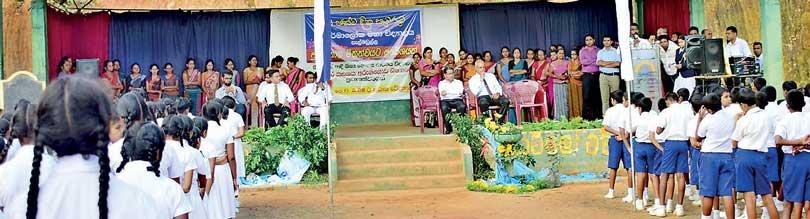
immediately: a procession of students lined up before a budhu medura,
boys on one side, girls on the other. It was charming, but perhaps a
little too much to take in, since nothing I, or we, had done had
warranted a retinue which had obviously been arranged for us. We got
down clumsily, some so confused that they’d forgotten to put on their
school ties, and stared. Then the bell rang, the principal and the
teachers came, and there was a call to worship. Hastily putting our
hands together, we obliged and prayed with them.
“What
have they planned for us?” the boy next to me asked, bewildered, as the
van we all were in drove up past the gates. He got the answer
immediately: a procession of students lined up before a budhu medura,
boys on one side, girls on the other. It was charming, but perhaps a
little too much to take in, since nothing I, or we, had done had
warranted a retinue which had obviously been arranged for us. We got
down clumsily, some so confused that they’d forgotten to put on their
school ties, and stared. Then the bell rang, the principal and the
teachers came, and there was a call to worship. Hastily putting our
hands together, we obliged and prayed with them.  7 May 2019
In most rural Sinhala villages, particularly in far-flung outposts,
Buddhism is firmly linked with the education of children. There’s one
school in Colombo that’s gained a reputation for its budhu medura, but
elsewhere it’s a norm: a school must have a shrine, and students pray
before it every morning. For schoolboys from multicultural – and in my
case, secular – establishments, it’s hard to come to terms with this
reality, because we’re taught a very different gospel in our classrooms.
The boys beside me knew their gathas and sutras, certainly more than
me, but this kind of communal worship was, I could see, outside their
experience: for them faith is personal, never to be invoked out loud.
Here, however, one cannot whisper. One has to raise one’s voice.
Through Ratnapura, Rakwana connects Colombo to Embilipitiya, which is
where the Sabaragamuwa meets the Dakuna (South). Pelmadulla lies between
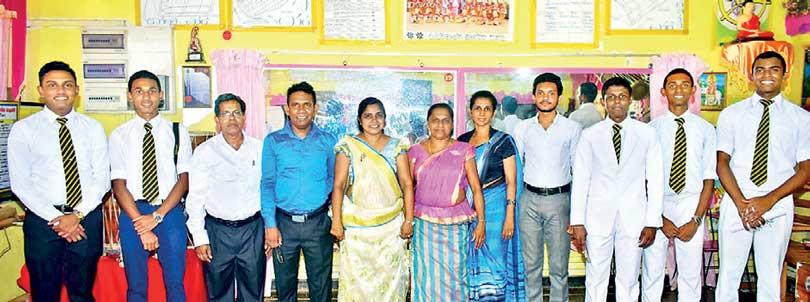
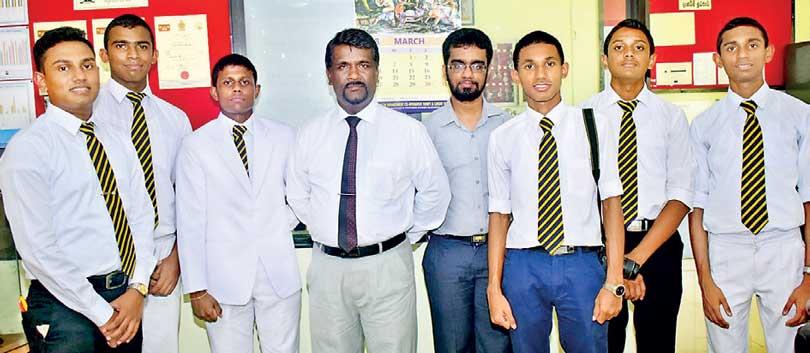
the two, and we were at present in a school there. To keep a long story
short, I had written an article on a set of boys who had organised a
Book Fair at their school in Colombo; their leader, who had attended the
school we were at until Fifth Grade, had been asked to come with them,
and me, to an otherwise innocuous ceremony: the opening of a new
library.
Dharmaloka is in that sense an indictment on this dilemma: whereas the big schools have 10 or 15 students studying the subject for their A/Levels, here there are more than 40
It’s a little difficult to explain the sociological undercurrents of
this phenomenon: the telescoping of mundane ceremonies to the status of
profoundly significant events. But it’s a reality that’s only too
pervasive outside Colombo. And in any case, it wasn’t just the library
we were occupied with: the boy was being “celebrated” because he’d made
it to the news years after he had aced that ultimate symbol of
educational mobility, the pahe shishyathwaya (Grade 5 ). We were being
celebrated with him, and also thanked for having contributed, in some
small way at least, to his ascent.
The school we were at, Dharmaloka Vidyalaya, is not small, but then I
realised that this was precisely the point: it’s the kind of
intermediate institution which churns out most of the scholarship
wallahs who end up at Royal and Ananda and Dharmaraja and Richmond. In
this boy and his colleagues, who had also gone to Colombo through the
shishyathwaya (scholarship), the staff and the principal had thus
vindicated themselves.
Dharmaloka is special, and stands out, for a reason: for the last few
years and decades, the school has clinched nearly every category at
national art competitions. At last year’s Interschool Art Competition,
for instance, 15 of the 16 participants won awards and certificates,
coming first in three categories, second in three, and third in one,
with two consolation prizes.When it comes to ART or chitra kalawa
another problem persists. With each passing generation, fewer and fewer
children tend to paint. It’s not just that they don’t want to draw; the
truth is that they CAN’T draw. Dharmaloka is in that sense an indictment
on this dilemma: whereas the big schools have 10 or 15 students
studying the subject for their A/Levels, here there are more than 40.
Yet even among the 40 there is an issue: most of them prefer graphic
design (mosthara) to expressive art (prakashana); digital commercial art
has, sadly, gained over the hand-drawn variety.
Pix by Manusha Lakshan
Gamini Muhandiram, Art teacher at Dharmaloka, cogently highlighted a
related problem: “There is an urban-rural gap when it comes to students
who settle for this subject. Many of those who select it from these
parts of the country do so because they can genuinely draw.
Unfortunately, they don’t have financial strength. We have to provide
for them and we have to make up for their shortfalls.” In that sense he
feels that State-sponsored art festivals are to be welcomed: “The
National Art Competition achieves what it aims at. Among other things,
the prize money the students win goes a long way in meeting certain
urgent needs.” Not that this solves the problem: the truth remains that
the more talented you are, the more indigent you tend to be.
Dharmaloka is special, and stands out, for a reason: for the last few years and decades, the school has clinched nearly every category at national art competitions
Dharmaloka has gone a long way in addressing these issues. If the
students have anyone to thank for that, it’s their teacher. And he
hasn’t gone unnoticed: last year, for instance, “Gamini sir” won the
Teacher of the Year Award at the International Forum for Teachers
organised by Gateway Graduate School. There were four other finalists,
from Dehiaththakandiya, Galgamuwa, Puttalam and Nuwara Eliya as well.
The author can be reached on UDAKDEV1@GMAIL.COM
