Peace for the World World ! Your War Our Lives

The Dalai Lama
A Brief Colonial History Of Ceylon(SriLanka)
Sri Lanka: One Island Two Nations
A Brief Colonial History Of Ceylon(SriLanka)
Sri Lanka: One Island Two Nations
(Full Story)
Back to 500BC.

Tuesday, May 7, 2019
Easter Sunday carnage The big picture of Intelligence failure and how to fix it Only the tip of the iceberg of a wider intelligence failure
Sri Lanka’s
battle against Islamic extremism would involve two integral parts: (a)
an intelligence driven kinetic approach to flush out, arrest or
neutralize violent extremists; and (b) a State facilitated and
community- led approach to combat non-violent extremism, reverse the
spread of Wahhabism and Arabization of local Muslims and restore the
primacy of moderate Sufi Islam among Sri Lankan Muslim community.
 7 May 2019
For each task at hand, the Government, security apparatus, community
leaders and other stakeholders should understand and identify the
gravity of the problem, before they proceed to address them.
In this first article of a two part series, I analyze the overall
intelligence failure that led to the disaster and core areas that need
fixing in order to achieve a degree of coherence and certainty in
intelligence operations against homegrown Islamic terrorism.
 The
bickering of the President and Prime Minister in Sri Lanka’s uneasy
political cohabitation is blamed on for letting the Easter Sunday
tragedy to happen. They, in turn, have claimed that they were not privy
to crucial prior intelligence provided by a ‘friendly nation’ ( aka
India), and blamed the higher- ups of the security and Police
establishments for not passing information right up the chain of command
and across the assorted security agencies and tri-forces. Defence
Secretary and IGP have taken the flak, one resigned, the other was sent
on compulsory leave.
The
bickering of the President and Prime Minister in Sri Lanka’s uneasy
political cohabitation is blamed on for letting the Easter Sunday
tragedy to happen. They, in turn, have claimed that they were not privy
to crucial prior intelligence provided by a ‘friendly nation’ ( aka
India), and blamed the higher- ups of the security and Police
establishments for not passing information right up the chain of command
and across the assorted security agencies and tri-forces. Defence
Secretary and IGP have taken the flak, one resigned, the other was sent
on compulsory leave.
Repeated intelligence failure- from April 5th when the Indians first
alerted their Sri Lankan counterparts, to the hours before the attack
when the final alert was received- is a criminal negligence of
unprecedented scale. With right security measures, the monstrosity on
Easter Sunday could probably have averted.
Security forces had not performed any better for the most part of the three-decade of war against the LTTE
However, this is only the tip of the iceberg of a wider intelligence
failure, which kept the entire security establishment in dark over the
scale, capability and intent of creeping violent Islamic extremism in
the country. That this happened right under the nose of security
apparatus that had a proven track record in counter terrorism is a
further shock.
On November 30, last year, two Policemen, PC Walpita Gamage Niroshan
Indika Prasanna and PC Ganesh Dinesh, who were on duty at the
Vavunathivu Police were hacked to death by unknown assailants, who got
away with the service revolvers of their victims.
The Police arrested an ex -LTTE cadre, who still languishes in remand
custody, charged under the Prevention of Terrorism Act (PTA).
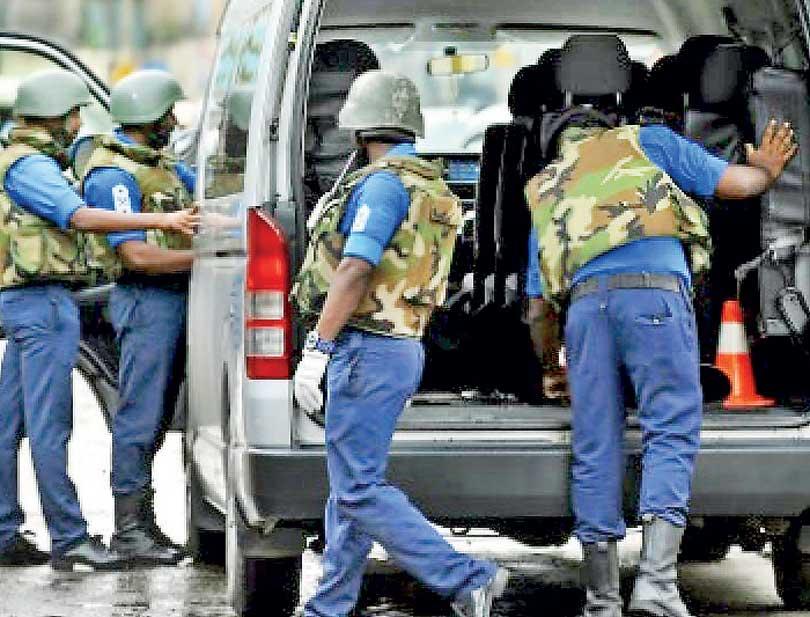
However, military and Police raids after the Easter Sunday attack
uncovered the disturbing details that the attack was a work of Islamic
terrorists. The driver of terrorist ring leader Zahran Hashim, Mohommed
Shareef Adam Lebbe (53) alias Ghaffor Mama revealed the group’s
involvement and led the Police to a safe house, where one of the service
revolvers was found along with a cache of other weapons. The other
was found buried in the terrorist hideout in Vanathavilluwa. Two
suspects have since been arrested.
Also in December, intelligence agencies failed to follow up with the
disturbing evidence uncovered in the Vanathavilluwa hideout. Again, it
was a politically sensational investigation into the vandalism of Buddha
statues that led to the Vanathavilluwa site, and not some proactive
intelligence operation.
Now, there are scandalous details of a discovery of a sprawling
terrorist training centre with a visible watch tower in the heart of
Kattankudy, a crowded city of 60,000 people.
There were also early warnings by local Muslims of Zahran’s preaching of hate. Protests were held in the town since 2014, and a final dozier on Zahran’s preaching was handed over to the Defence Secretary in January this year.
There were also early warnings by local Muslims of Zahran’s preaching of hate. Protests were held in the town since 2014, and a final dozier on Zahran’s preaching was handed over to the Defence Secretary in January this year.
The sectarian strife in the town culminated into a clash in March last
year between the local Sufis and Zahran’s followers. Intelligence
agencies did not follow up on any of those leads.
One should ask how did that happen – and why did that happen?
One should ask how did that happen – and why did that happen?
This brings us to a snippet of overall conditions of Sri Lankan politics, its institutions and its stakeholders.
Pro-activeness is never a Sri Lankan trait. Our Public Service, the
Ministries and Departments are an epitome of inefficiency and red tape.
Meritocracy hardly counts in the election of political leaders, and when
in power, their political calculations have overwhelmed the national
interest.
Security forces had not performed any better for the most part of the
three-decade of war against the LTTE. One security top brass went to the
Rupavahini to plead the case of his daughter’s Olympic participation,
while the battered Army was making a hasty withdrawal from the Elephant
Pass military garrison.
Another former Commander of Army had the reputation of dancing only with
underwear atop tables of Officers mess. APCs (Armored Personnel
Carrier) brought for military operations in the Vanni stuck in the sand.
Body armours malfunctioned. Missile frigates were bought at millions of
dollars and then docked at the harbor for most part due to an engine
failure. Some people became instant millionaires through shady
procurement rackets.
However, somewhere down the line things changed. The catalyst, to give
the devil his due, is ex-president Mahinda Rajapaksa and the manifest
conviction to finish the war for once and for all.
The subsequent success was, as widely identified, down to the
combination of three individuals, Mr Rajapaksa as the President and the
Commander-in-Chief, the then Defence Secretary Gotabaya Rajapaksa and
Commander of Army Field Marshal Sarath Fonseka.
Each of them faced tough challenges, which any faint hearted (Which the
majority of Sri Lankan politicos and bureaucracy are) would have shied
away.
Their personal attributes, and a combined conviction (Rather than an
institutional arrangement) was the primary driver of the military
success. However, the same combination of personalities later saw the
deterioration of the security apparatus and their politicization.
After Sarath Fonseka’s Presidential bid, Mr Rajapaksa’s unleashed full
blown vengeance at former Army Chief and his perceived supporters, many
including the current Army Commander, were sent on compulsory
retirement.
Field Marshal Fonseka was jailed. Military was politicized. Many top officers who were instrumental in winning the war then sang paeans, expecting promotions and diplomatic postings.
This did not necessarily erode the intelligence operations. But, it politicized it. That was again due to personal calculations of Mr Rajapaksa, who saw a perceived security threat/international conspiracy as a driver for internal mobilization of masses to a personality cult.
This phase ended with Mr Rajapaksa’s defeat at the Presidential Election on January 8, 2015.
However, new era of politically motivated indifference to national
security began. Just like his predecessor sought to use a possibility of
the revival of the LTTE and an international conspiracy as means of
political legitimization, their successors used reconciliation and
international endorsement for the same purpose.
Their political considerations and scaled down threat perceptions
resulted in the Government’s indifference towards national security.
Though affected, security forces could still function organically for
existing institutional structures, laws, regulations and budgetary
allocations.
However, intelligence agencies were the worst affected. The reason:
There is no legal framework governing intelligence activities in Sri
Lanka.
During the war against the LTTE, intelligence agencies-defence
intelligence agencies in particular- operated under the limited powers
vested under the Emergency Regulations.
In addition, there was understanding of an unofficial immunity and
political cover for the intelligence activities undertaken in the
interest of nation security.
Defence Secretary and IGP have taken the flak, one resigned, the other was sent on compulsory leave
The State of Emergency lapsed on 30 August 2011, and since then the
Rajapaksa regime relied on calling of the Armed Forces by the President
in terms of Section 12 of the Public Security Ordinance (Chapter 40).
In February 2015, after the election of President Maithripala Sirisena,
calling of the security forces under the Public Security Ordinance
(Chapter 40) was revoked.
This effectively reduced the space and mandate for the Defence Intelligence services to engage in effective intelligence operations.
This effectively reduced the space and mandate for the Defence Intelligence services to engage in effective intelligence operations.
At present there are a number of intelligence agencies in Sri Lanka. They include Defence Intelligence Services such as Dte of MI, Directorate of Naval Intelligence (Dte of NI), Office of Air Intelligence (CIO) and State Intelligence Agencies; the SIS, Criminal Investigation Department (CID), Terrorist Investigation Division (TID), Police Special Branch (SB), and the Special Task Force (STF) Intelligence Branch. The operational capabilities of defence intelligence services were seriously constrained by this legal lacuna.
It is politically convenient to blame the arrests and legal action taken
against several military officials for crippling the intelligence
service. That is far from the truth, though the absence of legal
guarantees of immunity for intelligence work definitely demoralized
intelligence officials. However, the lack of operational mandate due to
the absence of a legal framework had a far more destructive blow on
effective intelligence work.
Sri Lanka needs an Intelligence Service Act.
In order to effectively deploy its multiple intelligence agencies, Sri
Lanka needs to provide a unified legal framework through a Parliamentary
Act. And Sri Lanka does not need to reinvent the wheel. Many countries
that encountered the same problem have adopted their own legal
provisions. USA Patriot ACT of 2001, Intelligence Services Act of 1994
of the United Kingdom and the Intelligence Services (Powers and
Regulations) Act of 2011 of India are some examples.
A Sri Lankan Intelligence Services Act should review the current
security situation, conceptualize an institutional structure that brings
together multiple intelligence services to an unified umbrella, clarify
the mandate of each of these agencies to engage particular domestic and
international arenas and provide a legal framework for organization and
coordination for intelligence activities and immunity from persecution
for intelligence operatives for undertaking mandated intelligence work.
Also important in the Sri Lankan context is such a legal framework would
serve as a bulwark against the politicization of intelligence services
as has been the case in the past.
An earlier proposal for an Intelligence Service Act was presented to the Cabinet, but did not proceed further.
An earlier proposal for an Intelligence Service Act was presented to the Cabinet, but did not proceed further.
The government now confronted with a monstrous internal security threat
would suddenly find that effective intelligence services are sine qua
non for national survival. However, in the absence of a unified
institutional framework, ad-hoc agencies investigating overlapping tasks
and then not sharing information would continue. Also, irrespective of
the immediate sense of urgency, certainty and long term operational
mandate of intelligence agencies are still subject to political whims.
When the threat level recedes with the arrests of core members of
Islamic terrorist, some fool would suggest the return to the old sense
of complacency. Then the next bomb will go off. An Intelligence Service
Act would also be a deterrent against such petty-minded political
opportunism.
Follow @Rangajayasuriya on Twitter
