Peace for the World World ! Your War Our Lives

The Dalai Lama
A Brief Colonial History Of Ceylon(SriLanka)
Sri Lanka: One Island Two Nations
A Brief Colonial History Of Ceylon(SriLanka)
Sri Lanka: One Island Two Nations
(Full Story)
Back to 500BC.

Wednesday, May 15, 2019
How Bangladesh has kept Islamic radicals in check
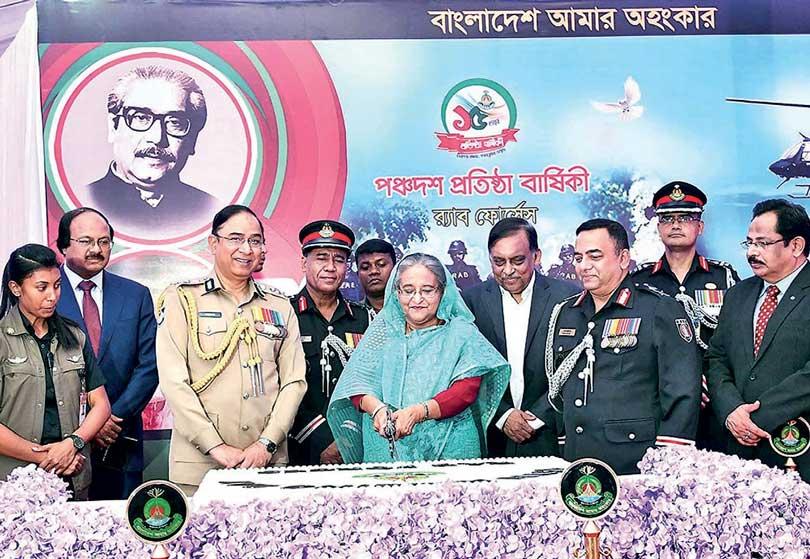
Bangladesh marks the 15th anniversary of the anti-terrorist Rapid Action Battalion
Muslim-majority
Bangladesh was born out of an explicitly secular and linguistic
movement spearheaded by Sheikh Mujibur Rahman. But it did not take long
for the new born to show that it was “Islamic” as well as “Bengali”.
 14 May 2019
 This was due to the failure of Bangladesh’s post-independence secular rulers to live up to their promises. With the failure of Mujib’s secular government, political Islam became the rallying point for the disgruntled.
Subsequently, unpopular military rulers seeking legitimacy strengthened
political Islam by reviving and nurturing it. Pakistan also played a
role in instigating and sustaining political Islam to get back
Bangladesh which it lost in 1971.
 Over
time, political Islam became increasingly radical and terroristic.
Successive governments in Dhaka were formally “secular” but were bending
over backwards to carry Islamist forces with them, giving them
legitimacy in the process. And whenever the State asserted its modern
secular character, Islamist radicals would unleash terrorism to make the
government mend its ways.
Over
time, political Islam became increasingly radical and terroristic.
Successive governments in Dhaka were formally “secular” but were bending
over backwards to carry Islamist forces with them, giving them
legitimacy in the process. And whenever the State asserted its modern
secular character, Islamist radicals would unleash terrorism to make the
government mend its ways.
The Islamists saw abjuring Islam in favour of a “Bengali”
ethno-linguistic identity as a mark of subservience to India which had
been seeking a greater political and economic role in a country which it
helped found by sending in its military in December 1971.
Over time, Islamism mixed with nationalism proved to be a potent political mix which governments found hard to fight.
Between January 2005 and December 2017, about 746 persons had fallen
prey to Islamist terror and State counter-terror operations. According
to a study, 91% of these ghastly incidents had taken place since 2013
when Prime Minister Sheikh Hasina of the Awami League was trying to put
Bangladesh back on its original secular track.
In 1977, before Hasina came to power, the constitution replaced
secularism by “absolute trust and faith in almighty Allah”. Military
ruler Ziaur Rahman’s Bangladesh Nationalist Party (BNP) fostered the
notion that Bangladesh is Islamic. Between 1976 and 1979, Zia legalized
religious political parties and allowed Islamists, who had worked with
the Pakistani Army during the liberation war, to participate in
government.
The Bangladesh Jamaat-e- Islami (BJeI), banned by Mujib, was able to
publicly rejoin Bangladeshi politics in 1979. Gen. H.M. Ershad, the
country’s second military dictator, made Islam Bangladesh’s state
religion. He even gave cabinet positions to two BJeI “war criminals”.
The world was unaware that a whole generation of Bangladeshis had grown up with no love for Pakistan or the Islamic movement prior to the formation of Pakistan in 1947
In 1990, democracy returned to Bangladesh. But it did not augur well for
secularism. The BNP led by Gen. Zia’s widow, Begum Khaleda Zia,
continued to cultivate and accommodate Islamic radicals. But this was
vehemently opposed by the Awami League now led by Sheikh Mujib’s
daughter Sheikh Hasina Wazed.
While the “Battle of the Begums” raged, Bangladeshi militants returning
from the “Jihad” in Afghanistan added fuel to the fire. They teamed up
with the al-Qaeda Rohingya Solidarity Organization (RSO). RSO came to
Bangladesh along with the 200,000 persecuted Rohingyas from Myanmar.
Pakistan’s ISI, waiting in the wings, tied up with BJeI to turn
Bangladesh into a launching pad to stage attacks in neighbouring India.
BJeI and its student wing, Islami Chhatra Shibir (ICS), the Jagrato
Muslim Janata Bangladesh (JMJB) and Jamatul Mujahideen Bangladesh (JMB)
attacked Hindus, Ahmadiyas and Awami League workers.
The JMJB and JMB merged under the leadership of Sheikh Abdur Rahman and
Siddiqur Rahman, known as “Bangla Bhai” (Bengali Brothers). The Bangla
Bhai became popular for providing instant justice. Mainstream
politicians cultivated the “Bangla Bhai” and ran protection rackets with
them till the BNP government led by Prime Minister Begum Zia felt the
need to control them. The Rapid Action Battalion (RAB) was set up to
fight the menace.
In August 2005, the JMB set off 459 bombs simultaneously in 63 of
Bangladesh’s 64 districts to push the country into adopting Sharia law.
The Harkat-ul-Jihad-al Islami Bangladesh (HuJI-B), founded in 1992,
issued death threats against the feminist authoress Taslima Nasreen, who
had to flee from Bangladesh. It tried to assassinate Prime Minister
Sheikh Hasina.
The Pakistan-based Lashkar-e-Taiba (LeT) staged many attacks in
Bangladesh. Many Bangladeshis resident in the UK went to Syria to fight
alongside the Islamic State (IS). Adept at using sophisticated
communication technologies, the IS influenced well educated and
well-heeled young Bangladeshi Muslims.
The killers of 18 foreigners and two Bangladeshis in the up-market Holey
Artisan Bakery in Dhaka on July 1, 2016, were well-heeled students from
Dhaka’s private North-South University.
In 2009, despite the wide berth given by the predecessor BNP regime to
Islamic radicals, Sheikh Hasina set up a War Crimes Tribunal to try
persons who had committed war crimes during the liberation struggles as
auxiliaries of the Pakistani army. There had been a mass student
movement since 2007 seeking the trial of war criminals.
But the Jamaat-e-Islami, the main target of the trials, and human rights
groups cried foul saying that the procedures did not accord with
international norms. Apart from Pakistan which passed many resolutions
against the trials, Malaysian leader Mahathir Mohammad and Turkish
leader Erdogan appealed for clemency. But Sheikh Hasina was undeterred.
The trials continued and many were sent to the gallows.
Hasina was adept at resisting foreign pressure. When the US put
tremendous pressure to get Bangladesh to let an island be used as a US
base, she put her foot down.
Hasina was undeterred even by the country-wide mayhem unleashed by the
Jamaat because she had the support of Bangladeshi youth, including youth
from the private universities. In 2013, the broad-based Shahbad
movement backed her to the hilt, demanded capital punishment and a ban
on the Jamaat.
Explaining this a Bangladeshi commentator said: “The world was unaware
that a whole generation of Bangladeshis had grown up with no love for
Pakistan or the Islamic movement prior to the formation of Pakistan in
1947. These were young students and professionals born after 1971.
Hasina was cued into this generation.”
An independent minded person, Hasina resisted the temptation to go along
with the Western view that the Holey Artisan Bakery attack was the
handiwork of the international lslamic State and not a local group. She
sensed that attempts were being made to link up the massacre with the IS
so that the Western agencies could enter the investigation process and
infiltrate the Bangladeshi security set up. She therefore doggedly held
on to the view that the massacre was a local job.
She refused to yield to pressure from the Bangladesh elite to release
some of the suspects saying that law enforcement machinery could not be
fettered.
To get the ramifications of the network which carried out the July 1,
2016 attack, and to avoid harassment of the public, Hasina appealed to
families to inform the police of any missing persons or anyone moving
about suspiciously in their neighbourhood. This unearthed information
about more than 200 persons, which helped crack the case.
Hasina knew that people were tired of terrorism and governments which tolerated and fostered radicalism and helped radicalism metamorphose into terrorism. Therefore her appeal for “Help to Help You” had the desired effect. People came out with useful information.
The Prime Minister tackled the drug menace in the same way. She knew
drug traffickers were terrorizing locals and forcing them to tolerate
their nefarious activities. That was why, despite the international cry
over extra-judicial killings, there was no local resistance or
disapproval of the strong arm methods she used.
Political commentators predicted that Hasina and her Awami League would
lose the last elections because of “human rights violations” under her
rule since 2009. But she won handsomely. The opposition BNP was in
disarray and did not contest and the Jammat had gone into hiding as it
had lost its base.
Hasina knew that people were tired of terrorism and governments which tolerated and fostered radicalism and helped radicalism metamorphose into terrorism
However, Hasina is not oblivious to the fact that Bangladesh is an
Islamic country and the hold of religion is strong in the rural areas.
Therefore she has come to an understanding with Hefazat-e-Islam which
runs thousands of Qawmi Madrasahs.
The Hefazatis preferred to the Jamaat because unlike the Jamaat, the
Hefazat was not against the struggle for freedom from Pakistan.
Hasina yielded to the Hefazat’s demand for recognition of their
certificates for government jobs. She removed from the Supreme Court, a
statue of justice showing a lady in a sari holding the scales of
justice, which the Hefazat said was un-Islamic. She did not allow writer
Tasleem Nasreen to come back to Bangladesh as she had ridiculed Islam.
She criticized secular bloggers for going overboard in their posts.
Hasina has mastered the art of balancing secularism and Islam and has
curbed radicalism and terrorism with a mixture of guile and firmness.
