Peace for the World World ! Your War Our Lives

The Dalai Lama
A Brief Colonial History Of Ceylon(SriLanka)
Sri Lanka: One Island Two Nations
A Brief Colonial History Of Ceylon(SriLanka)
Sri Lanka: One Island Two Nations
(Full Story)
Back to 500BC.

Monday, May 13, 2019
Israel’s choice in Gaza
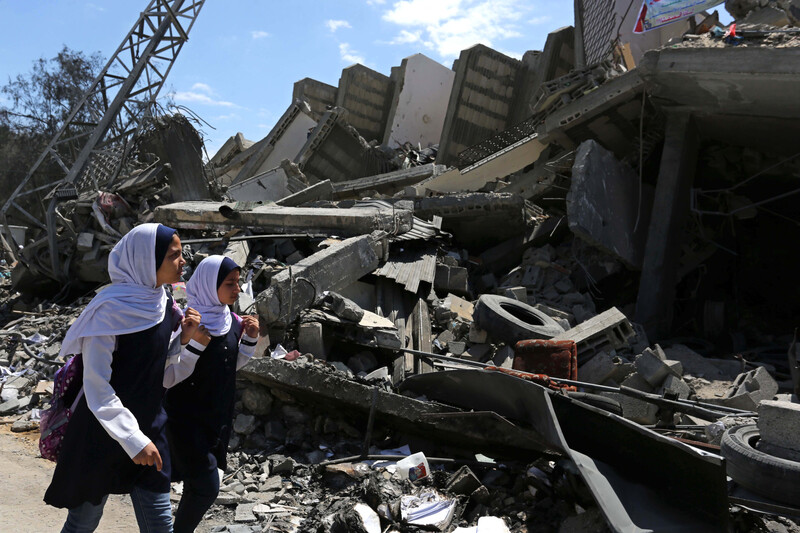
Palestinian students walk past a school destroyed days earlier in Gaza City on 8 May.
APA images -10 May 2019
Will Israel opt for another war on Gaza, or will it finally lift the
siege it has imposed on the territory for 12 years, at great cost to its
two million Palestinian inhabitants?
That is the choice Prime Minister Benjamin Netanyahu and his generals face as armed factions in Gaza have given Israel until Monday to deliver on its commitments under a ceasefire agreement reached earlier this week.
That ceasefire brought to an end more than 48 hours of
violence across the Gaza-Israel boundary that left 27 Palestinians in
Gaza dead – 14 of them civilians killed by Israeli fire – as well as
four civilian fatalities on the Israeli side.
The agreement reached on Monday is understood to be similar to
understandings that brought an end to major Israeli offensives in Gaza
in summer 2014 and November 2012.
The immediate steps expected by Palestinian factions include the reopening of the fishing zone, the transfer of funding from Qatar and the reopening of Gaza’s commercial crossings.
“Regular” life anything but
Regular life in southern Israel resumed immediately after the agreement.
But Gaza, along with the West Bank, remained under full closure as Israelis vacationed during national holidays.
Fishers were unable to set sail until Israel partly lifted restrictions on Friday.
“In Gaza, where the economy struggles for survival and residents face
adverse humanitarian conditions, every additional day that passes until
these further restrictions are lifted by Israel has severe
implications,” Gisha, a human rights group that monitors Israel’s
siege, stated on Tuesday.
“Traders cannot fulfill their business commitments, patients miss
crucial appointments for life-saving treatment, and fishermen cannot
feed their families,” Gisha added.
The rights group said that “Israel’s use of its control over the
crossings to deliberately harm the civilian population in Gaza has to
stop.”
Even when Israeli bombs aren’t being dropped, the status quo in Gaza –
under air, sea and land blockade for more than a decade, and military
occupation for half a century – is far from normal.
Every two in three Palestinians in Gaza is a refugee from lands now
inside Israel, which forbids Palestinian refugees from exercising their
right to return because they are not Jewish.
“Critically, since 1948, Israel has maintained brutal effective control
over Palestine through the ongoing Nakba, the systematic denial of
Palestinian human rights, and the creation of a regime of racial
domination and oppression over the Palestinian people, amounting to the
crime of apartheid,” the human rights organization Al-Haq stated this week.
Al-Haq slammed the European Union for its “abhorrent” stance of one-sided support for Israel during last week’s escalation.
The group demanded that the EU withdraw its positions that disregard
international law and Palestinian lives and “apologize to the
Palestinian people and the families of the victims of Israel’s most
recent assault on the Gaza Strip.”
Protester killed
More than 200 Palestinians in Gaza have been killed during protests
against these conditions since the Great March of Return began on 30
March 2018. Dozens more in Gaza have been killed by Israeli forces outside the context of protests.
The most recent fatality is Abdallah Jumaa Abd al-Al, 24, slain east of Rafah in southern Gaza during protests on Friday.
Four children and a paramedic were among more than 30 injured during protests on Friday, according toGaza’s health ministry.
A farmer in Gaza was reportedly shot in the foot by Israeli occupation forces earlier in the day.
Meanwhile Israeli gunboats opened fire toward fishers in Gaza’s north.
Fire against Gaza fishers and farmers by Israeli occupation forces is routine; there were at least 30 such incidents along Gaza’s boundaries between 23 April and 6 May alone, causing three injuries.
Meanwhile, some 1,700 Palestinians injured during the Gaza
demonstrations may require amputations because specialized treatment for
what medical groups have described as war injuries resulting from
Israeli army sniper fire is unavailable.
The UN is seeking $20 million for Gaza’s medical facilities which are
“under very serious stress,” Jamie McGoldrick, a humanitarian official
with the world body, stated this week.
Nearly 30,000 Palestinians have been injured during the Great March of
Return, 7,000 of them with live ammunition. Some 120 amputations have
already taken place, with 20 children among those who have lost a limb.
“We are running against the clock for some of these cases and
osteomyelitis – bone infection – will be a crisis, and the need is to
treat that, prevent that, otherwise we will have amputations,”
McGoldrick said.
These are the conditions of “normal” life during periods of ceasefire in Gaza.
Israelis are readying themselves for the Eurovision Song Contest to be held in Tel Aviv next week.
At the same time, Palestinians are prevented from freely accessing their
holy sites during Ramadan and are organizing marches along Gaza’s
eastern boundary next Wednesday to commemorate the Nakba, the
dispossession from their land before, during and after the establishment
of the state of Israel in 1948.
Meanwhile, EU officials will be throwing a beachside rave for Israeli partygoers.
