Peace for the World World ! Your War Our Lives

The Dalai Lama
A Brief Colonial History Of Ceylon(SriLanka)
Sri Lanka: One Island Two Nations
A Brief Colonial History Of Ceylon(SriLanka)
Sri Lanka: One Island Two Nations
(Full Story)
Back to 500BC.

Monday, May 20, 2019
Sri Lanka: Failed Pledges Mar 10 Years Since War’s End
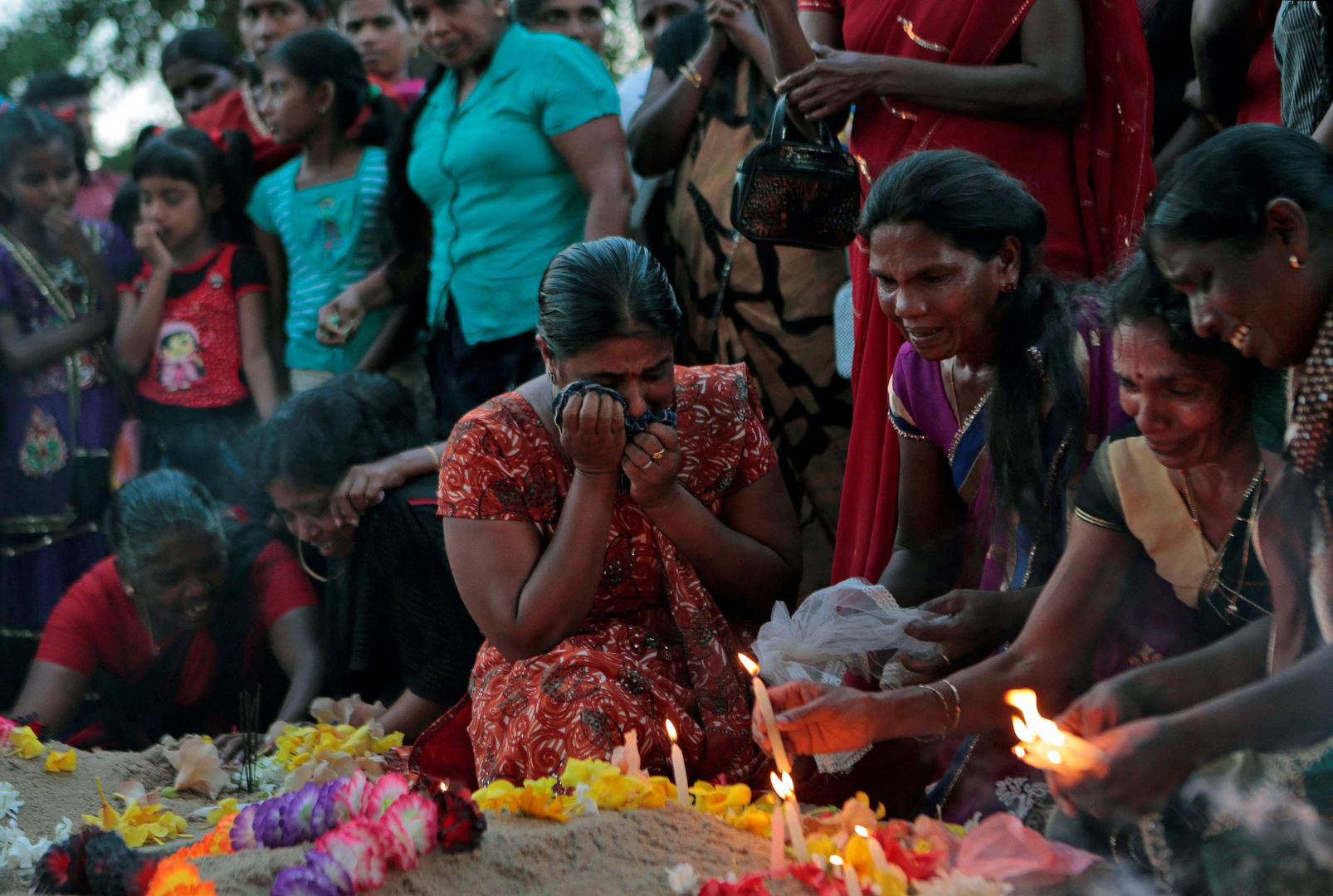
Women mourn at the graves of their relatives who died in 2009 during the
last days of the war in Mullivaikkal, Sri Lanka, May 18, 2015.
© 2015 AP Photo
May 17, 2019
(New York) – Ten years since the end of Sri Lanka’s
brutal civil war, the government has failed to provide justice for the
conflict’s many victims, Human Rights Watch said today. The conflict
ended on May 18, 2009, with the total defeat of the Liberation Tigers of
Tamil Eelam.
The Sri Lankan government pledged to provide justice for wartime abuses
and to take other measures to promote respect for human rights in a United Nations Human Rights Council resolution adopted in October 2015. While there has been some progress to address these commitments, there has been none to provide justice and accountability.
“The end of Sri Lanka’s long civil war in May 2009 provided an
opportunity not only to rebuild shattered lives and society, but also to
restore respect for rights and the rule of law,” said Meenakshi Ganguly,
South Asia director. “Yet successive Sri Lankan administrations have
frittered away this opportunity, failing to investigate atrocities by
both sides, hold those responsible for the worst crimes accountable, or
provide truth and reparations to the victims.”
Under Human Rights Council Resolution 30/1, Sri Lanka committed to 25
key undertakings across a range of human rights issues. A core pledge
was to set up four transitional justice mechanisms to promote
“reconciliation, accountability and human rights” in the country. These
included an accountability mechanism involving international judges,
prosecutors, investigators, and defense lawyers; a truth and
reconciliation mechanism; an office on missing persons; and an office
for reparations.
The Office on Missing Persons and the Office for Reparations overcame delays and were established,
but neither is fully functioning. There has been no progress on
establishing a war crimes tribunal with international involvement.
Instead, Sri Lankan political leaders have repeatedly opposed using
foreign judges, who would be less vulnerable to threats, and said that
“war heroes” will be protected from prosecution.
In March 2019, the UN high commissioner for human rights, Michelle Bachelet, told the Human Rights Council that
in Sri Lanka, “there has been minimal progress on accountability.
Continuing impunity risks fuelling communal or interethnic violence, and
instability. Resolving these cases, and bringing the perpetrators of
past crimes to justice, is necessary to restore the confidence of
victims from all communities.”
Numerous UN experts and treaty bodies since 2015 have highlighted the marginalization and misrepresentation faced
by minority communities, as well as a trust-deficit between these
communities and the government that has been due in significant part to a
culture of impunity.
The Sri Lankan government has also not fulfilled its 2015 commitment to
repeal and replace the Prevention of Terrorism Act (PTA), which allows
prolonged detention without trial. Those detained under the law have
frequently been subjected to torture and sexual violence.
A proposed replacement, the draft Counter Terrorism Act, is before
parliament. While the bill is an improvement on the Prevention of
Terrorism Act, several problematic provisions remain,
and there are reports that amendments will be introduced to further
undermine human rights protections. Meanwhile, the authorities continue
to arrest and detain people under the existing law.
The torture and other ill-treatment of detainees, particularly in
political cases, has remained a problem since the end of the conflict.
The UN special rapporteur on torture found after a 2016 visit to Sri Lanka that
“torture and ill-treatment, including of a sexual nature, still occur,
in particular in the early stages of arrest and interrogation, often for
the purpose of eliciting confessions.”
The government also promised in 2015 to return land to families that the
military appropriated during the war and still occupied. The security
forces have not only used this land for military purposes,
but also for agriculture, tourism, and other commercial ventures. While
the government has released land in a number of sites in the north and
east, the process in returning other sites has been slow.
Instead of taking action against those implicated in past abuses, the
government has often protected and promoted them. In January 2019, Maj.
Gen. Shavendra Silva, whose 58 Division was linked to numerous
laws-of-war violations during the final months of the war, became army chief of staff. On May 11, the government reinstated Prabath Bulathwatte,
a military intelligence official whose unit was accused of attacks on
at least three journalists, including the 2009 murder of Sunday Leader editor Lasantha Wickrematunge.
The appalling Easter Sunday bombings and
the ensuing mob violence targeting Muslims underline existing tensions
in Sri Lanka 10 years after the war’s end and the urgent need to uphold
human rights protections. The government enacted emergency regulations after the attacks that
provide sweeping powers for detention without trial and curtail freedom
of expression and other fundamental rights. The police have been slow
to respond to mob attacks on Muslim shops and businesses, in which at least one man has died.
The government needs to act promptly and adequately to protect
marginalized groups from harassment and violence while upholding basic
due process standards and respecting international law.
The UN and concerned governments should maintain engagement with and
pressure on the Sri Lankan government to protect human rights and
promote reform, reconciliation, and accountability.
“On the tenth anniversary of the end of the war and in the aftermath of
the Easter bombings, the Sri Lankan government should recommit itself to
defending the human rights of everyone in Sri Lanka,” Ganguly said.
“For that to happen, the government needs to live up to its commitments
to provide justice, compensate those harmed, and reform laws and
practices to uphold human rights standards.”
