Peace for the World World ! Your War Our Lives

The Dalai Lama
A Brief Colonial History Of Ceylon(SriLanka)
Sri Lanka: One Island Two Nations
A Brief Colonial History Of Ceylon(SriLanka)
Sri Lanka: One Island Two Nations
(Full Story)
Back to 500BC.

Saturday, May 11, 2019
Sri Lanka: National Security And National Reconciliation
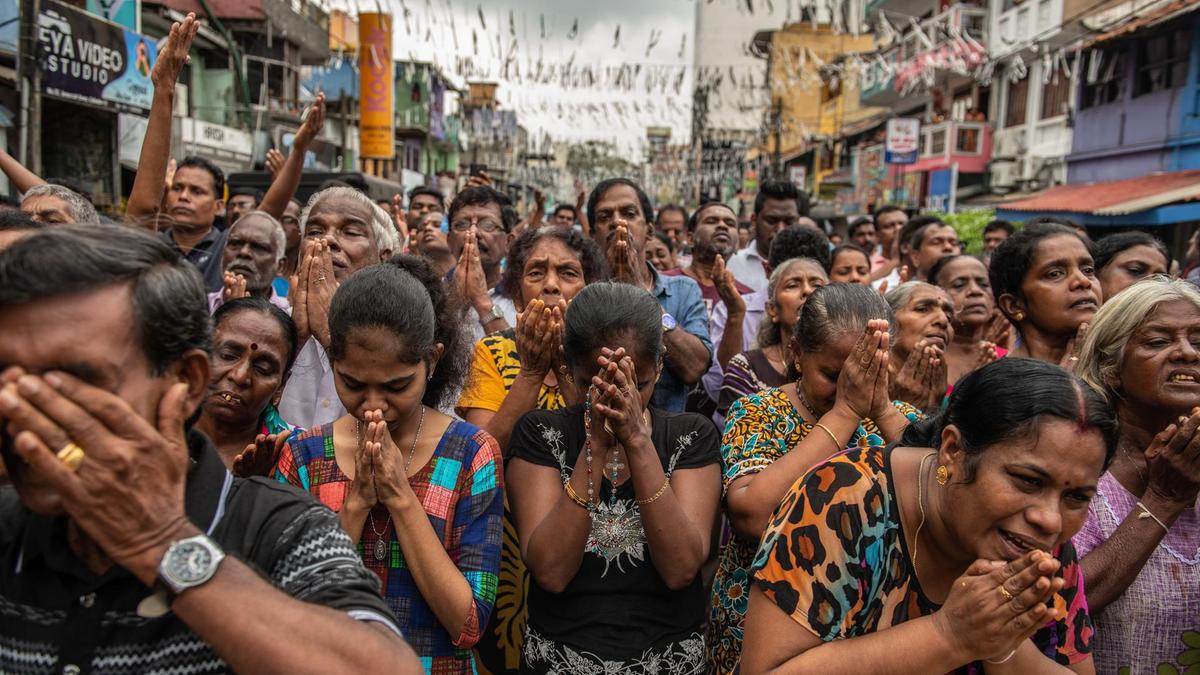
Photo courtesy Getty via The National

DR. KALANA SENARATNE-05/08/2019
The Easter-Sunday attacks have changed a lot of things in Sri Lanka. It
proved, if proof was indeed required, the sheer inefficiency of the
present government. Some of the responses provided by the President, the
Prime Minister and state-officials, in the immediate aftermath, were
preposterous. Though Sri Lanka is not a failed state, it has a deeply
divided, weak and fragile government, which can embolden terrorist
movements such as the Islamic State (IS). In a culture where politicians
cannot be held accountable for their negligence, incompetence and
arrogance, the only weapon for many appears to be the vote. Never the
revolutionary type, the majority Sinhala community is waiting for the
next major election.
**
The IS-inspired terrorist bombings of 21 April 2019 have re-ignited
debates on a number of issues which are not novel for Sri Lankans. Two
such issues which are set to have an enduring impact on our lives relate
to: security and freedom, and peaceful co-existence. There have been
many occasions in post-independent Sri Lanka when the people got an
opportunity to reflect on these issues. The present moment, like many
other moments in the past, provides yet another opportunity for such
reflection. Sri Lanka is not a place which reforms itself very easily.
It reforms, if at all, at a snail’s pace, and that too, when significant
pressure is exerted on it by external forces. Thus there is no
guarantee that anything positive would come out of the present crisis as
well.
But there is, perhaps, a responsibility to reflect and respond, given
the seriousness of the situation. And the reflections presented below
are not of some neutral entity, claiming to adopt an ‘objective’
position. These reflections remain those of an individual who belongs to
the majority community; and being so, they may be partly influenced by
some of the varied interests and prejudices that a member of the
majority Sinhala-Buddhist community may hold on security, freedom and
co-existence.
**
One of the old and immediate questions that arise, given the nature of
the terrorist attacks and the subsequent imposition of emergency rule in
Sri Lanka, is the question about security and freedom. The popular
question is: what should triumph – security or liberty of persons? When
asked this question, there is often a tendency to choose one over the
other. Where that’s not possible, there is another tendency to suggest,
as if to strike a balance, that both security and freedom are not only
required but can also be guaranteed. These answers, in turn, have an
impact on our understanding about the nature and purposes of the state,
with some desiring a strong state and others being highly critical and
even dismissive of it.
To begin with, the question is a flawed one. This is because we demand
and require both. The interests of humans are too great and varied that
it is impossible to choose one over the other, especially in the long
term. Security and freedom are values which have much to do with
emotions and feelings; for example, quite often, we feel secure
or free, without knowing or being able to know whether we actually are.
And these feelings often intermingle, producing different demands and
interests.
Another reason why the question is flawed is because both security and
freedom, taken separately, are broad values which can encapsulate the
other. We might demand one, not realizing that in most instances we are
actually demanding both. And what is often forgotten is that in
demanding security and freedom, we are also inevitably demanding a
strong state. This was most evident when we rushed to critique the state
for not preventing the Easter-Sunday attacks. It was natural and
correct to demand security; but implicit in that critique was the demand
for a strong state (and state-agencies) which can guarantee security.
This was also evident in the support the Tamil people (or a dominant
segment of the Tamil community) showed for a separate state. In the face
of threats to their liberty, the Tamil people demanded not just greater
liberty but also security. And since the 1970s, this was expected to be
guaranteed by a separate state. In practical terms, that separate state
had to be an entity which not only protected the liberties of its
citizens but was strong enough to guarantee their continued security.
People need both security and freedom, and this would need to be assured
to them by an effective and strong state. Therefore, it is often
meaningless to ask whether one is for security or freedom. Barring very
specific issues, one naturally wants both. It is equally problematic to
assume that security and freedom can be guaranteed by weak states.
However, the above does not mean that the state can guarantee both
security and freedom to the satisfaction of all its citizens. To believe
that there could be a neat balance struck between security and rights
considerations, especially in the current global context, is not only a
mistaken view. It is also a dangerous view, for it leads to greater
frustration, when one begins to see the balance tilting in favour of
security or freedom on given issues and circumstances. When a state
attempts to guarantee both freedom and security (as it ought to),
tensions arise due to a number of factors. It may be due to the numerous
prejudices of the state and its officials (e.g. ethnic-bias); it could
be due to the overwhelming character of the demands of citizens; it
could be due to the lack of resources; and it may even be due to the
relative efficiency or inefficiency of respective institutions (e.g. the
police, judiciary, etc.). Thus, constant tension ensues.
This is perhaps best exemplified in the debate surrounding the role and
relevance of laws aimed at preventing terrorism; more specifically, the
polarized debate surrounding the Prevention of Terrorism Act (PTA). The
idea of totally abolishing the PTA, as the critics would vehemently
suggest, is problematic especially in contemporary times and in a
country which has witnessed different forms of terrorism. Far from
abolishing the PTA, there are two key tasks involved. One is to strive
to reform the law to minimize the chances where personal liberties would
be infringed. But an equally fundamental requirement is for
state-agencies to develop an ethnically non-discriminatory approach when
having to apprehend persons under the PTA. The dominant but flawed
perspective of state-agencies at present is that it is largely members
of minority communities who could perpetrate terrorism. The vital task
is to expand this understanding to include members of the majority
community as well. Terrorism can come wrapped in burkas, sarees, denim
trousers and yellow robes.
In short, addressing concerns relating to security and freedom,
especially in the context of terrorism, is never an easy task (except
for academics like us). It is a matter that broadly demands
considerations pertaining to rights and liberties, as well as duties,
responsibilities, demanding further a certain degree of sacrifice. In
the aftermath of the Easter-Sunday attacks, this is an essential truth
we would be re-discovering. And without an effective state, there will
be neither security nor freedom. But no effective state, in the modern
age of global terrorism, can fully guarantee either the complete
protection of our fundamental freedoms, or security, or both. Only part
satisfaction of these two values can be realized. Destined to live under
such tragic circumstances, we would only be able to critique specific
policy measures, and suggest alternatives that we think could best
guarantee our security and freedom to the most practical extent
possible.
**
The other most important question, having both short and long term
consequences, is that of ensuring ethnic and religious harmony and
co-existence. This assumes heightened importance, especially because the
mistrust which undergirded the Sinhala-Muslim relationship for quite
sometime has escalated to unprecedented levels. If there are more
bombings, mob attacks – organized but sporadic at present – are set to
rise exponentially, leading to an unmanageable crisis, and a vast
majority of the Muslim community which had no role to play in this mess
would be left helpless.
At the outset, it is necessary to point fingers at certain actors (in
addition to the state), belonging to both the Sinhala and Muslim
communities, for the broader situation we are placed in. It is not
correct to suggest that the inability to address minority political
concerns within the country led to the development of Islamic extremist
groups. Islamic extremism of the IS-variety, the project of creating a
global caliphate, has very little or almost nothing to do with issues of
constitutional governance in Sri Lanka. Rather, a more pointed
accusation can indeed be levelled against groups such as the Bodu Bala
Sena (BBS), the dark underside of Sinhala Buddhist nationalism, for its
highly divisive rhetoric, including the hateful ideas they spread,
especially by attempting to read and interpret the Quran in ways that
hurt the Muslim community (when alternative readings were possible).
Groups such as the BBS ought to have been far more aware of the
possibility of further radicalization of members of the Muslim community
when their religion and dignity were under constant attack. Violence,
after all, can be both horrifying but also attractive. Even the BBS
would know that.
There was also a serious problem with many of the Muslim politicians.
Though their utterances these days sound more Sinhala Buddhist than
those of the Sinhala Buddhists themselves, many of them were unwilling
to acknowledge that there was a growing problem of radicalism within
their own community; a problem which the BBS had correctly and
confidently pointed out ever since its emergence. The Muslim
politicians, by and large, turned a blind eye. A classic case in this
regard is the statement made by Minister Rauf Hakeem just last year
(March 2018). When asked by The Hindu newspaper
about rising Islamic fundamentalism in Sri Lanka, Minister Hakeem was
categorical in stating: “I don’t see that Muslims have been radicalized
to that extent so as to resort to violence. Whatever radicalization has
been happening it is in the cultural domain.” Apparently, the Minister
knew what he was talking about: “We local politicians know. We have been
monitoring, we keep our ears to the ground and we interact with all
these people.” We now know that the Minister was being disingenuous,
mainly because certain members and groups representing the Muslim
community had already alerted the security agencies about Islamic
radicalism.
While taking note of such serious lapses which can be attributed to both
communities, the present crisis has created an opportunity for greater
introspection, self-critique, and the creation of a more pluralistic
political, religious and cultural ethos. And a fundamental task in this
regard concerns the reformation of these respective communities, which
involves the task of identifying and tackling those ideologies, thoughts
and practices which lead to the development of an extremist mentality.
So far, it is the Muslim community that has been asked to reform. There
are already calls to limit the operation of Madrasa schools, to reform
or abolish personal laws, the banning of Halal products and certain
forms of religious clothing. The latter involves the recent legislative
measures aimed at banning the burqa and the niqab. While it would have
been ideal had the ban been a self-imposed limitation (and that too,
based upon the autonomous views of Muslim women), it is a policy that I
welcome. The burqa/niqab amount to an extremist form of clothing,
especially because they retard the possibility of basic human
interaction in society, especially in educational institutions. It is
largely for this reason, and not necessarily because of security
concerns, that there ought to be a limitation imposed. The ban raises
questions concerning the right to manifest one’s religion. Such freedoms
pertaining to the manifestation of religion can be curtailed. But that
curtailment ought to be prompted by the need to promote a more liberal,
equal and secular society within Sri Lanka (which are some of the
principles that the European Court of Human Rights used to justify the
limitations placed on the the wearing of the Islamic veil and other
religious symbols in Turkey and France).
However, all other communities, including especially the Sinhala
Buddhist majority, have the responsibility to engage in this task of
introspection and reform. What is particularly required in this
reformist project is the need to critically confront all ideas and
teachings which seek to promote theories of purity and perfection.
Seeking purity and perfection, in matters concerning politics, religion
and culture, almost inevitably ends up in disaster. All ideas and
teachings which seek to promote the view that certain groups of people
and their land were somehow ‘pure’ in a distant past and the challenge
is to rediscover and reclaim that lost purity, or political notions
which promise perfect equality and harmony, are always to be viewed with
great caution and skepticism. Such ideas lie at the root of all forms
of extremism, both locally and globally. If the Muslims are to revise
their attitudes towards their personal laws, educational institutions
and religious practices, the Sinhala Buddhists and the Tamils ought to
engage in a similar exercise too.
**
Sri Lanka has entered another phase in its history where security,
freedom and co-existence have been seriously threatened. They have
always been under threat because of our own failings, but the threat
appears more pronounced, more real, given the emergence of a more
palpable and dastardly form of extremism and terror. Rather than seeking
illusive comfort in theories which promise perfection, people will need
to realize that in a polarized society as ours, harmonious co-existence
often comes at a price. The best that’s possible is to seek ways of
minimizing the tendencies that different actors have towards adopting
extreme measures. It is a process that all ethnic and religious groups
in the country would need to engage in; not with starry eyes, but with
the resolve to acknowledge dark and uncomfortable truths about
themselves.
