Trump’s Middle East team appear to have begun implementing the plan over the past 18 months even without its publication
US
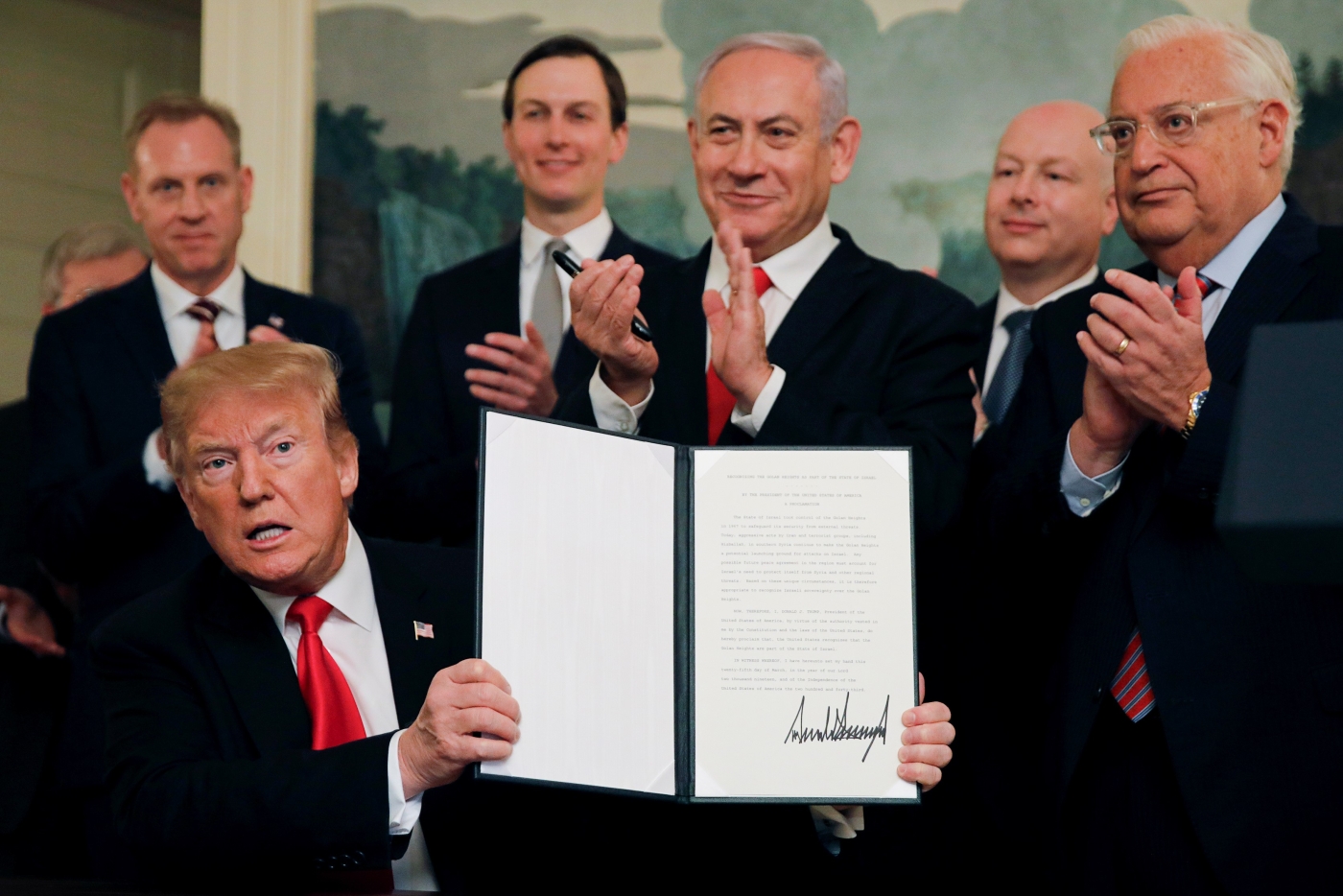
President Donald Trump holds a proclamation recognizing Israel's
sovereignty over the Golan Heights as he is applauded by Israel's Prime
Minister Benjamin Netanyahu and others in the White House on 25 March
(Reuters)
11 May 2019
A report published this week by the Israel Hayom newspaper apparently
leaking details of Donald Trump’s "deal of the century" reads like the
kind of peace plan that might be put together by an estate agent or car
salesman.
But while the authenticity of the document is unproven and indeed
contested, there are serious grounds for believing it paves the
direction of any future declaration by the Trump administration.
Greater Israel
Not least, it is a synthesis of most of the Israeli right’s ambitions
for the creation of a Greater Israel, with a few sops to the
Palestinians – most of them related to partially relieving Israel’s
economic strangulation of the Palestinian economy.
This is exactly what Jared Kushner told us the "deal of the century" would look like in his preview last month.
Also significant is the outlet that published the leak: Israel Hayom. The Israeli newspaper is owned by Sheldon Adelson,
a US casino billionaire who is one of the Republican party’s chief
donors and was a major contributor to Trump’s presidential election
campaign funds.
Adelson is also a stalwart ally of Israeli Prime Minister Benjamin
Netanyahu. His newspaper has served as little more than a mouthpiece for
Netanyahu’s ultra-nationalist governments over the past decade.
Netanyahu behind leak?
Adelson and Israel Hayom have ready access to key figures in both the US and Israeli administrations. And it has been widely reported that little of significance gets into print there unless it has first been approved by Netanyahu or its overseas owner.
The newspaper contested
the authenticity and credibility of the document, that spread across
social media platforms, even suggesting "it is quite possible the
document is fake" and that the Israeli foriegn ministry was looking into
it.
The White House had already indicated that, after long delays, it
intended to finally unveil the "deal of the century" next month, after
the holy Muslim month of Ramadan finishes.
The leaked plan is a synthesis of most of the Israeli right’s ambitions for a Greater Israel
An unnamed White House official told the paper the leak was
“speculative” and “inaccurate” – the kind of lacklustre denial that
might equally mean the report is, in fact, largely accurate.
If the document is genuine, Netanyahu looks to be the most likely
culprit behind the leak. He has overseen the foreign ministry for years
and Israel Hayom is widely referred to by Israelis as "Bibiton", or
Bibi’s newspaper, employing the prime minister’s nickname.
Testing the waters
The alleged document, as published in Israel Hayom, would be
catastrophically bad for the Palestinians. Assuming Netanyahu approved
the document’s leaking, his motives might not be too difficult to
discern.
On one view, leaking it might be an effective way for Netanyahu and the
Trump administration to test the waters, to fly a trial balloon to see
whether they dare publish the document as it is, or need to make
modifications.
But another possibility is that Netanyahu may have concluded that there
could be an unwelcome price in publicly achieving most of what he is
already gaining by stealth – a price he may prefer to avoid for the time
being.
The Trump administration appears to be ready to give its blessing to a
Greater Israel comprising 88 per cent of the land stolen from
Palestinians over seven decades
Is the leak designed to foment pre-emptive opposition to the plan, both
from within Israel and from the Palestinians and the Arab world, in the
hope of stymieing its release?
The hope may be that the leak, and the reaction it elicits, forces
Trump’s Middle East team to postpone yet again the plan’s publication,
or even foils its release entirely.
Nonetheless, whether or not the “deal of the century” is unveiled soon,
the leaked document – if true – offers a plausible glimpse into the
Trump administration’s thinking.
Given that Trump’s Middle East team appear to have begun implementing
the plan over the past 18 months even without its publication – from
moving the US embassy to Jerusalem to the recognition of Israel’s
illegal annexation of the Syrian Golan Heights – the leak helps to shed
light on how a US-Israeli "resolution" of the Israeli-Palestinian conflict is likely to unfold.
Annexing the West Bank
The proposed Palestinian entity would be named "New Palestine” –
apparently taking a page out of the playbook of Tony Blair, a Britain’s
former prime minister who became the international community’s Middle
East envoy from 2007 to 2015.
Back in the 1990s, Blair filleted his own political party, Labour, of
its socialist heritage and then rebranded the resulting
corporation-friendly party, a pale shadow of its former self, as “New
Labour".
The
name “New Palestine” helpfully obscures the fact that this
demilitarised entity would lack the features and powers normally
associated with a state. According to the leak, New Palestine would
exist on only a tiny fraction of historic Palestine.
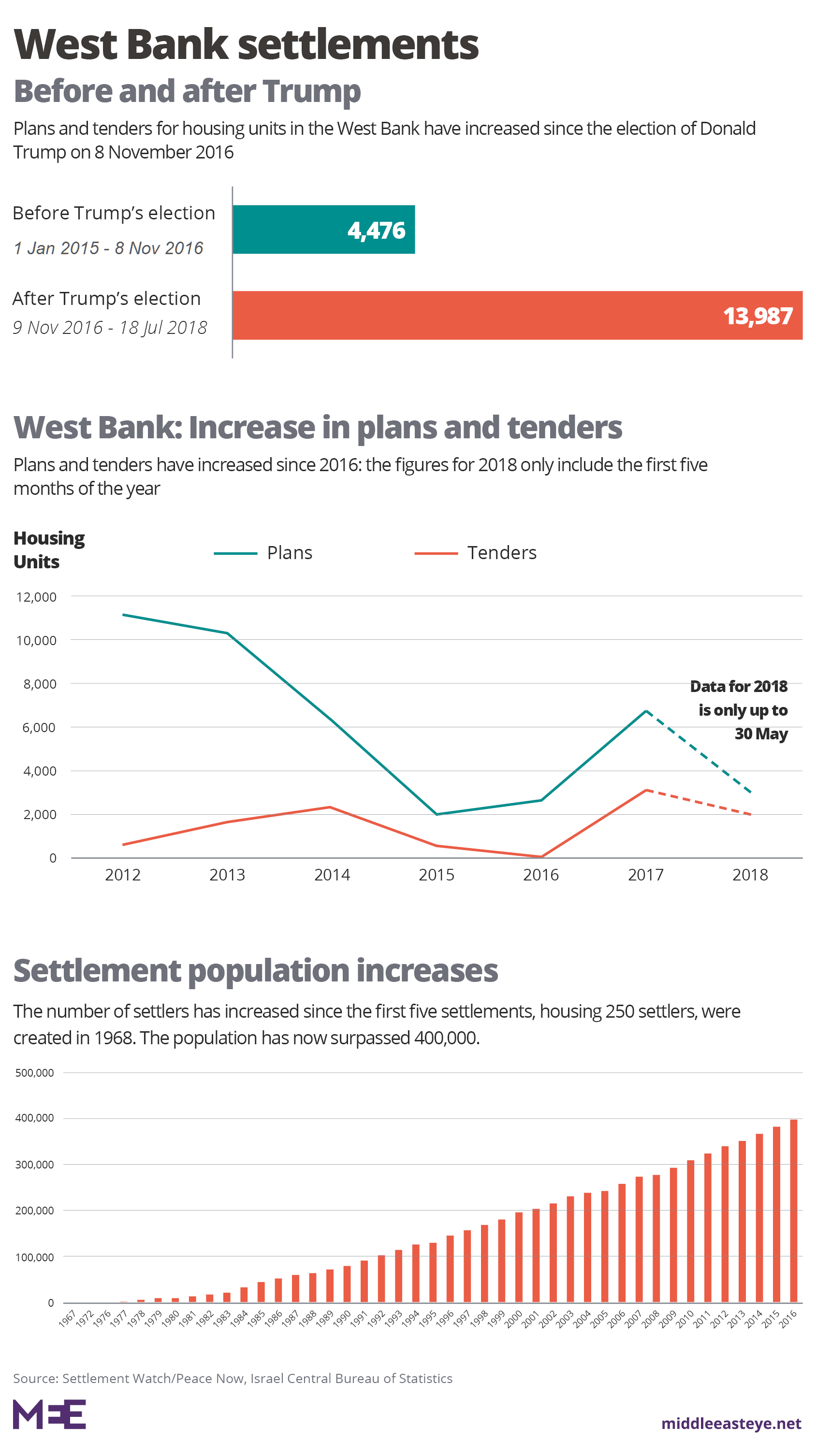
All illegal settlements in the West Bank would be annexed to Israel – satisfying a pledge Netanyahu
made shortly before last month’s general election. If the territory
annexed includes most of Area C, the 62 per cent of the West Bank Israel
was given temporary control over under the Oslo accords, and which the
Israeli right urgently wants to annex, that would leave New Palestine
nominally in charge of about 12 percent of historic Palestine.
Or put another way, the Trump administration appears to be ready to give
its blessing to a Greater Israel comprising 88 per cent of the land
stolen from Palestinians over the past seven decades.
'New Palestine'
But it is far worse than that. New Palestine would exist as a series of
discrete cantons, or Bantustans, surrounded by a sea of Israeli
settlements – now to be declared part of Israel. The entity would be
chopped and diced in a way that is true of no other state in the world.
It is hard to imagine how 'New Palestine' would fundamentally change the current, dismal reality for Palestinians
New Palestine would have no army, just a lightly armed police force. It
would be able to act only as a series of disconnected municipalities.
In fact, it is hard to imagine how "New Palestine" would fundamentally
change the current, dismal reality for Palestinians. They would be able
to move between these cantons only using lengthy detours, bypass roads
and tunnels. Much like now.
Glorified municipalities
The only silver lining offered in the alleged document is a proposed
bribe from the US, Europe, other developed states, though mostly
financed by the oil-rich Gulf states, to salve their consciences for
defrauding the Palestinians of their land and sovereignty.
A Palestinian youth was arrested by Israeli police in Qabatiya on 4 February, 2016 (AFP)These
states will provide $30bn over five years to help New Palestine set up
and run its glorified municipalities. If that sounds like a lot of
money, remember it is$8bn less than the decade-long aid the US is currently giving Israel to buy arms and fighter jets.
What happens to New Palestine after that five-year period is unclear in
the document. But given that the 12 per cent of historic Palestine
awarded to the Palestinians is the region’s most resource-poor territory
– stripped by Israel of water sources, economic coherence, and key
exploitable resources like the West Bank’s quarries – it is hard not to
see the entity sinking rather swimming after the initial influx of money dries up.
Even if the international community agrees to stump up more money, New Palestine would be entirely aid dependent in perpetuity.
Drunk with power: How Trump is destroying the Middle East
The US and others would be able to turn on and off the spigot based on the Palestinians’ "good behaviour" – just as occurs now. Palestinians would live permanently in fear of the repercussions for criticising their prison warders.
In keeping with his vow to make Mexico pay for the wall to be built
along the southern US border, Trump apparently wants the Palestinian
entity to pay Israel to provide it with military security. In other
words, much of that $30bn in aid to the Palestinians would probably end
up in the Israeli military’s pockets.
Interestingly, the alleged report argues that oil-producing states, not
the Palestinians, would be the "main beneficiaries" of the agreement.
This hints at how the Trump deal is being sold to the Gulf states: as an
opportunity for them to fully embrace Israel, its technology and
military prowess, so that the Middle East can follow in the footsteps of
Asia’s "tiger economies".
Ethnic cleansing in Jerusalem
Jerusalem is described as a "shared capital", but the small print reads
rather differently. Jerusalem would not be divided into a Palestinian
east and an Israeli west, as most had envisaged. Instead, the city will
be run by a unified Israeli-run municipality. Just as happens now.
The only meaningful concession to the Palestinians would be that
Israelis would not be allowed to buy Palestinian homes, preventing – in
theory, at least – a further takeover of East Jerusalem by Jewish
settlers.
But given that in return Palestinians would not be allowed to buy
Israeli homes, and that the Palestinian population in East Jerusalem
already suffers massive housing shortages and that an Israeli
municipality would have the power to decide where homes are built and
for whom, it is easy to imagine that the current situation – of Israel exploiting planning controls to drive Palestinians out of Jerusalem – would simply continue.
A view of the Dome of the Rock, Al-Aqsa mosque compound (AFP)Also,
given that Palestinians in Jerusalem would be citizens of New
Palestine, not Israel, those unable to find a home in Israeli-ruled
Jerusalem would have no choice but to emigrate into the West Bank. That
would be exactly the same form of bureaucratic ethnic cleansing that Palestinians in Jerusalem experience now.
Gaza open to Sinai
Echoing recent comments from Jared Kushner, Trump’s son-in-law and
Middle East adviser, the plan’s benefits for Palestinians all relate to potential economic dividends, not political ones.
Palestinians will be allowed to labour in Israel, as was the norm before Oslo – and presumably, as before, only in the most poorly paid and precarious jobs, on building sites and agricultural land.
A land corridor, doubtlessly overseen by Israeli military contractors
the Palestinians must pay for, is supposed to connect Gaza to the West
Bank. Confirming earlier reports of the Trump administration’s plans,
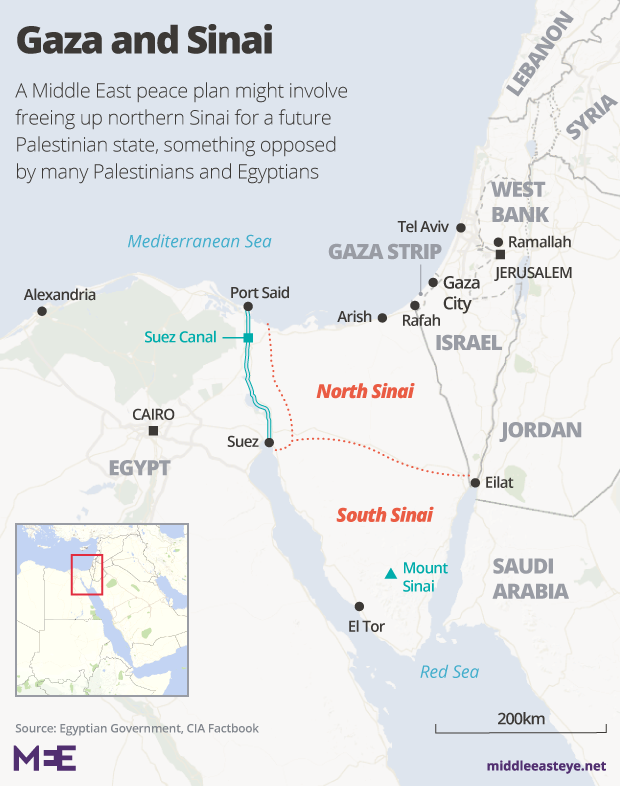
Gaza would be opened up to the world, and an industrial zone and airport created in the neighbouring territory of Sinai.
The land – its extent to be decided in negotiations – would be leased from Egypt.
Helpfully for Israel, as Middle East Eye has previously pointed out,
such a move risks gradually encouraging Palestinians to view Sinai as the centre of their livesrather than Gaza – another way to slowly ethnically cleanse them.
Meanwhile,
the West Bank would be connected to Jordan by two border crossings –
probably via land corridors through the Jordan Valley, which itself is
to be annexed to Israel. Again, with Palestinians squeezed into
disconnected cantons surrounded by Israeli territory, the assumption
must be that over time many would seek a new life in Jordan.
Palestinian political prisoners would be released from Israeli jails to
the authority of New Palestine over three years. But the plan says
nothing about a right of return for millions of Palestinian refugees –
descended from those who were expelled from their homes in the 1948 and
1967 wars.
Gun to their heads
Don Corleone-style, the Trump administrations appears ready to hold a
gun to the head of the Palestinian leaderships to force them to sign up
to the deal.
The US, the leaked report states, would cut off all money transfers to
the Palestinians if they dissent, in an attempt to batter them into
submission.
The alleged plan would demand that Hamas and Islamic Jihad disarm,
handing their weapons over to Egypt. Should they reject the deal, the
report says the US would authorise Israel to "personally harm" the
leadership – through extrajudicial assassinations that have long been a mainstay of Israeli policy towards the two groups.
Pro-Palestine demonstrators march down a street in central London in 2017 (MEE/Areeb UllahRather
less credibly, the alleged document suggests that the White House is
prepared to get tough with Israel too, cutting off US aid if Israel
fails to abide by the terms of the agreement.
Given that Israel has regularly broken the Oslo accords – and international law – without paying any
serious penalty for doing so, it is easy to imagine that in practice
the US would find work-arounds to ensure Israel was not harmed for any
violations of the deal.
US imprimatur
The alleged document has all the hallmarks of being the Trump plan, or
at least a recent draft of it, because it sets out in black and white
the reality Israel has been crafting for Palestinians over the past two
decades.
It simply gives Israel’s mass theft of land and cantonisation of the Palestinians an official US imprimatur.
Cliches, lies and double standards: Jared Kushner's twisted views on Palestine
So,
if it offers the Israeli right most of what it wants, what interest
would Israel Hayom – Netanyahu’s mouthpiece – have in jeopardising its
success by leaking it?
A couple of reasons suggest themselves.
Israel is already achieving all these goals – stealing land, annexing
the settlements, cementing its exclusive control over Jerusalem, putting
pressure on the Palestinians to move off their land and into
neighbouring states – without formally declaring that this is its game
plan.
It has been making great progress in all its aims without having to
admit publicly that statehood for the Palestinians is an illusion. For
Netanyahu, the question must be why go public with Israel’s over-arching
vision when it can be achieved by stealth.
Fearful of backlash
But even worse for Israel, once the Palestinians and the watching world
understand that the current, catastrophic reality for Palestinians is as
good as it is going to get, there is likely to be a backlash.
The Palestinian Authority could collapse, the Palestinian populace
launch a new uprising, the so-called "Arab street" may be far less
accepting of the plan than their rulers or Trump might hope, and
solidarity activists in the West, including the boycott movement, would
get a massive shot in the arm for their cause.
Equally, it would be impossible for Israel’s apologists to continue
denying that Israel is carrying out what the late Israeli academic
Baruch Kimmerling called "politicide" – the destruction of the
Palestinians’ future, their right to self-determination and their
intergrity as a single people.
If this is Trump’s version of Middle East peace, he is playing a game of
Russian roulette – and Netanyahu may be reluctant to let him pull the
trigger.
The views expressed in this article belong to the author and do not necessarily reflect the editorial policy of Middle East Eye. This article is available in French on Middle East Eye French edition.



 US
President Donald Trump holds a proclamation recognizing Israel's
sovereignty over the Golan Heights as he is applauded by Israel's Prime
Minister Benjamin Netanyahu and others in the White House on 25 March
(Reuters)
US
President Donald Trump holds a proclamation recognizing Israel's
sovereignty over the Golan Heights as he is applauded by Israel's Prime
Minister Benjamin Netanyahu and others in the White House on 25 March
(Reuters)

 The US and others would be able to turn on and off the spigot based on the Palestinians’ "good behaviour" – just as occurs now. Palestinians would live permanently in fear of the repercussions for criticising their prison warders.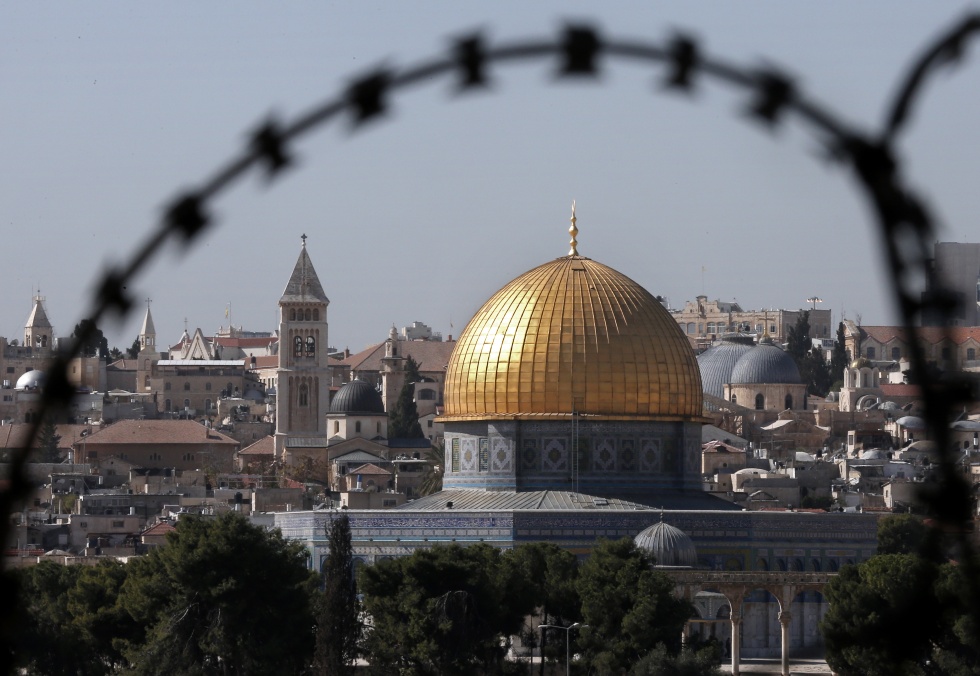

 So,
if it offers the Israeli right most of what it wants, what interest
would Israel Hayom – Netanyahu’s mouthpiece – have in jeopardising its
success by leaking it?
So,
if it offers the Israeli right most of what it wants, what interest
would Israel Hayom – Netanyahu’s mouthpiece – have in jeopardising its
success by leaking it?