

Peace for the World World ! Your War Our Lives

The Dalai Lama
A Brief Colonial History Of Ceylon(SriLanka)
Sri Lanka: One Island Two Nations
A Brief Colonial History Of Ceylon(SriLanka)
Sri Lanka: One Island Two Nations
(Full Story)
Back to 500BC.
Friday, May 17, 2019
Tunisia's quest for historic justice under threat from Ben Ali-era officials
Leaked
amnesty proposal puts Tunisia's transition from old regime under
threat, as reparations advocates accuse past officials of undermining
them

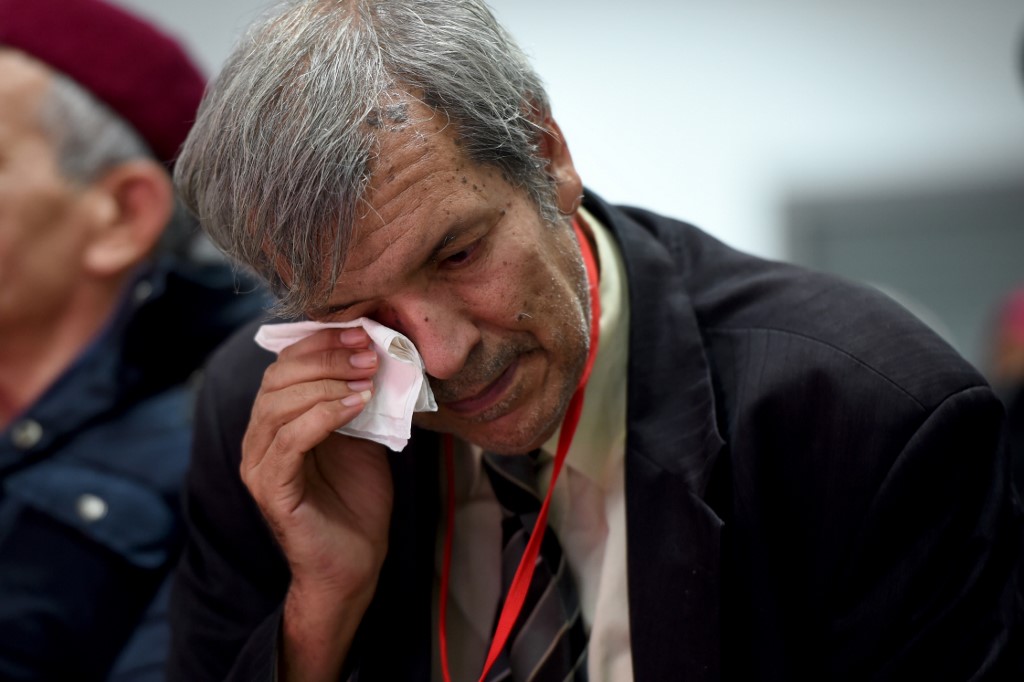
A live broadcast of testimonials by the victims before Tunisia's Truth and Dignity Commission in 2016 (AFP)
 Faïrouz ben Salah-16 May 2019
Members of the independent commission set up to investigate crimes by
the Tunisian state in the wake of the 2011 revolution say former Ben
Ali-era officials are actively trying to overturn their findings.
After five years of work, 63,000 complaints of violations, tens of
thousands of interviews and 12 televised public hearings, the Instance
Verite et Dignite (IVD) – or Truth and Dignity Commission – released its
final report in late March.
'Our commission has been under constant attack'- Sihem Bensedrine, Head of the Truth and Dignity Commission
The panel proposed a laundry list of reforms, from dismantling corrupt
and repressive state systems to restricting security forces. It also
called on Tunisian President Beji Caid Essebsi to apologise on behalf of
the state to all victims of human rights violations since 1955.
But as the 2,000-page report was released, a draft law leaked to civil
society organisations that would allow alleged perpetrators to go
unpunished was already circulating among members of the Tunisian
parliament.
Drafted by Mohamed Fadhel Mahfoudh, Tunisia’s minister of human rights
and transitional justice, the law would give amnesty to those accused of
human rights violations and corruption if they apologised, according to
a copy seen by Middle East Eye.
In a note attached to the draft, Mahfoudh said reconciliation would
allow Tunisia’s nascent democracy to take root and put an end to
political instability which, according to the human rights minister, has
stopped lawmakers from tackling the country’s serious economic issues.
“The country’s profound socio-economic challenges leave us little choice but to reconcile and go forward,” he wrote.
The leak caused an outcry among victims and their advocates.
Madfoudh then told a group of civil society actors involved in the
transitional justice process on 24 April that the draft was just some
personal thoughts and not anything that had been approved, according to
Khayem Chemli, a coordinator for Lawyers Without Borders (ASF), who was
at the meeting.
Personal thoughts or not, the draft has alarmed several Truth and
Dignity Commission officials, lawmakers and human rights advocates who
say the proposed bill is only part of a broader attempt by the
Democratic Constitutional Rally (RDC), the former ruling party under Ben
Ali, to return to power.
Sihem Bensedrine, the head of the IVD elected by the Tunisian
parliament, told MEE: “Our commission has been under constant attack,
particularly from the moment we started to investigate the role of Ben
Ali and his administration in human rights and corruption violations.”
Chemli, the coordinator with ASF, said he believed the leak was intentional and a prelude to more.
"The minister is not stupid. It’s a bargaining strategy. He must have
expected the leak and hopes to end up somewhere in the middle," he told
MEE.
"We - the civil society organisations - are just wondering when? Before
or after the elections? Sometimes laws pass all of a sudden."
'Drafted by victims, carried out by purported perpetrators'
The transitional justice process in Tunisia is wrapped up in the political struggle following the 2011 revolution.
Tunisia’s interim "Troika" alliance, formed in the revolution’s wake and
led by the Ennahda party, passed the transition justice law, which set
up the Truth and Dignity Commission, in 2013.
But after its victory in 2014, the Nidaa Tounes party was saddled with
the responsibility of carrying it out, with the commission
lagging behind the economy and security as a priority.
“We have to understand the amnesty law proposal in the political
context,” said human rights lawyer Mokhtar Trifi, in a roundtable
discussion in April at civil society organisation L'Art Rue.

“The transitional justice law was drafted by the supposed victims but is carried out by the purported perpetrators.”
Meanwhile, with the establishment of Nidaa Tounes in 2012 and the use of
media, money and networks, former officials under Ben Ali have made a
steady return into Tunisian politics.
While former RDC members joined all of the political parties, including
Ennahda, Nidaa Tounes became the main political shelter for the Ben
Ali-era lawmakers, particularly after the 2014 elections which empowered
the party.
“Their political clout remains significant,” Trifi said during the
discussion at L'Art Rue. Parties that support amnesty "are battling to
salvage their political future and to consolidate their presence on the
political scene".
It’s in this context that Mahfoudh released the draft amnesty law in
which he proposes to abolish the specialised chambers set up for the
truth and reconciliation process to prosecute perpetrators.
In his draft, Mahfoudh proposes the creation of two brand new
reconciliation commissions, one focused on human rights violations and a
second concentrating on corruption and embezzlement cases.
Each commission would be overseen by nine members of a committee, with
three appointed each by the president, the head of government and the
speaker of the parliament respectively.
Through an administration procedure, the two bodies would grant amnesty
to alleged perpetrators who apologise before them, and the commissions’
decisions would not be subject to appeal in any court, including "an
appeal for abuse of power".
'Forward, not backwards'
A coalition of civil society organisations, dismayed by Mahfoud’s initiative, published a manifesto on 25 April saying his proposal was a flagrant violation of the Tunisian constitution and international human rights.
If passed, they wrote, the bill would strengthen impunity and only
encourage those responsible for current and future human rights
violations.

The minister however, can count on political support from ruling party
Nidaa Tounes, including Mongi Harbaoui, a Nidaa Tounes MP and the
party’s spokesman, who told MEE he supports the bill.
“We need to go forward, not backwards,” Harbaoui said, adding that the
eras of presidents Ben Ali and Habib Bourguiba shouldn't be swept under a
rug.
“To a certain extent, Nidaa Tounes embodies the old regime. We believe
in continuity, we aim to continue down the road taken by former
president Bourguiba… Ben Ali wasn’t all bad, we must preserve his
achievements and learn from the mistakes.”
Reparation for the victims
But Yamina Zoghlami - an Ennahda MP and vice president of the
parliamentarian commission charged with the transitional justice
process, a body separate from the IVD - says the proposed amnesty law violates the country’s existing transitional justice law.
“Tunisia urgently needs truth and reconciliation regarding years of state repression and human rights violations,” she told MEE.
Ennahda was banned before the overthrow of Ben Ali. During the years it
continued operating underground, Zoghlami said many of its members
suffered severe repression “ranging from physical deprivation and
torture while in prison, to the harassment and abuse of families of
those sent to prison”.
'Apart from the systematic sabotage of remnants of the old regime, all political parties are equally to blame for obstruction'- Adel Maizi, former Truth and Dignity Commission member
“To the Muslim democrats [how Ennahda describes its members],
reconciliation is one of the key objectives of transitional justice
based on a fair trial, reparations for victims and restoring victims to
their position as rights bearers and citizens,” she said.
For Adel Maizi, a former member of the IVD, however, “Nidaa or Ennahda,
it’s all the same.” His five years in the Truth and Dignity commission
have made him cynical.
“Apart from the systematic sabotage of remnants of the old regime, all
political parties are equally to blame for obstruction,” he told MEE.
Chemli, from Lawyers Without Borders (ASF), said he believes Ennahda has
used some of the victims for its own political purposes.
“They are one-sided and picky in choosing the civil society stakeholders
with whom they want to maintain relationships," Chemli said.
“Ennahda,” he said, “will eventually support the amnesty bill and hope
victims can be convinced to accept apologies in exchange for financial
reparation.”
'Irreversible change'
The Ministry of Interior has confidentially warned some critics of
former Ben Ali officials, Truth and Dignity Commission officials and
others working on transitional justice that their security is at risk.
But citing policy and security reasons, the ministry has refused to elaborate or give further information.
Judges of the specialised transitional justice chambers, supported by
lawyers and civil society activists, have repeatedly called for better
protection, logistical support and police collaboration to little avail.
But Sihem Bensedrine, the head of the IVD, and others say they have
little doubt: they suspect Ben Ali regime holdovers to be the driving
forces behind the threats – and the proposed amnesty bill.
“Impunity for old top officials of the Ben Ali regime is a key component
of the strategy to bring back an authoritarian regime,” said Chemli of
the draft bill. “It’s basically a form of rehabilitation.”
Both Chemli and Bensedrine, however, remain optimistic.
“They won’t win this war,” said Chemli. “There might be setbacks for democracy, but the country has irreversibly changed."
