Peace for the World World ! Your War Our Lives

The Dalai Lama
A Brief Colonial History Of Ceylon(SriLanka)
Sri Lanka: One Island Two Nations
A Brief Colonial History Of Ceylon(SriLanka)
Sri Lanka: One Island Two Nations
(Full Story)
Back to 500BC.

Saturday, May 18, 2019
Wahhabism, Salafism: The good, the bad and the evil

A madrasa or
religious school in Kattankudy: Many Muslims here follow the traditional
Islam recognized by the All Ceylon Jammiyyatul Ulema. AFP
 17 May 2019
As investigations continue into the gruesome terror attack on April 21
Easter Sunday, with the people asking questions as to what drove the
terrorists to commit this heinous crime on the innocent people,
Wahhabism is often cited as the basis for the terror ideology.
But as blameworthy as the terror ideology is the monumental blunder --
the authorities’ failure to act upon the intelligence they had received
from India.
While the colossal failure raises questions on the involvement of deep
state or external elements, little is known about the outcome of the
committee President Maithripala Sirisena appointed to go into the
aspects that led to the massacre. One wonders whether there will be
anything on Wahhabism or any other jihadi ideology in the committee’s
final report.
Whenever a terrorist attack is carried out by a jihadi group, many
assume that the problem begins and ends with Wahhabism. Without
understanding what Wahhabism is all about and how it has evolved into
different versions today, they project it as an evil ideology that is
hell bent on promoting violent jihad to kill or convert the non-Muslims.
They are only partly correct.
In the wake of the Easter Sunday massacres, the eastern city of
Kattankudy was sullied as the hotbed of Wahhabism, whereas a majority of
its people call themselves Sunnath Jamath Muslims who follow the
guidelines of the Colombo-based All Ceylon Jammiyyathul Ulema.
Of Kattankudy’s nearly 70 mosques, perhaps only about 12 are identified as Thowheed mosques.
But all Thowheed mosques do not follow Wahhabism. Thowheed Jamath adherents would say they are not blind followers of any ‘isms’ or imams. They insist that to define what Islam is, they do their own research, perusing the Quran and what they claim to be ‘authentic’ Ahadeeth.
But all Thowheed mosques do not follow Wahhabism. Thowheed Jamath adherents would say they are not blind followers of any ‘isms’ or imams. They insist that to define what Islam is, they do their own research, perusing the Quran and what they claim to be ‘authentic’ Ahadeeth.
Thowheed groups and the Wahhabis promote monotheism with equal zeal.
While the Wahhabis follow the Hambali school of thought, the Thowheed
groups do not identify with any of Sunni Islam’s four schools of thought
– the Shafis, the Hanafis, the Malikis and the Hambalis. This position
brings the Thowheed groups closer to Salafism, which is also blamed for
the so-called jihadi violence.
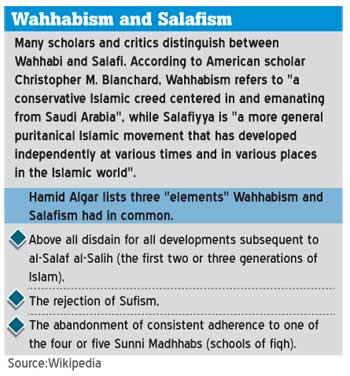
To understand Salafism, we need to understand Wahhabism, which emerged
as a reform movement in the late 18th century. Founded by Muhammad ibn
Abdul Wahhab, it flourished in the Najd province of the Arabian
Peninsula. His reforms were aimed at reviving monotheism— Thowheed — and
cleansing Islam from superstitions and new rituals introduced largely
by Sufis and their blind followers. He saw ignorant Muslims becoming
saint worshippers, instead of supplicating directly to Allah. He had the
support of a powerful tribal leader, Muhammad bin Saud. Together, they
established an emirate in Diriyah, close to Riyadh, with the aim of
bringing the Arabs of the peninsula back to the “true” principles of
Islam.
Abdul Wahhab was greatly influenced by the teachings of Ibn Taymiyyah, a
13th century Islamic scholar who lived through the holocaust the
Mongolian invaders under Hulagu, the grandson of Genghis Khan, brought
upon the Muslim world. Though Ibn Taymiyyah was a reformist, he was less
tolerant of Islam’s other strains, especially the Sufism, the Shiism
and the Alawism. The problem with Ibn Taymiyyah and Abdul Wahhab is that
they did not adopt intellectualism as a methodology to prove their
point. Instead, they justified violence. At least, in Ibn Taymiyya’s
case, violence was promoted in the context of the geopolitical upheaval
that engulfed the then Muslim world.
It is said in 1802; ten years after Abdul Wahhab’s death, a Wahhabi army
marched into Karbala in Iraq and ransacked the gravesite of the
prophet’s grandson, Imam Hussein, who is revered by the Sunnis and the
Shiites alike. The Wahhabi soldiers killed thousands whom they condemned
as ‘grave worshippers’. The Ottoman caliph saw the rise of Wahhabism as
a rebellion and wanted it crushed. In 1811, the task was given to
Muhammad Ali Pasha, the caliph’s viceroy in Egypt. The war went on for
seven years. In 1818, Ibrahim, the son of Muhammad Ali, defeated the
rebel emirate of Diriyah. Its emir Abdullah ibn Saud was sent to
Istanbul where he was executed
by the Ottomans.
by the Ottomans.
 The
Ottomans believed Abdul Wahhab was a British spy and he was working for
them to destablise the Ottoman caliphate. Decades later the Ibn Sauds
were to betray the Ottoman Caliph again -- this time decisively turning
the tide of World War I in favor the Western powers led by Britain. The
Arab rebellion eventually ended the Ottoman caliphate.
The
Ottomans believed Abdul Wahhab was a British spy and he was working for
them to destablise the Ottoman caliphate. Decades later the Ibn Sauds
were to betray the Ottoman Caliph again -- this time decisively turning
the tide of World War I in favor the Western powers led by Britain. The
Arab rebellion eventually ended the Ottoman caliphate.
The Middle East was carved up and among the new states that were created
by Britain and France in terms of the Sykes-Picot Agreement of 1916 was
Saudi Arabia. Abdul Azeez Ibn Saud became the country’s first king.
Like his forefathers, he adopted Wahhabism as state religion.
In the meantime, Salafism emerged as a reform movement in the late 19th
century. Initially, Salafism was a name given to the modernists. The
name is derived from the term Salaf as-Saliheen or the righteous
predecessors. These modernists promoted religious freedom, inter-faith
dialogue and emulating the West in science and technological
development. Among the famous modern Salafists were Jamal al-Din
al-Afghani, Muhammad Abdul and Rashid Riza. They deplored the blind
acceptance of traditional doctrines and customs and called for the
revival of the pristine faith as practised by the early Muslims in a bid
to regain the glory of the Muslim world.
But in parallel to this movement, conservative Salafist groups also
emerged. They saw the West as a problem and promoted their
interpretation of Islam as a response to end Western imperialism and
prevent the diffusion of what they called the ‘decadent’ Western culture
into the Muslim world. They became more popular while al-Afghani’s and
Abduh’s rationalist Salafism gradually lost its sheen.
Like the Wahhabis, the conservative Salafists are also zealous promoters
of Thowheed or monotheism and vehement opponents of bid’ ah or any
innovation in religion, while they also disapprove Shi’ism and Sufism.
They are accused of relying heavily on the literal meaning of the
Quranic verses and the Prophetic sayings while paying less attention to
the spiritual meaning.
Today there exist may Salafi movements and analysts have identified
three main categories: the quietists, the activists and the jihadists.
A vast majority of the Salafis are either quietists -- scholarly
Salafists -- or political activists (like the Muslim Brotherhood of
Egypt). These versions are spreading fast across the Muslim world. The
adherents of the dangerous version -- jihadi Salafism -- form only a
small minority and they include terror groups such as al-Qaeda, ISIS,
Boko Haram and Al-Shabab. Many Muslims believe these groups are handled
by one intelligence agency or another.
Famous Salafi Imams such as Sheikh Nasiruddin Albani, Sheikh Muhammad
bin al-Uthaymeen and Sheikh Abdul Aziz ibn Baz are promoters of
non-violence. They have declared suicide bombing as unislamic and
sinful. Condemning suicide bombings, ibn Uthaymeen wrote a book titled
‘The Suicide Bomber is not a Martyr and is in Hellfire.’
But the jihadi Salafis have denounced these respected Salafi scholars as
Shiekhists – meaning they have become vassals of oil sheikhs.
To combat the spread of violent Salafism or Wahhabism, in countries such
as Britain, the mainstream Salafis have at times been encouraged to
play a part in countering terrorism. Perhaps, Sri Lanka can think about
this, as the saying goes, we need a thorn to remove a thorn.
