Peace for the World World ! Your War Our Lives

The Dalai Lama
A Brief Colonial History Of Ceylon(SriLanka)
Sri Lanka: One Island Two Nations
A Brief Colonial History Of Ceylon(SriLanka)
Sri Lanka: One Island Two Nations
(Full Story)
Back to 500BC.

Sunday, June 9, 2019
Large Ebola outbreaks new normal, says WHO
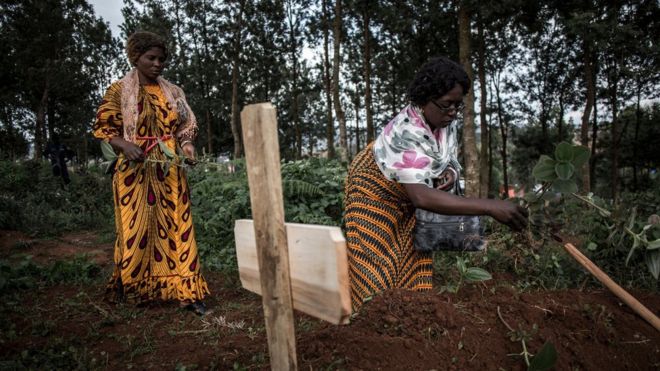
Family members place leaves on the grave of a deceased relative who died from Ebola in Butembo
 7 June 2019
The world is entering "a new phase" where big outbreaks of deadly
diseases like Ebola are a "new normal", the World Health Organization
has warned.
Previous Ebola outbreaks affected relatively small numbers of people.
But the Democratic Republic of Congo is dealing with the second largest
outbreak ever, just three years after the world's largest one ended.
The WHO said countries and other bodies needed to focus on preparing for new deadly epidemics.

What is Ebola?
- Ebola is a virus that initially causes sudden fever, intense weakness, muscle pain and a sore throat.
- It progresses to vomiting, diarrhoea and both internal and external bleeding.
- People are infected when they have direct contact through broken skin, or the mouth and nose, with the blood, vomit, faeces or bodily fluids of someone with Ebola.
- Patients tend to die from dehydration and multiple organ failure.
There have been 2,025 cases of Ebola and 1,357 deaths from the virus during the outbreak in the Democratic Republic of Congo.
The largest outbreak, in West Africa in 2014-16 affected 28,616 people mostly in Guinea, Liberia and Sierra Leone. There were 11,310 deaths.
Yet the 12 outbreaks between 2000 and 2010 averaged fewer than 100 cases.
So why are modern outbreaks so much bigger?
"We are entering a very new phase of high impact epidemics and this
isn't just Ebola," Dr Michael Ryan, the executive director of the WHO's
health emergencies programme told me.
He said the world is "seeing a very worrying convergence of risks" that
are increasing the dangers of diseases including Ebola, cholera and
yellow fever.
He said climate change, emerging diseases, exploitation of the
rainforest, large and highly mobile populations, weak governments and
conflict were making outbreaks more likely to occur and more likely to
swell in size once they did.
'Get to grips'
Dr Ryan said the World Health Organization was tracking 160 disease
events around the world and nine were grade three emergencies (the
WHO's highest emergency level).
"I don't think we've ever had a situation where we're responding to so
many emergencies at one time. This is a new normal, I don't expect the
frequency of these events to reduce."
As a result, he argued that countries and other bodies needed to "get to
grips with readiness [and] be ready for these epidemics".
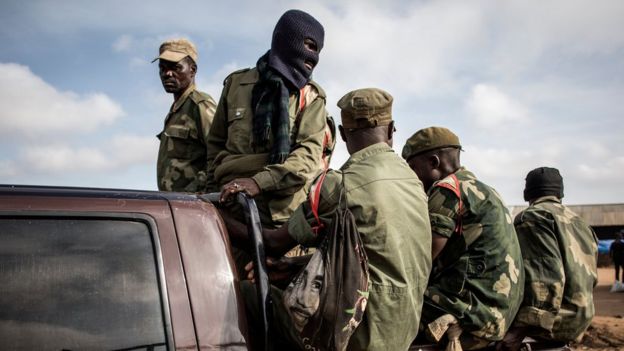
Soldiers of the armed forces of the DR Congo prepare to escort health workers
The outbreak in DR Congo continues to worry health officials.
It took 224 days for the number of cases to reach 1,000, but just a further 71 days to reach 2,000.
Tackling the disease has been complicated by conflict in the region -
between January and May there were more than 40 attacks on health
facilities.
Another problem is distrust of healthcare workers with
about a third of deaths being in the community. It means people are not
seeking treatment and risk spreading the disease to neighbours and
relatives.
Dr Josie Golding, the epidemics lead at the Wellcome Trust, said the world needed to get better at preparing for such outbreaks.
"With Ebola in West Africa, that was the mobility of people and porous
borders - that is now the world we live in, that won't stop," she said.
Climate change could lead to more outbreaks like cholera in Mozambique after Cyclone Idai, she said. But she hoped diseases resulting from humanitarian crises would not be a new normal.
"Preparedness needs to be better, we can see movement of populations and
climate change, a lot of this we can see coming, and we need more
resources to plan and prepare."
Follow James on Twitter.
