Peace for the World World ! Your War Our Lives

The Dalai Lama
A Brief Colonial History Of Ceylon(SriLanka)
Sri Lanka: One Island Two Nations
A Brief Colonial History Of Ceylon(SriLanka)
Sri Lanka: One Island Two Nations
(Full Story)
Back to 500BC.

Saturday, June 8, 2019
Learn lessons from Sri Lanka attack to prevent future attacks
 Saturday, 8 June 2019
‘Israel never hesitated to share intelligence with the
relevant authority’ – Schweitzer
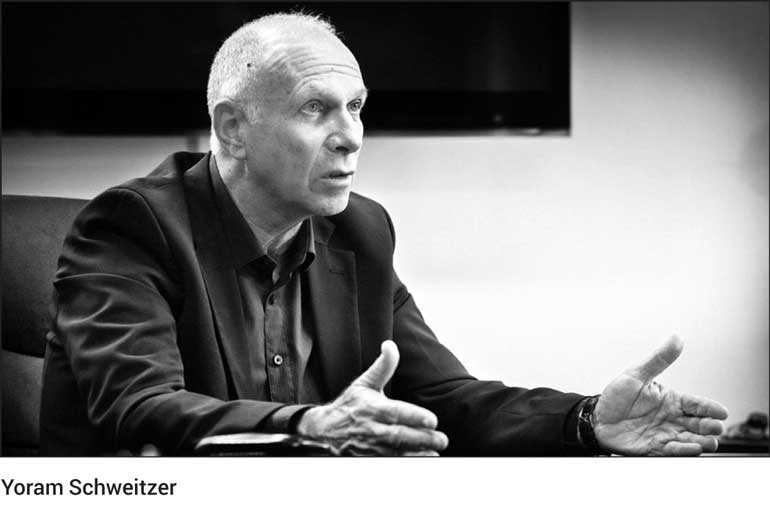
Yoram Schweitzer is a senior researcher at the Institute for National Security Studies (INSS), an Israeli think tank. Before he joined the INSS, he was a researcher and head of Educational Curriculum at the International Policy Institute for Counter Terrorism (ICT) at the Inter Disciplinary Center in Herzliya.
He has specialised on internationalisation of suicide terrorism; Schweitzer’s writings include ‘An Expected Surprise; The September 11th Attack and its Ramifications; Al Qaeda and the Internationalization of Suicide Terrorism; and editing and contributing to ‘Female Suicide Bombers: Dying for Equality’.
Recently, I had an opportunity to catch up with Schweitzer and listen to his views on global terrorism, counter-terrorism, importance of intelligence, and Easter Sunday attacks in Sri Lanka.
While denying the recent press reports that Mossad had foreknowledge on the September 11 attacks by Al-Qaeda in the United States of America, he says, “As a former intelligence officer, I could assure you that we never hesitate to share the information and prevent any sort of adversaries, not only against the friendly nations, but also other state parties. Mossad did not have any foreknowledge on the September 11 attack.”

“Manufactured lies by enemies,” he added.
Schweitzer formerly served as Chief of the Israel Defence Force’s Military Intelligence Division’s Foreign Terrorism Section, and private consultant to the Office of the Prime Minister of Israel. With extensive experiences in counterterrorism, Schweitzer demonstrates his views on Salafi Jihadi terrorism, Easter Sunday attacks in Sri Lanka, and how Israel could support in eradicating Jihadi terrorism.
While commenting on the Easter Sunday attacks in Sri Lanka he says, “Vulnerable communities can be easily infected by the germs and spread the terrorist ideologies than others. If you look at the background of the ringleader and his motive behind the attack, it demonstrates the vulnerability of this community.”
“The military defeat of the Islamic State does not herald the destruction of the organisation, or the end of its activity – quite the opposite. The Salafi jihadist ideology and the modus operandi represented by the Islamic State, Al-Qaeda, and their affiliates continue to inspire terrorists, whether they are directly or indirectly linked to them, or see them as a model for imitation,” he said, while quoting his recent analysis on terrorist attacks in Sri Lanka.
The “attack demonstrated anew that the lack of effective cooperation and intelligence sharing between the intelligence, security, and enforcement agencies is a central factor in the success of terror groups to carry out their plans,” Schweitzer observed.
“These details and the lessons of bombings in Colombo, if properly learned, will help prevent or obstruct future terror plans of the Islamic State and its supporters – plans that are expected to challenge many countries in the years to come,” he said.
Meanwhile, answering why the terrorists targeted Sri Lanka although it doesn’t have any political impact, he said, “This is how the Salafi jihadist terrorism strikes. Terrorising society and targeting anywhere vulnerable, and killing as much possible, are the aim of these terrorists.”
Meanwhile, responding to the allegations against State parties that are targeting civilians in warfare, Schweitzer is confident that not a single State which is bound by the law of war and ratified international law purposely targets unarmed civilians.
“There are a few fatal incidents, but not a single law-abiding government purposely targets civilians in warfare, but terrorists’ prime target is unarmed civilians. No matter what ethnicity or what religious belief you follow, terrorists will eliminate you to propagate social fear and attract attention,” he said.
“Countries ruled by dictators are different scenarios,” he added.
Challenges are ahead: “Israel is helping to eliminate Salafi jihadist terrorism, and we will always share intelligence with the State parties to support counter-terrorism. Most importantly, intelligence gathering, analysis, and sharing with the correct authority is a need of the hour. We have engaged via third parties or directly with countries to fulfil this need. I have done this before and I’m confident Israel is always standing with the state, not with terrorists,” Schweitzer further said.
Why Muslims are gelling during a crisis
 6 June 2019
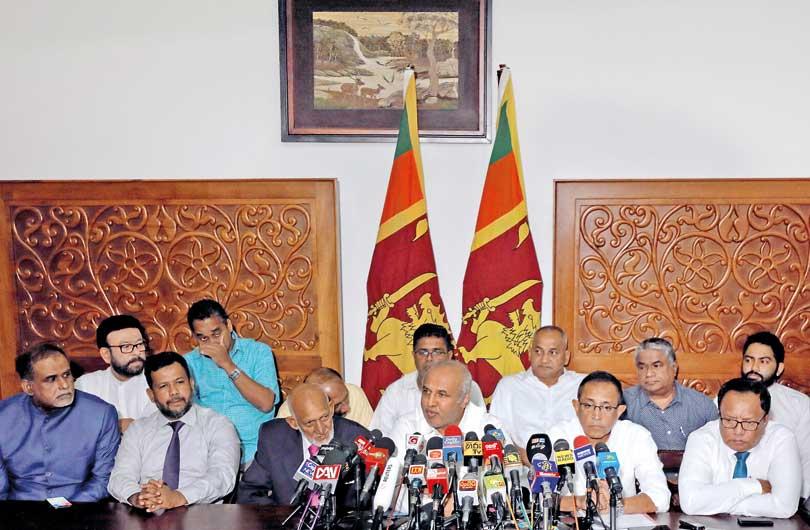
 If Ven. Gnanasara Thera boasted about priests in the island uniting in the face of meeting the challenge of extremists, he only has to look just a little far ahead to see another group working in similar solidarity. The Muslim politicians in Sri Lanka have come together in a move to protect their race and for this purpose they have tendered their resignations as state and Cabinet ministers.
Muslims are largely traders and are a well-to-do community in the island. But after the ‘April 21 massacre’ their businesses have been hit badly because the majority Sinhalese customers shun doing business with them. This blow to them is a victory for some, but unhealthy to the country in the long-run.
The two Governors and Minister Rishad Bathiudeen, who resigned following the pressure exerted on them due to a fast by Ven.Rathana Thera, helps two things. One is that the investigations against the trio can be carried out to figure out whether they aided Muslim extremists in the country. The other is that it relieves tension in the society thereby protecting the lives of innocent Muslims.
Rauff Hakeem, one of the key individuals among this group of Muslims and the Leader of the Sri Lanka Muslim Congress, has said that he wishes the investigations to be carried out by the CID and not by the parliament Select Committee appointed for the task.
President Sirisena has assured the Muslim community that those arrested would be freed soon if existing charges against them that can’t be proved
 These
Muslims coming together also means that two minority parties-the SLMC
and the All Ceylon Makkal Congress (ACMC)- would ‘auction’ their votes
given that many elections are to be held in the coming two years. The
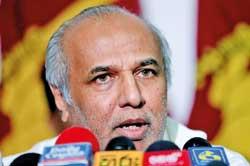
key person among those who resigned from their portfolios is Bathiudeen
who heads the Ministries Industry & Commerce, Resettlement of
Protracted Displaced Persons and Co-operative Development and Vocational
Training & Skills Development. This is one reasons why the
Government didn’t want to support a proposed No Confidence Motion (NCM)
against him. However the proposed NCM will now not be moved against
Bathiudeen because he has now resigned from his ministerial portfolios.
These
Muslims coming together also means that two minority parties-the SLMC
and the All Ceylon Makkal Congress (ACMC)- would ‘auction’ their votes
given that many elections are to be held in the coming two years. The
key person among those who resigned from their portfolios is Bathiudeen
who heads the Ministries Industry & Commerce, Resettlement of
Protracted Displaced Persons and Co-operative Development and Vocational
Training & Skills Development. This is one reasons why the
Government didn’t want to support a proposed No Confidence Motion (NCM)
against him. However the proposed NCM will now not be moved against
Bathiudeen because he has now resigned from his ministerial portfolios.The problem with Sinhalese parliamentarians is that they don’t think far and aren’t united. The Muslim parliamentarians coming together can form a formidable combination. In fact this is what the late lawmaker and one of the founders of the SLMC
MHM Ashraff underscored time and again. He was disgusted with Muslim politicians being lured in by the UNP and SLFP for incentives. Ashraff wanted a Muslim identity in Sri Lanka politics and created the SLMC in 1981.
Ashraff saw Muslim politics from a wide angle. His eyes went far and wide to all nooks and corners of the island. But his roaming eyes stopped in the East where he saw enough potential for a base to be built for the Muslims. In the East he saw a lot of strength for this minority community because here the Muslims comprised 35% of the population at that time. The figure could be more at present.
- Ashraff saw Muslim politics from a wide angle
- Already Sirisena has appointed a Muslim as the Governor of the Western Province
This is the province which Bathiudeen represents and that’s why he is so important for any political party wishing to form a government.
The Muslim minority will always prefer a major political party which accepts their culture and entertains their problems. The news that’s circulating that President Maithripala Sirisena is likely to forge ahead with the United National Front after reconciling differences with the ‘Green Party’ will have the effect of sweet music on the Muslims. This is because Sirisena is far from being a hard-liner and is considered as a politician who entertains the minorities. Already Sirisena has appointed a Muslim A.J.M Muzammil as the Governor of the Western Province. Also the minority Muslim political parties would find it easy to work with a UNP led Government because the ‘greens’ are considered to be more liberal compared to the ‘blues’ in Sri Lankan politics. For the record President Sirisena has affirmed during a recent National Ifthar ceremony held for Islam devotees at President’s House that “As long as we regard each other with hatred and suspicion there is no hope for peace in the country’.
The Muslim parliamentarians coming together can form a formidable combination. In fact this is what the late lawmaker and one of the founders of the SLMC. MHM Ashraff underscored time and againThe bottom line to all this is that the Muslims in general are pissed off with the Government authorities. They believe that they are a harassed community and the regime has done little or nothing about it. There is so much hate speech being posted on social media against Sri Lankan Muslims. Wearing the Burqa has been banned and apart from that as many as 559 Muslims are in custody for allegedly being involved in or aiding terrorist activities. President Sirisena has assured the Muslim community that those arrested would be freed soon if existing charges against them that can’t be proved.
When compared to the Sinhala voters, the Muslim voters have something to lean on during a crisis like this; the brotherhood that Islam promotes among its devotees.
A crisis like this gels a community and the Muslims are fully aware of it. Ven.Gnanasara expressed this same sentiment during the drama when Ven.Rathana Thera staged the fast. But before even a day was up after the Thera gave up on the fast Ven.Gnanasara has accused Rathana Thera of taking prevailing issues into his hands. The firebrand monk, associated with the Bodu Bala Sena, has also blamed Rathana Thera claiming that the fast had swept main issues ailing the country under the carpet. This shows how frail unity can be whenever it is formed among whatever sections of the Sinhalese community.
The Muslim politicians don’t fear Ven.Gnanasara’s gab. If there is anything that they fear it is the law of the land.
