Peace for the World World ! Your War Our Lives

The Dalai Lama
A Brief Colonial History Of Ceylon(SriLanka)
Sri Lanka: One Island Two Nations
A Brief Colonial History Of Ceylon(SriLanka)
Sri Lanka: One Island Two Nations
(Full Story)
Back to 500BC.

Tuesday, June 11, 2019
Two deaths and one big lie
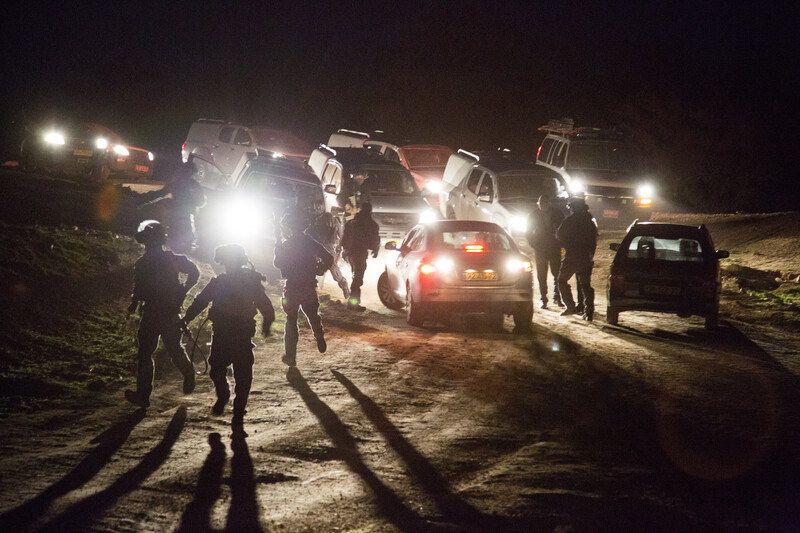
Israeli police raid Umm al-Hiran, a village slated for demolition, 18
January 2017. A resident of the village and police officer were killed
during the raid.
ActiveStills) -10 June 2019
The killing of math teacher Yaqoub Abu al-Qiyan during
an early 2017 raid on a Palestinian village was in many respects a
typical act of violence by Israel’s colonization project. A Palestinian
was left dead, others injured and homes were destroyed – starting with
those belonging to Abu al-Qiyan’s family – to make way for a Jewish
settlement.
There are unique aspects to his case – he was killed in Israel, not in
the occupied West Bank, for one. And thanks to the UK-based research
group Forensic Architecture,
a moment-by-moment breakdown of the events leading up to Abu al-Qiyan’s
death and the state cover-up that followed has been made publicly
available.
When Yaqoub Abu al-Qiyan was killed in a Bedouin village slated for
demolition on 18 January 2017, Benjamin Netanyahu immediately alleged he
had carried out a “terror attack.”
The narrative pushed by Israel’s prime minister, as well as interior
minister Gilad Erdan and police spokesperson Micky Rosenfeld, was that
Abu al-Qiyan was attempting to attack officers with his car, killing
officer Erez Levi. Rosenfeld and police chief Roni Alsheikh even claimed
that Abu al-Qiyan had links to the Islamic State group.
But residents of Umm al-Hiran, the Naqab desert village in southern Israel stormed by hundreds of officers that day, as well as activists present, swiftly challenged the government’s narrative of events. They said that Abu al-Qiyan was killed without provocation.
Video recorded by Keren Manor, a member of the Activestills collective
whose work has previously appeared on The Electronic Intifada, proved
critical to unraveling Israel’s narrative.
Analysis from Forensic Architecture indicated that Abu al-Qiyan, a
Palestinian citizen of Israel, was driving slowly and his vehicle only
accelerated after he was shot at by police, suggesting he had lost
control of his car.
Leaked details from Abu al-Qiyan’s autopsy report “suggested that the
bullet had crushed al-Qiyan’s right leg, which controlled the
accelerator and brake pedals, suggesting our theory that the
acceleration of his vehicle was the result of gunfire,” according to
Forensic Architecture. A second bullet hit Abu al-Qiyan in the chest,
and “led to his death from loss of blood.”
Israel’s official narrative soon fell apart, but Forensic Architecture
“wanted to understand better what had happened in the moments leading to
Abu al-Qiyan’s death.”
Mishandling of evidence
The research group has published a new video report that
includes more documentation contradicting Israel’s claims. That
documentation includes newly available footage from body and handheld
cameras operated by police officers at the scene, a “partial and
incomplete” police evidence file, the full recording of the thermal
aerial video, and recordings of police radio channels.
The body cam footage recorded by one of the officers indicated that
Forensic Architecture’s earlier suspicion that Abu al-Qiyan was killed
by a single bullet fired at close range while his car had come to a stop
– to “confirm the kill” – was unlikely.
The research group also used reenactment at the scene of Abu al-Qiyan’s
killing, as well as synchronization of audio and video documentation, 3D
modeling and other methodologies, to reach its conclusions.
A reenactment using the same model of vehicle as the one driven by Abu
al-Qiyan indicated that the slope of the terrain on which he was
driving, rather than the gas pedal, caused the acceleration of his car.
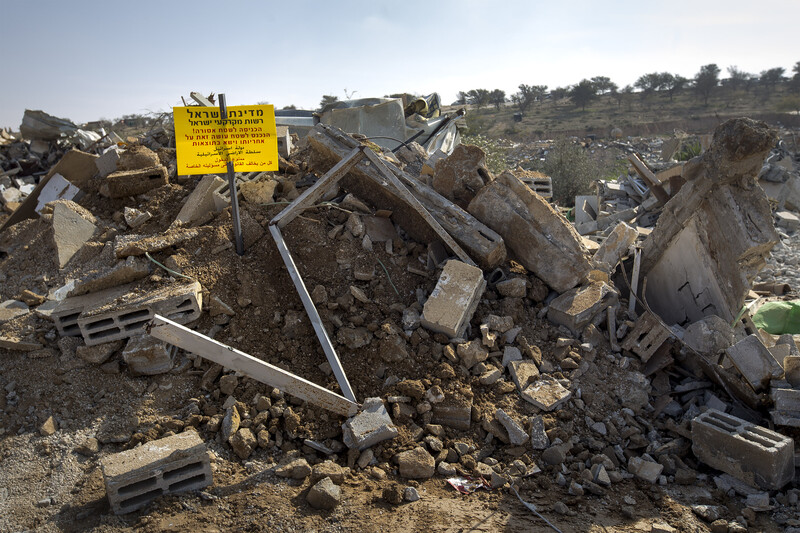
Ruins of demolished homes in Umm al-Hiran on 18 January 2017. Israel
plans to completely demolish the village in order to build a Jewish-only
town on that land.
ActiveStills
It also studied the injury of Ayman Odeh, then the senior Palestinian
lawmaker in Israel’s parliament, during the same incident. The group’s
conclusions support Odeh’s claim that he was hit in the head by a sponge
bullet fired by Israeli police.
The research group notes that police prevented medics from accessing Abu
al-Qiyan while he bled to death in his vehicle. “Abu al-Qiyan’s life
could have been saved,” the report states.
Regarding the cover-up of the truth about the killing of Abu al-Qiyan
and Levi, as well as the wounding of Odeh, Forensic Architecture states:
“Our work pitted us directly against Israeli politicians and police
chiefs, and exposed inconsistencies in the official account of the
event, as well as mishandling of evidence after the fact.”
As the video report shows, Israeli police accused Forensic Architecture
of using a “manipulative edit” of leaked thermal footage recorded from a
police helicopter “that distorts evidence.”
Yet it was the Israeli police that manipulated evidence and doctored video to support its narrative.
Redactions in the police report in the evidence file given to lawyers
suggested that additional footage was recorded but missing from the
evidence file.
Gaps at critical moments
A year and a half after the incident, footage was leaked by a police
officer to an Israeli TV channel and sent to a prosecutor “who was
considering whether to press charges against the policeman involved,”
Forensic Architecture states.
The edited video broadcast by Israel’s Channel 10 purports to show that
Odeh was injured by a fragment of a stun grenade. Police accused Odeh of
giving false testimony by saying he was hit with a sponge bullet.
Forensic Architecture analyzed the video and found that it was “made up
of multiple clips and that gaps in the footage occurred at critical
moments.”
A whole page is missing from the transcript in the evidence file of the
interrogation of the police cameraman. The missing page contains the
conversation between the cameraman and interrogator as they watch the
original, uncut footage that was leaked to Channel 10.
“The incident that began with a dead-of-night raid on the village of Umm
al-Hiran became host to many more violations. It led to the killing of
Abu al-Qiyan, to assaults against residents, activists and politicians,
and the subsequent manipulation of evidence,” Forensic Architecture
states.
“To date, no policeman has been charged for the violence in Umm
al-Hiran. The shooting of Abu al-Qiyan was justified as a split-second
decision taken legitimately by the policeman involved,” the group
concludes.
“But instinct is culturally and politically produced and the victims of
police violence in Israel are disproportionately Palestinian. In this
way, a long history of separation and marginalization is condensed in a
split-second.”
