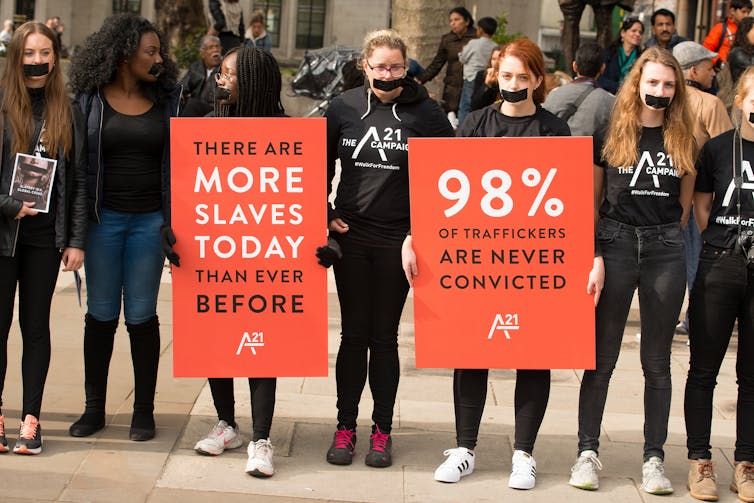
The
Modern Slavery Act was seen as a big achievement for combating the
issue of forced labour. But since it was passed by the UK government in
2015, many have pointed out its shortcomings.
In particular, how the legislation helps cover up serious forced labour
issues, all the while making citizens who are concerned about the
problem feel better.
Less well known is how Article 54 of the act, which assigns British
companies the responsibility to clean up their global supply chains,
hurts factory workers in developing countries. I’ve witnessed how
British companies outsource this responsibility to local factory
managers in Sri Lanka.
These local managers feel tremendous pressure to monitor their
workforce, even beyond the shop floor, for fear of losing their
contracts. And this leads to an excessive amount of surveillance, with
devastating consequences for factory workers, most of whom are female.
The Modern Slavery Act was passed after years of pressure from
anti-trafficking organisations, which promoted global laws that hold all
commercial actors jointly accountable for forced labour. Article 54 of
the act requires UK companies to prepare slavery and human trafficking
statements that account for their supply chains. Besides protecting
vulnerable workers, these statements are also geared toward enhancing
their reputations and improving investor confidence.
But by recommending universal policies, the Modern Slavery Act fails to
take into account how local suppliers around the world respond to it,
even though the law effectively transfers to them the responsibility to
keep the workforce free from modern slavery. It has led to a climate of
suspicion and fear that exacerbates the already difficult lives of their
workforce.
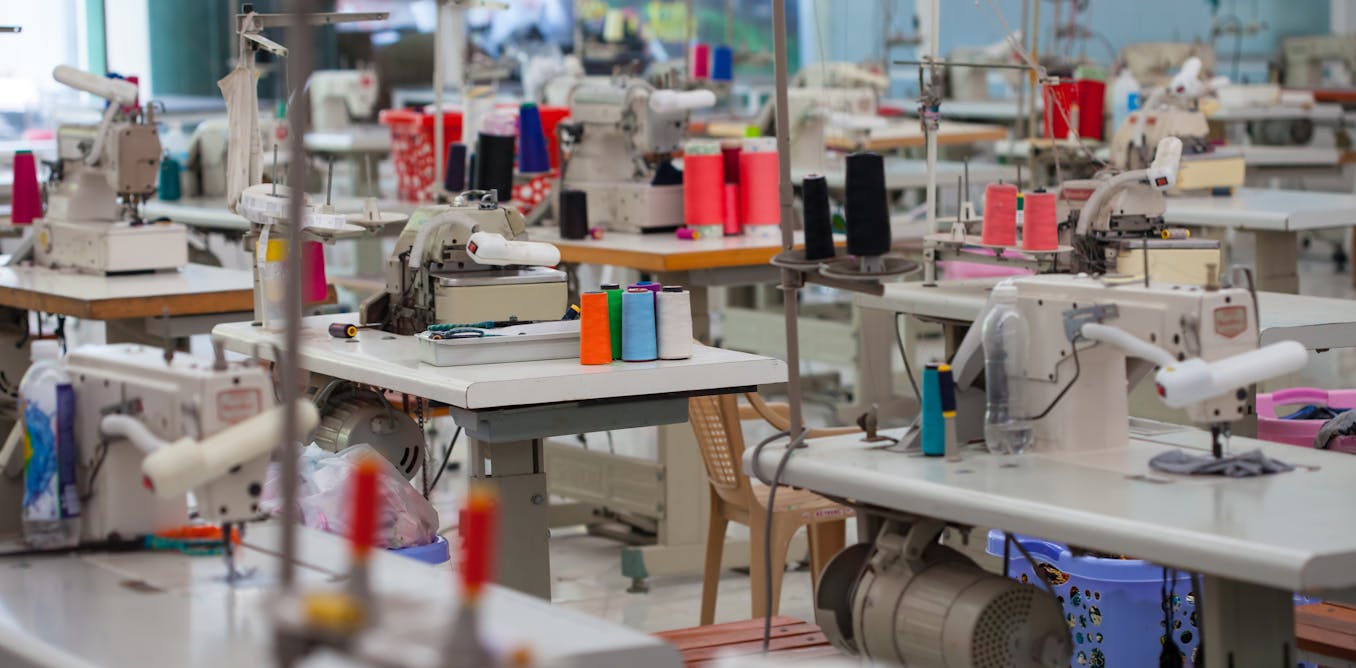
I spent two summers speaking about the Modern Slavery Act to female
factory workers in Sri Lanka’s free trade zones, which are industrial
areas with a number of garment factories that supply many foreign
companies. I found there is intense pressure on local managers to clean
up their assembly lines in such a way that the western companies which
hire them could not be accused of modern slavery. The pressure to appear
“clean” results in an unhealthy working environment.
It also limits women’s freedom in a number of ways. For instance, a
number of women I spoke to engaged in part-time sex work to make extra
money outside of their factory jobs. This work was of their own choosing
– and very different to the sexual trafficking or exploitation that the
Modern Slavery Act is also designed to stop. But local managers feared
it would be seen by Western auditors as exploitation and threaten their
contracts. As one factory manager told me: “If we do not fire part-time
sex workers, our factories can get blacklisted, and our orders will be
cancelled.”
Surveillance and suspicion
Some international companies also have whistleblower policies which put
the onus on workers to report any concerns they have about colleagues
being exploited. It’s meant to be for their protection, but increases
the environment of suspicion and surveillance in factories.
While there is nothing in the Modern Slavery Act that says workers must
behave a certain way outside the factory premises, managers are consumed
with anxiety over being accused of aiding and abetting sexual slavery.
Many factory workers told me how factory compliance officers asked them
to stop doing any part-time work, including sex work, as soon as
possible. They were also told to report on colleagues.
Women workers in Sri Lanka are experiencing unintended consequences of the legislation.Shutterstock
One worker speculated that the sudden firing of a colleague had
something to do with the new policies that came into place after the
Modern Slavery Act. While nobody had actually accused her of sex work,
there were rumours that she engaged in casual sex with various
boyfriends. Considering the cultural context of Sri Lanka,
where this behaviour is heavily frowned upon and even equated with
prostitution at times, it can be seen as the misapplication of the
Modern Slavery Act at the local level, resulting in an even more
stressful work culture.
It’s not the first instance where international attempts to stop human
trafficking has complicated things for the local workforce. In Congo,
the efforts to halt child labour associated with cobalt mining led to
thousands of legitimate adult jobs being lost and much socioeconomic upheavaldue to blanket policies being put in place, which pay little attention to local issues at play.
Precarious pay
The workers I spoke to who engage in part-time sex work told me that
they do so because their factory pay is not enough. Many women are
hoping to earn enough to buy a small plot of land to achieve financial
independence.
So a better remedy to stop women from sex work might be to pay them a
meaningful living wage. Instead, the Modern Slavery Act’s emphasis on
clean supply chains is making women’s livelihoods more precarious.
Perhaps if the act emphasised better pay for workers in global supply
chains the outcome might be different. But the bottom line is, it must
encourage better engagement with the local workforce.
The act was imposed in Sri Lanka without consulting global factory
workers and now threatens a space that previously allowed women a path
to economic empowerment. The conflation of sex trafficking with sex work
assumes the majority of women in developing countries are victims that
lack their own agency. But, for many of the women I spoke to, sex work
was their own choice.
More disturbingly, intentionally or not, Article 54 makes global factory
managers responsible for the leisure activities of their workers and,
by extension, their moral conduct. Rather than requiring UK companies to
ensure a living wage and help the education and economic empowerment of
their supply chain workforce, the Modern Slavery Act punishes them.




 The
Modern Slavery Act was seen as a big achievement for combating the
issue of forced labour. But since it was passed by the UK government in
2015, many have pointed out its shortcomings.
In particular, how the legislation helps cover up serious forced labour
issues, all the while making citizens who are concerned about the
problem feel better.
The
Modern Slavery Act was seen as a big achievement for combating the
issue of forced labour. But since it was passed by the UK government in
2015, many have pointed out its shortcomings.
In particular, how the legislation helps cover up serious forced labour
issues, all the while making citizens who are concerned about the
problem feel better.