Peace for the World World ! Your War Our Lives

The Dalai Lama
A Brief Colonial History Of Ceylon(SriLanka)
Sri Lanka: One Island Two Nations
A Brief Colonial History Of Ceylon(SriLanka)
Sri Lanka: One Island Two Nations
(Full Story)
Back to 500BC.

Friday, November 29, 2019
SRI LANKAN CRITICS FEAR A CRACKDOWN IS UNDERWAY, AND SOME FLEE
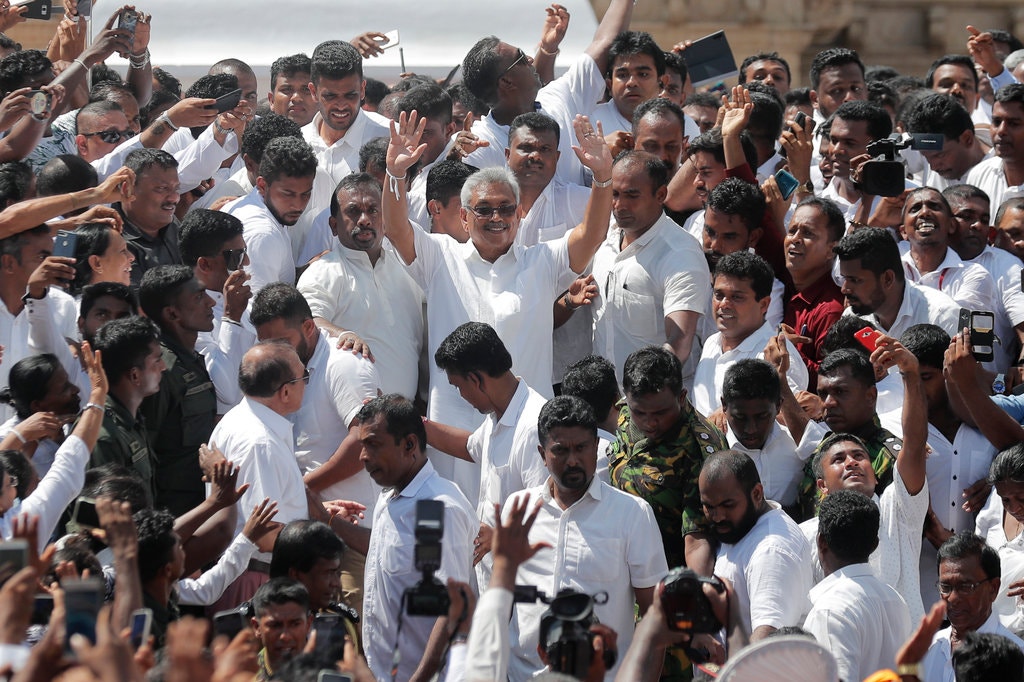
Image: Gotabaya
Rajapaksa, Sri Lanka’s newly elected president, center, greeting
supporters after his swearing-in ceremony in Anuradhapura, Sri Lanka,
this month.Credit…Eranga Jayawardena/Associated Press.
27/11/2019
 A
Swiss Embassy employee is abducted and asked about asylum applications
an.d investigators are banned from leaving just days after Gotabaya
Rajapaksa is elected.
A
Swiss Embassy employee is abducted and asked about asylum applications
an.d investigators are banned from leaving just days after Gotabaya
Rajapaksa is elected.
By Maria Abi-Habib and
Fears of a potential crackdown on critics of the newly returned
Rajapaksa political dynasty in Sri Lanka are rising just days after the
election, as officials and journalists who investigated the Rajapaksas
for human rights abuses and corruption began trying to flee the country,
officials said.
In a case that raised particular alarm, a Sri Lankan employee of the
Swiss Embassy in Colombo was abducted on Monday by unidentified men who
forced her to unlock her cellphone data to them, diplomatic officials
said. The officials said her phone contained information about Sri
Lankans who have recently sought asylum in Switzerland, and the names of
Sri Lankans who aided them as they fled the country because they feared
for their safety after Gotabaya Rajapaksa won the presidency in elections this month.
On the same day, Mr. Rajapaksa imposed a blanket travel ban on more than
700 members of the Sri Lankan police unit that had been investigating
the family. And other police officers raided a news outlet critical of
the Rajapaksas and forced several journalists to hand their computers
over for analysis, in what the police said was an investigation into
accusations of hate speech.
On Wednesday, a spokesman for President Rajapaksa said that “defense
authorities have decided to look into those allegations to ascertain the
truth,” when asked about the abduction of the Swiss Embassy employee.
More broadly, government officials said there was no intent to quash
investigations of the Rajapaksas.
In the abduction case, the diplomatic officials, who spoke on condition
of anonymity because of security concerns, said the men held the
embassy employee for several hours and then, before releasing her,
threatened to kill her if she told anyone.
The officials said the men appeared to be focused on finding information
about a Sri Lankan detective who had been investigating Mr. Rajapaksa.
The detective fled to Switzerland with his family on Sunday.
It was not clear whether the men were connected to Mr. Rajapaksa or were
acting of their own accord as supporters of the popular leader and his
political dynasty.
The Rajapaksa family had held power for a decade until 2015, when they
were voted out of office. Their last few years in government were marked
by frequent abductions of opponents, who were often bundled away into
vans by men in civilian clothing, never to be seen again.
But after a devastating terrorist attack by Islamist extremists killed hundreds of people in
April, security concerns were thrust to the forefront of public
consciousness, creating an opening for Mr. Rajapaksa and his family to
gain in the elections.
Gotabaya Rajapaksa was defense secretary and his brother Mahinda was
president during the crucial final phase of Sri Lanka’s long and deadly
civil war. The Rajapaksas received wide credit within Sri Lanka for
bringing the war to close. But the brutality of those years also led to
a accusations against the brothers of war crimes and other abuses.

Sandhya Eknaligoda, the wife of Prageeth Eknaligoda, a missing Sri
Lankan journalist, outside the United Nations offices in Colombo in
2013.Credit…Ishara S. Kodikara/Agence France-Presse — Getty Images
Shortly after his election victory, President Rajapaksa appointed
Mahinda as prime minister, keeping the country’s two most powerful
political posts within the family.
Sri Lanka’s foreign minister was scheduled to meet the Swiss ambassador
on Wednesday to answer questions about the abduction and provide
assurances for the safety of embassy staff, officials said.
The Swiss ambassador, Hanspeter Mock, declined to comment when reached by telephone.
In a separate development that has worried Sri Lankan journalists, the
police and plainclothes officers on Monday raided the offices of a news
outlet, News Hub, known for its criticism of the Rajapaksa family.
Several journalists said they were forced to unlock their computers for
them to be examined.
An associate of the News Hub website, Dhanushka Ramanayake, said in a
news conference after the raid that he feared this was the beginning of a
dark period for Sri Lanka.
“This is a sign of emerging repression and a clear effort to instill
fear,” said Mr. Ramanayake, who is also an opposition activist.
Ruwan Gunasekera, a police spokesman, said that the news outlet had
been raided based on a complaint that it was propagating hate speech but
that nothing incriminating was found.
That raid unfolded as the police conducted a separate eight-hour
interrogation of a journalist at a different news outlet who is known
for his fierce criticism of the Rajapaksa family.
Many diplomats had thought that Mr. Rajapaksa, who had handily won at
the polls, would try to reconcile with his opponents. In a statement
shortly after his victory, Mr. Rajapaksa had urged peace and unity.

Mr. Rajapaksa, center, with his brother Mahinda, left, during a
ministerial swearing-in ceremony in Colombo last week.Credit…Ishara S.
Kodikara/Agence France-Presse — Getty Images
“We thought there would be a period of demonstrating benign intent,”
said Paikiasothy Saravanamuttu, the executive director of Colombo-based
advocacy group, the Centre for Policy Alternatives. “But this is a
situation in which anyone who stands in their way, anyone who is
critical of the government or the president, will be seen as the enemy.
We are in slow descent into something very frightening.”
The Rajapaksa family appears focused on unraveling several
investigations into accusations of human rights abuses and corruption
from their time in power. Those inquiries have gained traction in recent
years.
On Sunday, the president raged against the investigations of him, his
family and their allies, dismissing them as politically motivated.
The investigations’ “focus was to put those who fought the war, the
former navy commander, intelligence officials and me in prison,” he said
in a speech to Buddhist monks. “They forced officers to say my name and
implicate me in investigations.”
“That is not justice,” he added. “That is not the rule of law.”
One case against Mr. Gotabaya had been set to begin on Wednesday, but
was postponed until next month. It involves the 2010 disappearance of
Prageeth Eknaligoda, a journalist and critic of the Rajapaksas.
Government investigators said that a military intelligence unit abducted
and likely killed him, and an army lieutenant colonel and six others
who served under President Rajapaksa’s command when he was defense
secretary have been indicted.
Mr. Eknaligoda’s wife, Sandya Eknaligoda, believes the trial will not go
forward, and fears for her safety after a decade of accusing the
Rajapaksas of abducting her husband.
The infrastructure that had been built to support the investigations
into the Rajapaksas and their allies has swiftly been unraveled over the
last week. The Criminal Investigations Department, or C.I.D., which has
been spearheading the inquiries, has been gutted, and its powers
limited.
The head of the C.I.D. was reassigned last week to a junior position
away from the capital, Colombo, officials said. And the lead detective
on many of the cases, Nishantha Silva, fled to Switzerland on Sunday.
National television channels on Tuesday displayed the photos of other
detectives involved in the investigations, accusing them of corruption
and treason, after they were stripped of their personal security.
A spokesman for the National Police Commission of Sri Lanka said they
would decide in the next few weeks whether the investigations would
continue.
Mr. Silva was the lead detective in several investigations into Sri
Lanka’s military, when President Rajapaska served as defense secretary.
“Now he will not be there to give evidence at trial,” Ms. Eknaligoda
said. “These vengeful actions against senior C.I.D. officials who led
these investigations will cripple the entire department — they will all
be afraid to act now.”
On Monday, Mr. Rajapaksa ordered a blanket ban on travel out of the
country for all 704 C.I.D. officials, a move seen as an attempt to
prevent other police officers from fleeing.
Some diplomats said Mr. Rajapaksa may be trying to take stock of the
government he just took over. But, they added, they would be watching
closely whether the travel ban is eventually lifted or whether the ban
leads to the ranks of C.I.D. being purged.
Kamal Gunaratne, Sri Lanka’s newly appointed defense secretary, said Mr.
Silva had broken the rules by not seeking approval from the government
before leaving to Switzerland. He denied accusations that the new
government intended to derail the cases against the Rajapaksas and their
associates.
“We are not going against anybody or any officer of the C.I.D. We are
just following the rule of law.,” Mr. Gunaratne said in a telephone
interview. “This is a democratic country. It is not a military rule,
where dissent will be crushed.”
During the civil war, Mr. Gunaratne led a military unit that the United
Nations accused of conducting summary executions of detained rebels. Mr.
Gunaratne has denied the accusations.
